Tuesday, 26 June 2018

Kandakhal, a Road Less Travelled


Come June every year, and the wanderlust bug bites all of us, the entire family goes into the wanders’ mood and everyone can be seen planning for the trip. We mostly head North to the mountains and our destinations are usually off-beat locations where we can expect a degree of privacy. Not for us are the overcrowded Mall Roads, nor the overhyped goods that sell two to three times their actual price! Nor for us is the desire to bump into other human beings, nor is it our desire to appreciate fashion in others or perhaps even to be appreciated ourselves.

The sight of a Munnia munching on succulent seeds can be wholesome!
A mere week after our return from a village resort in the Jim Corbett Park we headed once again to another off-beat destination, though this time in the company of my brother in law and his family. He came up with the idea of visiting a less known place called Khandakhal a place up in the mountains parallel to Lansdowne, in Uttarakhand, 278 kilometres from Gurgaon. We would stop for a couple of days in Ghaziabad at my Brother in law’s house and then drive to the hotel/resort that bore the name Hinvil Valley View Resort.
A Typical Garhwali House
The drive itself took us through the interiors of Uttar Pradesh, parallel to the Ganges Canal onto places like Khatouli and Bijnore. We did not enter Meerut. On the trip to Kandakhal we left Ghaziabad at 4:30 p.m. and reached our destination at 10:30 p.m. (something that I would avoid in future as the last thirty to forty kilometres wend through zones that see animals, especially elephants). The roads, moreover are narrow and liable to see rockfalls and avalanches and other obstructions that narrow down the road further.
A Himalayan Jay, curious about the lens?

Thirty-five kilometres before the destination, we did ask a shopkeeper in a major town about the directions to Kandhakal and he advised us to break the journey and instead continue in the morning. The reason he gave us was that it was a road less travelled. Later we learned that it was risky to drive at night as wild elephants were liable to make crossings at night and that the forest rangers could rescue stranded cars only during day-time.

The Hinvil Valley View Resort in the background

The Hinvil Valley View Resort/Hotel that we checked in is a no-frills hotel in the midst of rolling mountains commanding a grand-stand view into the distant mountains. Also amazing is the view of the firmament with a canvass of stars sprinkled on it. The rows of tall pine trees, winding river-beds, and the chirp of birds along with the lone chameleon gazing silently at the human visitors is an inspiring moment.
All Smiles for the clean air and peaceful surroundings


While no doubt you are in the midst of nowhere, the closest to visit destinations are Dugada, Lansdowne, and a waterfall an hour’s trek or twelve kilometres drive by car. For us, what mattered most was just staying put or else trekking to the top of the mountain. For me, the greatest Pass-Time was bird watching and insect spotting. The most interesting of all was spotting a white-headed Bulbul and a rather colourful Himalayan Jay. Among the insects that I spotted, the most awe-inspiring sight was to see a spider wrap her victim inside a white silken cocoon prior to feeding on it. I was also able to capture three beetles in different states of movement!

A Non-Veg Dinner for a hungry spider

The three states of  Beatles

The landscape, of course, was simply amazing. I used a variety of lenses to capture some amazing scenes. While the 55-250 mm lens was too narrow for the landscape shots, the 18-55 mm lens was much better, though I guess a wider-angle lens would have been better!


One most revealing moment was the realisation that most of the human being’s hairstyles, especially the punk hairstyle and the crested hairstyles might have been copied from birds especially the Bulbul bird.
A Model for Hairstyles
The Punk Hairstyle
A White-headed Bulbul, rarely seen!


But then, how could I forget that chameleon that would visit a particular tree-stump in the mornings to heat itself up! I wonder who was more surprised, the chameleon or I.


Wednesday, 20 June 2018

In Search of You, a poem


Dawn, A Poem


Tuesday, 19 June 2018

Birds Spotted in the Dhela Zone, Jim Corbett Park, Uttarakhand


Dhela village and the Dhela Zone of the Jim Corbett Park is a treasure trove of birds, especially the little ones that seem to be rather elusive and difficult to capture on camera in the plains. I was particularly drawn by the activities of  Sunbirds, Bee Eaters and Scaly Breasted Munia Birds while staying in the Corbett Treat Resort in Dhela Village. Most of my time was spent photographing the antiques of these birds. Of great interest was the sight of a female sunbird feeding her chick.


I have never been able to get really close to the Sunbirds pictured above in the plains more so because I have never seen them sit still for a second! At the Resort, I was able to take quite a few photographs of these rather twitchy birds (I used a 55-250mm lens for all of my bird shots).


Munnia Birds are the cutest birds I have seen. They are so 'cute' and so playful. The ones that I saw at the Resort seemed to belong to a closely knit community, and they seemed to be very expressive of their emotions.


The Female Sunbird doesn't have the bright purple hue of its male partner and it might be difficult to distinguish it from the green warbler.


The sight of a Green Warbler Mother feeding her chick was an amazing sight. The mother seemed to have brought her chick an insect that was too big for her chick.


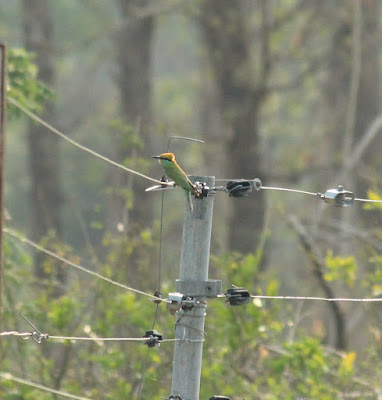
The Green Bee Eaters seemed to be present in large numbers, though they seemed to be shyer than the other birds and kept particularly away from the Resort Fence.


The Green Pigeon also found in the plains of North India, and Delhi NCR Territory can be seen in the forest area. They like their cousins could be found perched high up in the tree branches of the Dhela Village forest area.


Doves are commonly found in the farmlands in the Dhela Village. This one seemed to be not very shy of my camera and me.


Fly Catchers can be found in abundance and this might also because of the abundance of insects in the area. When my family and I visited the Dhela Village in the Jim Corbett National Park it was in the second week of  June, and surely the weather was very hot. It was perhaps for this reason that I was able to spot these birds mostly in the mornings before the sun had reached its Zenith.


Monday, 18 June 2018

Eco-Tourism in the Jim Corbett Park and Foothills of Uttarakhand


Come May, June and everyone from the plains rushes to the mountain destinations, especially Mussoorie, Nainital, Shimla and Manali. Unfortunately, this places a lot of strain on these tourist hotspots. Getting stuck in a traffic jam a couple of kilometres from Mussoorie can be a daunting experience what with locals making fun of the poor tourist stuck in the traffic. The Mussoorie crawl can take ages to clear and then when you reach the town, you are faced with another daunting task, that of parking your vehicle in a parking lot a couple of kilometres from your hotel.


It is because of the fact that some of the most popular tourist destinations have become crowded areas that people have begun to explore other options, options that are easily accessible, far from the madding crowd, places that offer some peace of mind. These options are often located in lesser-known villages far away from city centres. Often these locations have resorts that are close to villages. One such location that we visited this year for our summer vacations was a resort in the Dhela Village before Ramnagar. The Resort, Corbett Treat, is just adjacent to the electrified fence of a portion of the Jim Corbett National Park and it offers peace of mind.

While visiting the Jim Corbett National park, one is likelier to spot a wider range of wildlife than in the more populated areas of the hills. We were lucky to spot a tiger while driving back to our resort on the way back from Ramnagar. For people like me, the greatest attraction of visiting a hill station lies in the ability to spot a wide range of flora and fauna. While it might not be just about spotting a tiger, it might be something as simple as watching Munnia Birds playing or a Sunbird sipping nectar!
Eco-tourism is a growing trend not just in the plains but also the mountains of India. Resorts are being built close to villages and they provide employment to the youth. The reduced amounts of pollution, the sight of large vistas of farmlands, farmers sowing seeds or even harvesting provide a suitable break for eyes that have seen nothing but concrete jungles and madly driven cars. The sounds of birds calling to each other, crickets making a noise in the bushes, or perhaps even the call of a tiger is a big draw for discerning tourists.

It is the small pleasures of looking at nature in all its glory that makes you want to visit a place that is not overcrowded, I mean you become so fed up of the mad rush of the towns and cities, that it gives you great joy to connect with nature. The chameleons are so big, the flowers so fresh, the air so clean and what better than to see the clear sky with the stars shining at night!


You hardly get to see a bumble bee in the plains and seeing two is luckier still! Looking at the farmlands stretching till the horizon, or even the scarecrows in the fields all of these sights can be most welcoming at times.

While on an early morning walk you might come across strange sights in the field like for example, I thought there was a very tall woman standing in the field, but then when I got closer I noticed that it was a quilt that had been draped on to a pole!


The earthy scents, the sight of dew-drops on leaf ends, the quiet passage of a gust of wind, these are the treasure that one is bound to miss out when visiting crowded towns in the mountains.