Wednesday, 16 July 2014

Formal Letters to the Editor– An Important Checklist for students of Grade 12, CBSE


Checklist (does your letter contain the following items?):
  1. Sender’s address 
  2. Date
  3. Receiver’s designation and address
  4. Subject (Topic/problem)
  5. Salutation: Dear Sir/Madam
  6. Body of the letter: It is usually written in 3 paragraphs
  7. Complimentary close: Yours truly/sincerely
  8. Sender’s signature & full name
  9. Justified alignment/Block format

Important points to note:
1. Address the readers in the first paragraph, not the public, or even the authorities! Look at the sentence below:
I am Sarah/Sarthak, and through the columns of your esteemed newspaper, I would like to draw the attention of the readers towards..........
2. It is only in the last line that you mention the authorities. Look at the sentence below:
I request you to kindly print my letter in your newspaper so that the concerned authorities take the necessary steps to resolve the issue.

Sender’s Address:


Arun Kumar
77 Alaknanda Apartments
Adarsh Nagar
New Delhi
Pin code: 1100054


 Date:
  1. The date appears directly below the address (after a one line gap).
  2. Write out the full date as follows:
  3. 16th of December, 2013
Or
  1. December 16, 2013
  2. Avoid writing: 16/12/2013
Receiver’s Official Designation and address:
                                                                                                                            
The Editor
The Times of India
6 Tolstoy Marg
New Delhi

Pin Code:110007


  The Subject: 

The Subject is written like a newspaper headline, it is not written in the form of a sentence. It is brief, crisp and it provides a brief glimpse into the issues raised in the letter. The first letter of the word Subject is in capitals and it is followed by a colon, whatever comes after the colon is underlined:

Subject: Power cuts in town

The Opening Sentence:

  1. I am Amit Gupta, and through the columns of your newspaper, I would like to draw the attention of the readers towards the problem of...
  2. I am, Sunita Chauhan, and through the columns of your esteemed newspaper, I would like to bring to the notice of the readers...

The Salutation:
This is how you address the receiver of the letter. A more formal approach would be to address the reader as:
  1. Respected Sir, / Respected Madam,
  2. Sir, / Madam
A less formal address would be:
  1. Dear Sir, / Dear Madam
In many cases, the word ‘Dear’ signals familiarity and might be used after a number of correspondences.
The body of the Letter suggested ideas for paragraphs:
  • Para 1: who you are/what are you writing about
  • Para 2: Details about the Topic/Problem/Issue
  • Para 3: What would you like the reader to do (Your hope/appeal/warning/conclusion/comment/suggestions)
  • In case there is a problem that is discussed and a solution that is asked, you can include your suggestions in the third paragraph and then add a short fourth paragraph for your appeal/ conclusion.
The Complimentary Close:
  • It is a polite way of ending the letter and includes the following examples:

  1. Yours truly
  2. Yours sincerely
Sender’s Signature followed by  the words (A Concerned Citizen) in brackets :
  1. The sender initials or signs his/her name.
  2. This is followed by his/her full name and Designation within brackets

A.K                                                                                                                                  
(A Concerned Citizen)


A Sample Letter of the Letter to the Editor

B-26
Jacaranda Marg
Gurgaon
122001

22nd of December 2017

The Editor
Times of India
6 Tolstoy Marg
New Delhi
110007

Subject: Menace of stray animals

Dear Sir,
I am Komal Singh, a student of grade ten and a resident of Gurgaon. Through the columns of your esteemed newspaper, I would like to draw the attention of the readers towards the problem of stray animals on the roads. This is a serious issue as it has caused a lot of inconvenience to residents and commuters.
The presence of stray animals on the roads, markets, and public places results in traffic jams and poor sanitation. To make matters worse, the number of traffic accidents has risen. Just yesterday, a couple on a scooter met with an accident when a dog suddenly rushed into their path making the rider to swerve into a buffalo resting by the roadside.
I suggest that the civic authorities should impose a hefty fine on the owners of these so-called stray animals who set them free so that they can feed on leftover stuff. People need to be educated to avoid throwing wrappers, half-eaten food, and unused vegetables on the roads and footpaths. I request you to print my letter in your newspaper so that the concerned authority wakes up to the problem and does something to solve it.

Thanking you
Yours truly
K.S.
(A Concerned Citizen)

Important Note: Remember that when you are writing a letter to the Editor, you are addressing the readers of that newspaper, not the public! Also, the Editor is not someone who will solve your problem, he will only print the letter in his newspaper. You can, however, address the authorities in a general sense towards the end of the letter (in the last line).

Practice Questions:

1. You are Sunita/Sumit, a student in grade twelve. Recently a friend of yours had a tyre burst when the car being driven by his father ran into a pothole. You have noticed that the roads in your city have developed potholes which are very dangerous to drive on. Draft a letter to the Editor of an English Daily to draw the attention of the readers towards the dangerous roads of your city. Draft your letter in 125-150 words.

2. You recently visited the Sadar Bazaar in Gurgaon and noticed that people were not observing social distancing, nor were they wearing face masks. Draft a letter to the Editor of an English Daily to draw the attention of the readers towards the need to observe safety measures to prevent the spread of the coronavirus. You are Amita/Amit, a student of grade twelve. Write your letter in 125-150 words.

3. The number of road accidents has gone up in your city mainly because of underage and rash driving. Recently a car being driven at high speed lost control, jumped the median, and hit a person riding a motorcycle in the other lane. Draft a letter to the Editor of an English Daily drawing the attention of the readers towards the need to drive safely and not to allow minors to drive. You are Monica/Mohit, draft your letter in 125-150 words.


Sunday, 13 July 2014

The National Museum, New Delhi–A must visit for students, artists, and all!


OLYMPUS DIGITAL CAMERA
The signing of the surrender document
When the children expressed their desire for an outing just before the holidays came to an end, the first choice of that came to mind was the the Shankar’s Dolls’ Museum at ITO, the National Museum at Janpath, the Natural Museum close by and the India Gate to top it. We reached the Shankar’s Doll Museum which is housed in in the National Boot Trust Building   at about one 0’ clock in the afternoon and were treated to a display of dolls from all over the world. The greatest take away for all of us was to see dolls from all over the world under one roof. It was like visiting a microcosm of human civilization in different countries. Unfortunately though rightly so, we were not allowed to photograph the dolls as according to the guards, the light might damage the colours of the fabrics of the dolls.
After visiting the Shankar’s Doll Museum, we decided to proceed towards the National Museum at Janpath. We decided to park our vehicles at the India Gate Parking Lot, and then took Autos to the National Museum. The rational was that the parking lot at India Gate closes up by five o’ clock in the evening and they don’t allow visitors to park their vehicles after five, something we had learned to our consternation, a week before when we visited Delhi from Gurgaon.
OLYMPUS DIGITAL CAMERA
The Kids at The National Museum
At the National Museum, the first gallery you should visit is the Indus Valley Civilization Gallery which exhibits important artifacts, human remains, implements, jewelry items and of course the famous Bronze dancing girl figurine of the age. The figurine measuring about two inches must be more than three thousand years old!
OLYMPUS DIGITAL CAMERA
The Dancing Girl of the Indus Valley Civilization
Next two the Indus Valley Civilization Gallery, one can find galleries that present artifacts and stuff belonging to various Dynasties as old as 200 B.C. A large number of exhibits belong to the Shunga Dynasty, including, I guess the Frieze shown below  is so evocative, sensual and realistic – it is amazing how skilled those artisans were more than two thousand years ago!
OLYMPUS DIGITAL CAMERA 
Imagine, this Fresco is more than two thousand years old!

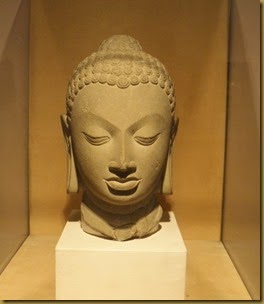
What struck me most was to see different renditions of Gautam Buddha, one of which appeared to be rather Romanesque in style while the most striking statue was the golden stature of Buddha. I have pasted snaps of all three forms and I am sure that you will notice the subtle variations:


OLYMPUS DIGITAL CAMERA

Bodhisattva Head,3rd Century A.D. Kushana Dynasty, Gandharva Art

OLYMPUS DIGITAL CAMERA

This is the more traditional rendition of the bust of Buddha 

The artefacts of the Mughal period are symbolic of a more sensuous period of art. One example is that of the Peacock Throne made according to the Rajasthani and Pahari tradition. It was taken away by Nadir Shah and placed in the Agra Fort in 1739.
OLYMPUS DIGITAL CAMERA
The famous Peacock Throne was studded with semi-precious stones
Another great attraction was the display of weapons and protective armor displayed in the section dedicated to the Moghul period. The sword of Tipu Sultan is one of the exhibits and also the full body armour of Akbar the Great. The weapons used by Aurangzeb feature feature as one of the exhibits.
OLYMPUS DIGITAL CAMERA          
Swords and daggers used by Aurangzeb
OLYMPUS DIGITAL CAMERA
Firearms used by the Moghuls
It was clear that the two hours that we had fixed for out visit to the museum would simply not be enough, as the whole complex is a sprawling one and it would require a good part of the day to even go through half of the  exhibits displayed. I would however say that a visit to the National Museums is a must for all children, parents, scholars, artists, and people like me! For students studying fine arts in school, especially at the grade twelve level, a visit to the Museum is a must because these students can study different art forms in India.
OLYMPUS DIGITAL CAMERA
The Intricate detail of this statue of Vishnu with his consorts, dated the 13th. Century A.D. from Konark, Orissa is simply amazing!
Sure it was a most enlightening visit and we were all lost in our thoughts looking at those amazing exhibits, proof of the amazing country that is India, and its amazing culture, arts, craftsmanship, aesthetics and advancement throughout the ages!
OLYMPUS DIGITAL CAMERA

OLYMPUS DIGITAL CAMERA

Saturday, 12 July 2014

The Andromeda Connection-A Journey in Time (A Glimpse into the book)


                                      The Andromeda Connection-A Journey in time
clip_image002
By Rodrick Rajive Lal


The Andromeda Connection is the culmination of the germ of an idea that was sown many years ago, when I was still a student studying in high school. I had always wanted to write short stories and had even made many a false start, one being a story written from the perspective of a deer living in the in the jungles of Africa! I have lost that scrap book, but the desire to narrate a story remains. Many years later, I was able to publish my collection of poems, although I had never dreamed of writing poetry! Poetry somehow came naturally to me and I used it as a suitable vehicle for communicating my perceptions about life. My priority has always been to write short stories and a few novels, but then I ended up publishing a collection of poems!
The Andromeda Connection is however an experiment which involves different genres of writing which include the biography, fantasy, mystery, and finally science fiction. All of these variants are to be found in this book!
Each piece is the result of careful thought, and while many of them might have parallels in real life, some of them have been the result of inspiration and perhaps even stories that were outlined in the vivid dreams that the narrator had no dearth of.
The writer’s experience of life in an African country has been so rich, (what with an amazing culture and a rich flora and fauna, and a society undergoing an upheaval after a revolution that overthrew an imperialistic regime) that it keeps presenting itself in many of the narratives. The Andromeda Connection is the result of a little boy growing up in a small town in Africa, where there was nothing in the form of entertainment except for the reading of a rich collection of novels in the school library, and of course enjoying nature in all its pristine splendour. Also, the book is the result of a desire to narrate something interesting, strange and compelling! Life in India, has afforded the writer the opportunity to introspect and meditate on his past experiences, and to forge from them new experiences and an opportunity to narrate something special.
The Andromeda connection is an experiment in narration. The author doesn’t profess to have written a collection of short stories, or discursive pieces, or even a novel! One can say that the book combines the stream of consciousness genre (where there might be a shifting of perspectives) with a more straight forward narrative having a single plot. The book includes biographical elements which might suddenly move on to the more fictional genre of writing. A combination of recollections of childhood memories of life in an African country in the first part titled: The African Connection-Memories of Childhood finds the same voice, narrating an adventurous episode in the second part, Titled: The Asian and Western Connection-The Present. The reader comes across the same voice in the third part titled: The Andromeda Connection the Future where the genre changes to that of Science Fiction. The reader may find the shifts in the narrative style sometimes perplexing but interesting as he identifies the familiar voice of the narrator as a presence hanging around in the background. The third part of the book is labelled as The Andromeda Connection-The Future. The stories in the third part of the book follow the Science Fiction genre.
The whole idea of writing The Andromeda Connection is to trace the growth of the narrator who grows up from a child living in an obscure town in Africa, more of a passive spectator of events marching past into an adult in the later parts who leads, makes decisions, and is more of an active participant in the events that take place. He has children of his own and discovers lost kingdoms and then goes on to fight cyborgs and aliens on strange planets. The change in narrative style, genre, and form is in keeping with the growth of the child in terms of mental maturity and thought processes.


Monday, 30 June 2014

Isn't it high time educators revisited their roles as ‘teachers’?

Today, during an informal discussion with a retired Principal and a couple of other educators, the matter of calling oneself a teacher and its implications cropped up. The idea was that for an educator to claim that he or she was a teacher came with riders and implications that literally shook us up a great deal. To claim that one was a teacher meant one was ready to accept the responsibilities of being a teacher. What came up in the discussion was that the role of a teacher entailed within it the responsibility of ‘judging’ others in a way that dealt with the inherent demands of meeting the standards of the role which is in a way full of responsibilities and duties that demand stringent requirements of being neutral, fair, unbiased, and a person holding the highest possible qualities found in some of the best teachers that the world has seen till date. Some of the best known teachers that the world has known include people like Jesus Christ, Gautama Buddha, Dronacharya and so on, people who were exemplary giants in their own ways. The argument was that to call oneself a teacher meant that one  had the abilities and qualities of the famous people mentioned above! So then what are the alternatives that would best define our roles of educating others? Do we, as teachers have the same qualities of Christ, or Dronacharya or perhaps even Buddha? The answer is probably a hesitant, ‘No!’
If to be a teacher entails imbibing the qualities of neutrality, and great wisdom, where do we as professionals stand? The answer is probably that very few of us probably even meet one fifth of the qualities of the great personalities that have guided us down the ages! This brought us to the question of the other job titles that we can use to define our roles as educators. These included job titles such as, facilitator, guru, instructor or, perhaps educator. Which is the best title that suits those who have taken up the profession of conducting instruction in a controlled environment? Looking at things as they are, it is very difficult to claim that we are teachers, more so if we are doing a job for emoluments rather than a passion or a desire to be the source of change and enlightenment in a society that is increasingly dependent on material rewards. If to be a teacher means doing a job for a pay, then I guess we fail the very tenets that the great teachers of the world have stood for.
This brings me to the need to define the roles of a teacher, facilitator, instructor or even educator! The Collins COBUILD Student’s Dictionary 2006 edition defines the role of teaching as, ‘The teachings of a particular person, school of thought, or religion are all ideas and principles that they teach.’ The question is, do we as teachers really teach schools of thought, ideas and principles? Kahlil Gibran, in one of his Twelve Books titled, The Prophet, writes ‘How shall I go in peace and without sorrow? Nay without a wound in the spirit…Nor is it a thought I leave behind me, but a heart made sweet with hunger and with thirst.’ Do we, as so called ‘teachers’ have a heart ‘made sweet with hunger and thirst’? Or, for that effect can we meet the brilliance of Jesus as a teacher, or for that effect the dedication of Dronacharya? I doubt if the answer would be a ‘yes!’ These questions bring me to the descriptions of Jesus as a teacher in the New Testament. The book of John, chapter 3, verse 2 reads, ‘The same came to Jesus by night, and said unto him, Rabbi, we know that thou art a teacher come from God: for no man can do these miracles that thou doest, except God be with him.’- A Rabbi, according to the Collins COBUILD dictionary ‘is a Jewish religious leader. Now the question is, do we as professionals perform the miracles that come from a strong conviction in God? In the Book of Mark, chapter 9, verse 17, John the disciple says to Jesus, ‘Master, I have brought unto thee, my son, which hath a dumb spirit.’ – It is the expectation of the parent that the ‘Master’ or the teacher will be able to handle a child with special needs. The same book of Mark, chapter 6, describes how Jesus went about, ‘villages teaching.’ In the book of Mark, chapter 4, verse 1, Mark describes how, ‘he began to teach by the sea and there was gathered unto him a great multitude, so that he entered into a ship, and sat in the sea’. Are we as so called ‘teachers’ able to initiate hunger in our learners for teachings that deal with life and all its complications? I guess the answer will be a no!
If we fall short of the requirements of a teacher, can we not then take up the role of a Guru? In order to understand this better, we need to define the meaning of a Guru. The Pocket English Dictionary defines the Guru as, ‘A Hindu spiritual teacher, an influential teacher or an expert on a particular subject.’ Do we as ‘teachers’ offer spiritual learning to our students today, or for that effect can we call ourselves experts in our subject areas? The answer to both questions would be yet another ‘No!’ We as teachers today cannot label ourselves as gurus for the basic reason that Spirituality rarely finds its way into the day to day pedagogy of today, and moreover, we cannot claim to be masters in our subjects in times when our learners are often better informed than us. How many of us are interested in updating our knowledge in our subject areas in times when information and new facts keep challenging our knowledge and expertise? Again looking at the answers to the questions it is clear that we, as educators fail in meeting up to the requirements of being true Gurus. This in itself brings me to the story of Eklavia giving his thumb to Guru Dronacharya. What was it that convinced him to part with his thumb, when asked to give the Guru Guru Dakshina, or for that effect the fees that was the dues that the Guru was entitled to? In the days when the Guru –Shishya tradition existed in India, the Guru Dakshina was often in form of services and donations in the form of provisions and goods that the Guru in the Ashram would require in order to carry on with life. The giving away of his thumb by Eklavia should not be seen as a wilful sacrifice of one’s body part, or for that effect self-induced mutilation. Rather, it was all about recognising the services of a dedicated teacher. It might also be seen as Eklavia’s recognition of his teacher’s qualities as a master of his subject area. How many of our students would today readily part with their thumbs to acknowledge their teachers? The answer would probably be yet another, ‘No.’
What then, can  professional educators claim to be if not to be teachers in a world of technological advancement? The least that  might be claimed is that they are only facilitators, guides, and supervisors who  supervise and conduct the daily routine of promoting an instruction that might at the very least, equip the learners for exam skills and probably groom them to answer all the questions in a written exam to the best of their abilities. In such a context, to call oneself a   ‘teacher’ would be a great travesty in that a person calling himself or herself  a ‘teacher’ falls short of the qualities of a teacher which include the spiritual uplift of the student, to be a healer of hurt feelings, a performer of miracles, a master of the subject, and to have an emotive, empathetic quality. How many of those who claim to be ‘teachers’ can claim to perform even the least duties of a ‘teacher’?
Looking at the demands of being a ‘teacher’ and not being able to perform all the roles of a teacher, (what with the pecuniary liabilities and and demands of living a demanding life in today’s times) would it not be perhaps relevant to identify a better an more suitable job title than that of a ‘teacher’? With the changing demands down the ages, and a changing job profile, it would perhaps be more pertinent for educationists to  claim to be ‘facilitators’ rather than ‘teachers’! That would bring us to identify the  role of a facilitator. The Pocket Oxford English Dictionary explains the meaning of ‘Facilitate’ as, ‘make something easy or easier’. Is time perhaps, that we revisit our roles as ‘teachers’? Perhaps we need to redefine our roles today, and take up the more achievable role of  a ‘facilitator’ rather than  that of a ‘teacher’ in today’s  context! It is clear that to call our selves, ‘teachers’, or ‘gurus’, might not be  an accurate indication of  the challenges  and the job roles  that we have today as educators. In view of all the arguments and examples provided in this article, it is perhaps high time educators redefined their role as that of ‘facilitators’ rather than ‘teachers’ or ‘gurus’! It is apparently high time educators revisited their roles as teachers!

Acknowledging the Success of our students in the Boards

It goes without saying that when the board results for grade twelve were announced this year, it gave me a great high as a teacher. The previous year had been a difficult year as constantly we had to convince the Science Stream students to work hard in English, and this came as no easy task since most of them wanted to join Engineering or Medicine. A common answer that I got was, ‘Why Sir, we don’t need very high marks in English, after all, what matters is our getting the minimum pass marks, and anyway, our passing the entrance exams is what matters after all! Such answers from my Science students drove me towards a feeling of despair, and I wondered what I was doing with students who were not even interested in English! True, they spoke fluently enough, but when they wrote their answers in the various tests, they just didn’t stick to the accepted norms, formats, and conventions. They just wanted to do there own thing!
The case with my Humanities stream students was different, however. They responded well, and took notes meticulously, they entered into debates on social issues, and, often the discussions on themes, plots, and characters lead us into other subject areas like Sociology and Psychology. I often wondered whether this was anything but an English class! Yes, the Humanities stream students maintained notebooks so well that they were in great demand with the students of the other sections. I had great expectations from the Humanities section and they did not let me down! What made teaching a joy in the Humanities Section was that there were fewer disruptions, fewer interruptions, and yes those ubiquitous Physics and Maths refreshers were not to be seen anywhere on the desks! It seemed as if they were completely focussed on their tasks and they even had set down their goals and aims for life after school.
It came as a great surprise, however while taking classes with the Science stream students, it became very clear that some of the students had a better inclination for  English, but then, parental pressure, peer pressure, and the glamour associated with Engineering and Medicine had swayed them into choosing those subjects even if they didn’t have an inclination for the same. It wouldn’t surprise me to see many of the Science Stream students switching over to Humanities streams at the graduate level, after all, the student who scored the highest marks of a whopping 98 marks out of a total of 100 belonged to the Science Section! Surely some of the best colleges in the capital would have offered her a seat in the B.A. (Hons) programme if she had shown interest. Towards the end of the session and right before the exams, another student of mine who belonged to the Science stream began meeting me in school for tutorials that would help him in the exams. He took away most of the time, but then I guess it had been worth it for him as well as myself, because at the end of the day he was able to come up with a whopping 95 marks out of 100. Well, he did call me up after the exams to express his gratitude, and I told him that he had deserved those marks because of his dedication during the last days. Maybe, if students like him had paid more attention throughout the year, who knows, the results might have gone up by more points!
Ultimately, they say, there is no gain without pain, and the pain of reminding the students to pay more attention, and convincing them to follow specified conventions and formats, and the explanation of the fact that it was not about knowing the answers to all the questions that mattered but the ability to complete the task in two hours and thirty minutes with thirty minutes to spare did not go waste! Ultimately the remarkably high marks that students from all the three sections got has been a re-affirmation on their part that they had been the best students we could ever have had. It has been a testimony that the students had been after all very hard working and that they had the desire to prove to their parents and their teachers, that yes, they could do it!
Nothing can beat the feeling of greatness that an educator feels when his or her students achieve success of the greatest levels. No money, no reward can be greater than when your student comes to you to tell you that he or she has finally done it! The credit for the amazing results that the students of my school have achieved goes to the students entirely, it has been thanks to their hard work, their patience, and of course their readiness to trust in their educators, their promptness in turning in assignments, notebooks, and any other tasks assigned to them. I guess, last but not last, the credit goes to those parents who stood by their children at all times. I have known of mothers who took leave from work in order to be around when their children were studying. I have known of parents who would stay awake all night while their children were studying. There have been fathers who would take their children to the coaching centre and back home. There have been parents who would go to the Photocopy shop to photocopy notebooks and other study materials while their children studied at home. How great these lucky parents must have felt to hear about the results of their children. The success that the students achieved in the boards was all because of a partnership that existed between the students, their parents and the educators! Finally, I would like to thank Alankrita Chikkara, my colleague for all the support provided by her, in spite of the fact that she had been keeping busy with students' services. Her dedication and hard work, her guidance and readiness to listen to the students meant that they simply could not fail her, and so this is how they thanked her, by giving her a wonderful result!