Showing posts with label #sarus_cranes. Show all posts

Sunday, 16 March 2025

Sarus Cranes at Chandu Budhera

Sarus cranes are among the largest native birds in India. They can fly and are distinctly unique, matching the height of an average Indian. Sarus cranes are the world's tallest flying birds and can appear intimidating.


Sarus cranes are also India's only resident breeding cranes. While a significant number of these birds can be found in Uttar Pradesh, they have been spotted in pairs at the Sultanpur National Park, the erstwhile Basai wetland, and of course at the Chandu Budhera canal abutting the Najafgarh wetland. While Sarus Cranes and human beings exist close to each other, in Uttar Pradesh, those found in Haryana, especially Gurgaon, are more wary of human presence.


The drying up of the Basai wetland and the near drought-like conditions at the Sultanpur National Park have forced the larger birds, native or migratory, to gather at the Chandu Budhera wetland. Larger birds like Sarus cranes and the Bar-headed geese need much food to survive. Dried up wetlands have little to offer in the form of Molluscs, snails, insects, and crustaceans, besides grains, and other vegetables.


Pairs of Sarus Cranes are perfectly synchronized to each other. They feed together, fly together and sing together. While they are preening themselves, one will always be on the watch while the other busies itself putting its feathers right, and looking for niggling fleas.


These rather majestic birds are known to be with each other for life. Adults can mostly be found in pairs, a male and a female. The male Sarus Crane is taller than the female bird. Both of them are regarded as metaphors of integrity and devotion. These majestic cranes are victims of human developmental activities, including the construction of roads through biodiversity hotspots, and the building of housing societies on drained-out wetlands.

Haryana, especially Gurgaon, is losing its wetlands, biodiversity hotspots like forests, green fields at an alarmingly fast rate. Soon the Sarus Crane will be as extinct as the Siberian Crane which has not visited its nesting grounds in Northern India for decades.

While I have mentioned the birds as belonging to Chandu Budhera, it wouldn't be unfair to suggest that these birds might inhabit a larger area and not be limited to one Biodiversity hotspot. Thus Sarus cranes might travel from the Sultanpur National Park to the Chandu Budhera zone, while in the process dropping in at various other convenient places.

These birds, metaphors of love, devotion and dedication might soon become extinct in the coming four or five years. It is important to take up steps to ensure the safe existence of the Majestic and Graceful Sarus Cranes in Haryana, especially Gurgaon.


Thursday, 15 June 2023

A Catalogue of Lesser Seen Birds and Animals in the Wetlands and city of Gurgaon

Eurasian Spoonbills at the Sultanpur National Park

It is not often that you might spot Eurasian Spoonbills at the Sultanpur National Park in Gurgaon. However, when you spot a whole flock of these birds tending their feathers in the morning, it makes for a special moment! However, spotting a wild Hare running around might catch you unawares. If that is not enough, spotting a large Monitor lizard advancing towards a Peacock or even a Golden Jackal looking at you with a Peacock in the background might seem worth photographing. It was only after the Monitor Lizard had disappeared in the undergrowth that I spotted the Golden Jackal. It looks like the Jackals have taken residence in the Sultanpur National Park.

A Hare scampering around at the Sultanpur National Park

A Monitor Lizard rushes towards a Peacock at the Sultanpur National Park

An Asian Golden Jackal at the Sultanpur National Park

Hornbills and Owls might be less visible in the city, but they definitely make their presence felt at the Sultanpur National Park in Gurgaon.

A Hornbill at the Sultanpur National Park

A Spotted Owl at the Sultanpur National Park

Spotting Cotton Pygmy Geese and a brace of Whistling Ducks can be a rewarding experience when visiting Sultanpur National Park. Whistling Ducks are declining in numbers and they are usually found in North-East India as a resident bird. A few numbers of Whistling Ducks can be found in the plains of Northern India, however.

A pair of Cotton Pygmy Geese at the Sultanpur National Park

Whistling Ducks at the Sultanpur National Park

Bluethroats are most commonly to be found on the outskirts of big cities and towns. They can be found flitting from one bush to the other and in some cases even pacing on the ground. Bluethroats have a distinct bright blue band under their throats.

Blue-throat spotted at the Sultanpur National Park, Gurgaon

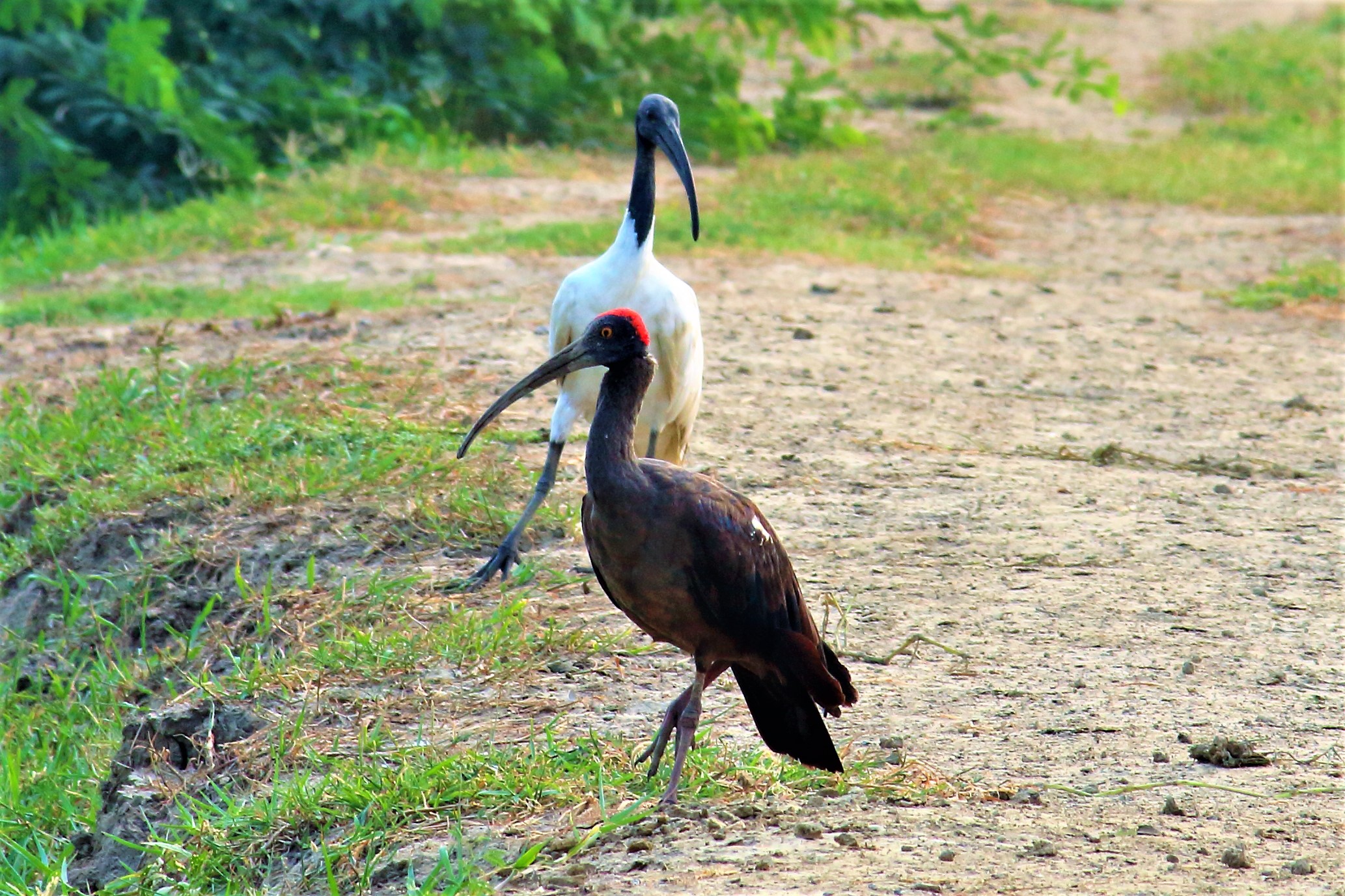
It is rare to spot a Black-headed Ibis in close proximity to a red-headed Ibis. Spotting the two will show how different they are in terms of the colour of their plumage.  I took a photograph of these two different species at the Basai Wetland a few years ago. I was also able to spot the Black-headed Ibis next to a Red-headed Ibis at the Basai Wetland. Spotting two different species of birds in close proximity to each other speaks volumes about the tolerance that different species of birds have for each other. This is a lesson for all human beings. I was able to spot a Black-headed Ibis in close proximity to a Cattle-Egret also at the Basai Wetland. Perhaps even spotting a Cormorant close to a Pond Heron might be special.

Red-headed Ibis next to a Black-headed Ibis at the Basai Wetland

A Cormorant in close proximity to a Pond Heron at the SNP National Park


A Black-crowned Ibis in close proximity of a Pnd Heron at the Basai Wetland 

Cuckoos are heard more often than seen. Cuckoos are shy birds and they are rarely spotted. These birds stay hidden within the branches of trees. I spotted this particular bird on the branches of a tree in Palam Vihar, Gurgaon from the balcony of my home.


A Cuckoo feasts on ripe figs at Palam Vihar, Gurgaon
a

Some of my favourite birds that I enjoy photographing are Sarus Cranes. I took some amazing photographs of serenading Sarus Cranes at the Sultanpur National in Gurgaon. These birds are incidentally amongst the largest flying birds in the world!

A pair of Sarus cranes at the Sultanpu National Park

Sarus Cranes performing a courtship dance at the Sultanpur National Park


Citrine Wagtails will not be spotted in urban areas, however, they will be found in the outskirts where there is greenery, grass and bushes. This bird was spotted at the Basai wetland. Shrikes are a welcome sight.

A Citrine Wagtail at the Basai Wetland


A Shrike at the Sultanpur National Park