Monday, 6 February 2017

The Church of Epiphany celebrates the Concluding Thanksgiving Service for 150 Years of Service and Witness

The Most Revd. P.K.Samantaroy, Moderator, Church of North India cutting the ribbon.

Mr Alwan Masih, General Secretary of the CNI Synod

The concluding thanksgiving service for 150 years of Service and Witness of the Church of the Epiphany took place on the 5th of February, 2017. The Re-dedication and Commitment service was attended by important dignitaries, office bearers and functionaries of the Church of North India, Diocese of Delhi.The chief guest on the occasion was The Most Revd. P.K.Samantaroy, Moderator, Church of North India. Guest of honour included The Rt. Revd. Warris K. Masih, Bishop of The Diocese of Delhi (CNI), Mr Alwan Masih, General Secretary (CNI Synod), Mr Prem Masih, Treasurer (CNI Synod).


Procession towards the old Church Building


Procession towards the Old Church Building


Carrying the archival registers, in front you Mrs Deena Joyce, and behind her is Mrs Poornima Lal

Leading the Women's fellowship team, Shikha Eileen and Mrs Maya Lal


In his sermon, the Moderator, Most Revd. P.K. Samantaroy spoke about how even while traveling on a long journey we are really not in control of the journey because the ultimate ownership belongs to God. He went on to state how a jubilee is a celebration of looking forward to being free.

Members of the Youth Fellowship

On the left, you have Mrs. Sabrina Benjamin and on the right, you have Mrs. Marion Sircar


On the left you have The Rt.Revd.Warris K. Masih, Bishop of the Diocese of Delhi CNI and on the right you have Revd.Sunil Ghazan, Presbyter in Charge of the Church of the Epiphany Gurgaon


In his message to the congregation of the Church of the Epiphany, the Moderator talked about how jubilation and atonement need to go hand in hand. He went on to speak about a need for churches to be 'forgiving churches' and that excommunication is not the only solution for a lot of problems happening across churches. 


Mr. and Mrs. Benjamin

He went on to state that there is a need for Churches to be 'Hospital Communities,' sanctuaries that welcome everyone in the manner that important people are invited and welcomed during festivals and functions. There is a need for Churches to be for those who are yet to come - a place where the guests become the hosts and hosts become guests.

Mr. Pramod Sagar and his Daughter


The Moderator, The Most Reverend P.K.Samantaroy exhorted the congregation to make coming to Church a liberating experience, an opportunity to rest and restore ourselves from the stress and troubles of everyday life.


The guest of honour analyzed the symbolism behind the procession to the Old Church, the ceremony conducted there and then the procession to the new Church building for the rest of the Mass. He stated that the whole procession was symbolic of a journey, a transition from old to new.


The Moderator exhorted all those present to allow the church to be a 'people driven church,' a fountainhead of hope.
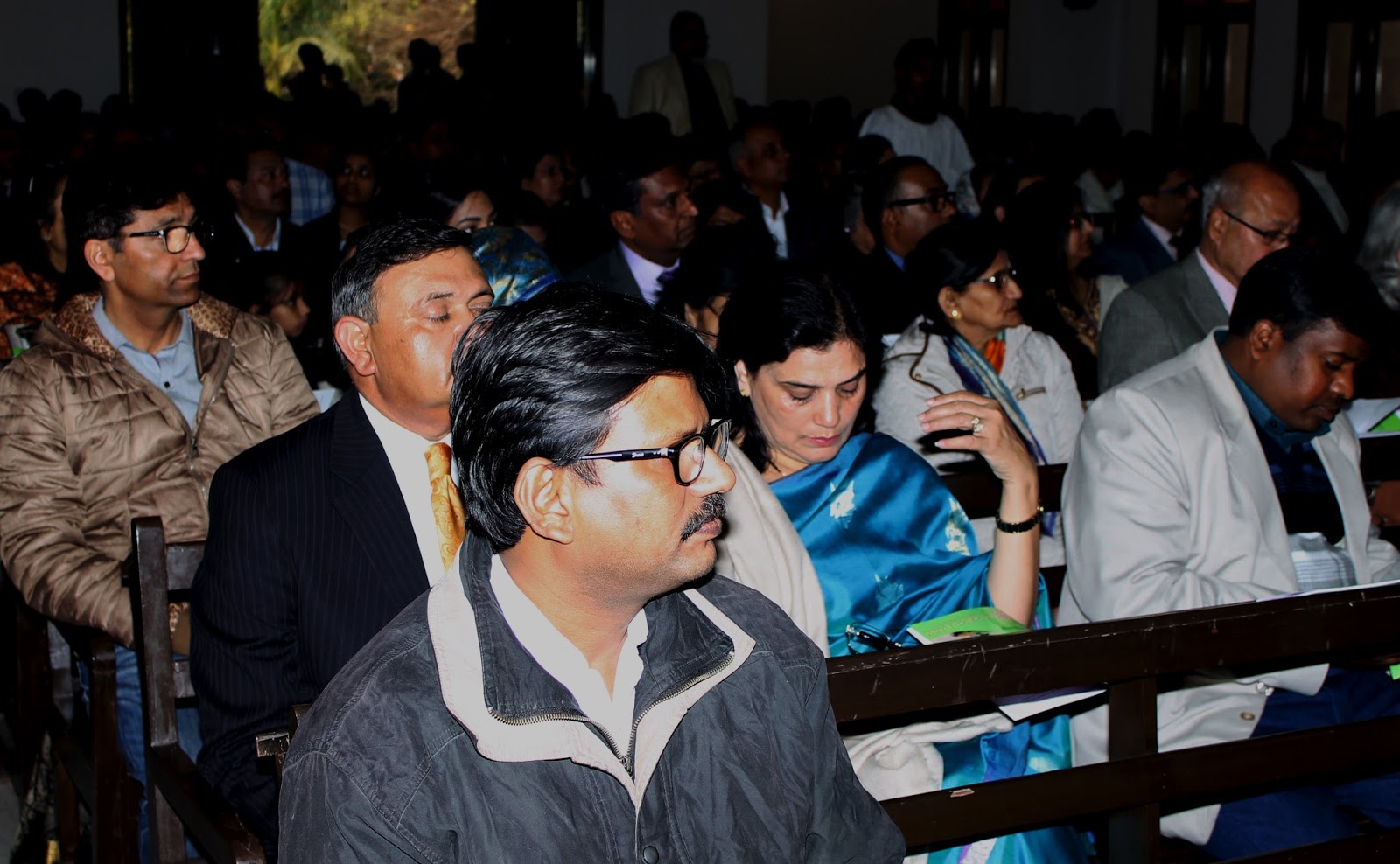
Mr. D.D.Lal, one of the oldest members of the Congregation


Of course, that's me!


Foremost in the photograph, is Mr. Sanjay Irwin Lal, the author of the Down Memory Lane Video

Aastha, a member of the Youth Fellowship

Mr. Peter John, our organist


The event that took place on the 5th of February brought to an end a year-long celebration of a hundred and fifty years of service, worship, and fellowship of the church in Gurgaon. It goes without saying that The Church of The Epiphany is one of the most important and oldest churches in Gurgaon. It happens to be an important part of the history of the town that was once no more than a small hamlet, the base of a British army contingent.


Thursday, 2 February 2017

Active and Passive Voice Constructions and the changes in the structure of the sentence

Changes in the structure of the sentence in the Passive Voice
In the passive voice, the action verb is preceded by an auxiliary verb and it takes on the past participle form. 
The sentence in the passive voice makes use of the word, ‘by’ as the agent.
A change in the pronoun in terms of person can be noticed. The pronoun ‘I’ that is the first person in the active voice changes into ‘me’ in the passive voice. This is done in order to make the sentence more impersonal and objective unlike in the active voice.

You will notice that sentences in the passive voice are statements whereas sentences in the active voice have a more conversational tone or quality.


     Students should note, however, that one cannot generalize that if the sentence contains the agent ‘by’, it is in the passive voice, because the agent ‘by’ can be omitted where the subject is a well-known entity like the Government or a competent authority. Sometimes, the subject is understood. A few examples are given as under:
1.The budget was announced last week.
2.The thief was arrested yesterday.
3.They are paid on Fridays
4.The movie is being made in Bollywood.
5.It would have been fixed during the weekend.
6.The national anthem is sung after assembly.


Where and when do we use the Passive Voice?

We use the Passive form in official communications like public notices, legal tenders, and notifications.
We use the Passive form in Newspaper Headlines.
We use the Passive voice while describing a process.


Examples of the use of Passive Voice in Newspaper Headlines:

Practice Exercise1

Convert the following into the Passive voice:

1. Who has broken my teacup?
2. You need to return the assignments by Friday!
3. A team of surgeons is operating on the patient.
4. We will help you when the time comes.
5. I will write a letter to the parent.
6. He is cooking some pasta right now.
7. Tom played football in the school team for two years.
8. The students are writing an exam.
9. The boys have set up their tent.
10.Leena is taking driving lessons.
11.Will you please shut the door?
12.I can't hear you, please talk louder!
13.The police have cordoned off the crime scene.
14.We are looking into the matter, and the culprit will be arrested soon!
15.The traffic police will penalize all those who are without helmets.

Use of Passive Voice in describing processes

Practice  Exercise 2

Convert the following steps into a paragraph in the passive voice. Use complete sentences.

How to make a cup of tea


1.Pour the required amount of water and milk into a saucepan.
2.Light the gas burner and place the saucepan on it.
3.Add sugar to taste and tea leaves.
4.Bring to boil, and then allow to simmer for a couple of minutes.
5.Pour the tea into cups through a strainer.
6.Serve the tea with biscuits and snacks.

Newspaper Headline Expansion

Newspaper headlines are crisp, eye-catching and they deliver a lot of information in fewer 
words. Tense forms need to be taken care of while expanding headlines. Thus if the 
headline is in the past tense, then the expansion should be in the past tense also.


Exercise 3

Look at the news headlines given below. Use the information in the headlines to complete 
the sentences.

1. 25 injured in train accident

About 25 passengers__________________by the White Line 
Express_____________injured when the train derailed at the Everest Junction.

2. Security stepped up for football match in capital

The police has________ vigil in the capital for the ____________match which will take 
place on the twenty-fifth.

3. Old swords and daggers found

The Archeological Survey of India ____________ the discovery of _____________ 
belonging to the fifteenth century A.D.

Thursday, 26 January 2017

The Rooster's Cry - Random Thoughts

I
Dear teacher,
Will you teach the children the joys of climbing trees
To look at birds nests, the pale, pink and speckled eggs,
Nestling within a tightly knit nest of complex patterns?
Dear curriculum,
Will you show them  the joys of chicks that hatch, the
Thrill of flight, anxious parents that watch them dip and slip,
Rise on trembling wings that soar, to seek the sky ahead?
Dear books,
Will you make them listen to the rooster crow,  greet the rising sun
With a Cock A Doodle Do (the real one not the canned one)?
Or tell them - a scraped shin wouldn't matter just the one!
Dear syllabus,
Will you tell your little ones to throw their cares and fears to
The winds, to gambol in the fields like lambs, toss and
Tumble without care,  play and eat of the sweet grass?

II
I would rather have  trees and nests, green fields, and
 Lambs that play than  drab, frightening boxes of concrete -
 Prisons to trap the children and make them repeat what to
Is taught, like mechanical parrots!
I would rather have the rooster and the sun,
The blue sky and the eggs than the mechanical processes that
Churn out copy-cats and conformists, mere robots, machines
That duplicate movements meant to create more of their kind!
I would rather  have the green fields and the cool
Breeze to caress my cheeks rather than the canned air in boxed
Rooms that feed a staleness that stinks of decay and deviousness.
The rooster's cry, Alas! I hear no more and the birds have flown away!
Lambs now gambol in laptops and tablets,
Trees are climbed no more, children have better things to do!
The rooster's cry is heard from tinny speakers, but none do hear it,
 The children are too mature today to climb trees or play with lambs.

III
Don't tell me that children are not children anymore, or they have
Better things to do! If they cannot climb trees or lie in green fields,
Or hear not the rooster crow, what then do they do? Where has
The innocence of childhood fled, if not to pore over screens that
Flicker and spit, ruin innocent minds with loads of information, 
The forbidden fruit that robs the young of sweetness so rare!
Oh, the freedom of childhood, the joys of learning, who a greater
Teacher than Nature can be in whose lap one might
Learn great things? With trees for books, hatching chicks for
Lessons, climbing of trees for exams, might one look for
A better childhood?


Monday, 23 January 2017

Why people think Fear and Anxiety need not be Obstacles

Recently, while supervising at an exam in school, I came across a sentence written of the window ledge, "Thanx for ruining our life." I was disturbed by what I was seeing and wondered what could have been the cause of such negativity and helplessness. On one another occasion, I came across one of my science students in Delhi, who had fallen into deep sleep. It was clear that he was deeply exhausted. Students the world over are facing tremendous stress like never before, and our systems and structures of education are not helping them in any case.
What had once started as a drive to reduce the weight of school bags has now changed into a challenge for reducing stress and anxiety in students. It must have been the result of unimaginable stress and anxiety that a student wrote in a rather sarcastic sense, of course, to thank somebody for ruining his or her life! To blame any one factor for this instance of extreme negativism and pessimism would be wrong, and thereby to advocate the doing away of written exams, or some form of assessment would be wrong!
It is clear in most cases that fear is both self-induced and also other-induced. So, when a mother tells her child to stop crying or else the bogey-man will take her away, she is in effect inducing a sense of fear in her child, a fear of the dark, a fear of strange sounds, empty spaces, and a lot of other things included. The fear of failure in children is induced by parents, the society, and even schools. A college mate of mine used to have panic attacks before the final exams. He would vomit, feel nauseous, and generally debilitated before each exam. He missed a few exams and thus completed his graduation much after me! The society that the student lives in, is also responsible for inducing the fear of failure in the child. So when people talk about their own fears about appearing in exams, their trepidation about impending results, they are in effect transmitting their own feelings on to the child.The school too is responsible for instilling a feeling of fear in the child when it tells him that he might as well seek admission in another school because of poor performance.
Students who don't fear failure will however also suffer from stress and anxiety related issues. Stress results from having to do too much at the same time. A brilliant science student, a girl studying in a girls only school in grade eleven decided that she would like to be a doctor. She joined one of the well-known coaching centers in Delhi. What happened was that she began spending more time working than resting. It became very difficult to complete whatever home task had been given to her. The tutors at the coaching center were very particular that she completed their homework. Her teachers at school demanded that she complete their homework. In the end, it became very difficult for her to cope and so she had to drop a year.
When a group of eighth-graders decided to use fear as the theme for their assembly, it became very clear that they had understood how fear had indeed become a debilitating factor which had robbed most students of their capability to excel. What makes matters worse is the bullying that students receive from their peers. 'Nerds', students who are good in studies are ridiculed when they go to the badminton field to play a game. They fail to play well before they even start a game, just because the comments made by their own classmates have made them so self-conscious and fearful; they are so afraid of making a wrong move that they fail miserably! Failure is infectious, and the fear of it is even more infectious!
Schools and curriculum-framers too are responsible for the fear, stress, and anxiety that students face during their days in school! A drastic shift in pedagogy and assessment strategies will put the fear of the unknown into the minds of learners. Thus, when seventh graders get promoted to the eighth grade and they get to write so much more than in their previous grade they are stressed out and anxious about their performance in exams that for them would be the first time they would be doing a two to three hours written paper! The attraction of 'joyful learning' fades away as all of a sudden, 'academic rigour' and 'deadly deadlines' begin to loom over them like a sword ready to dispatch them off!
So, what then is the solution for all of these issues? At the school level, it is important to introduce students to academic rigour steadily and gradually. What matters the most is that students need to start writing as much as possible from their earliest grades. Some form of formal written tests with a time limit should be introduced in the primary grades itself. The idea of deadlines should be introduced gently but surely in the early formative years of a student's life in school. The old but perfectly fine adage, 'practice makes a man perfect' works even today! Also, teachers should let struggling students taste success from time to time. This does not mean that students are always passed even when they have not done well enough.
The introduction of the grading system by different education boards across the world may have reduced cut-throat competition, but it has not eliminated it completely. Making board results not entirely responsible for getting admission to college, and instead, introducing entrance exams and interviews have helped a lot, though more needs to be done. Today, however, soaring cut off lists in some of the premier universities in the country based on board results have added to the stress and anxiety that students feel during the final year at school.
Parents need to learn to back off and not breath down their children's necks. Parents must accept that their children have potentials and capabilities that can be nurtured through tact and patience and not through threats, induced fear or even bribery. The word 'bribery' reminds me of a question that appeared in one of the Pre-board paper. In the question, students were asked to 'Write an article...urging all parents to give their time and moral support to their children' and not just fob them off with 'expensive gifts'. Parents are known to bribe their children by telling them that if they score a ninety-eight in the best of four subjects, they will gift them a car, or an expensive mobile. While this 'bribery' might have some motivational impact, it also induces undue stress in a student who is not so good to go all out and achieve those magical marks! The bad thing about this form of motivation is that it becomes a vicious circle where the student who achieves the magical marks expects more gifts from his parents to achieve success in college. What matters most is for the student to score well in exams and to view the good marks as the reward, not the expensive car. A few students whose papers I examined mentioned bribery as one of the things parents resort to in order to induce their wards to score well in exams.
We are living in a materialistic world where the economics of life dictate that we participate in a rat race in order to achieve success. Not all the rats will reach the finishing line the first, and not all of them will be the last. What we need our children to understand is that they don't always have to stand first, it is OK to come second or even last. What matters is to enjoy what we are doing and to gladly take ownership for our own performance. When a student comes up to me and tells me that I gave him fewer marks than he deserved, I respond to him and tell him that it could be the other way round, it could be that he had earned those marks. When another student scores a perfect ten on ten and tells me that I gave him a ten, I tell him that he had earned them! The label of being a failure is such a frightful one that one becomes devastated when one tastes failure! This reminds me of the story about Robert The Bruce. Once when he was recuperating from his wounds and the humility of having being defeated once again, he saw a spider attempt to climb up a  web string. It fell down a number of times and each time it fell, it started climbing up once again. Robert drew inspiration from this incident and he went on to be a successful warrior.
A great number of students will not answer a question in class because they are afraid of giving the wrong answer. Some will respond to their teacher's prompting but add that they are not sure about the answer. These hesitations are the greatest obstacles to learning and excelling. What needs to be communicated to all students is that failures, wrong answers, and mistakes can be some of the most powerful reasons to learn! A skilled teacher will be able to turn around a wrong answer to analyze concepts, ideas, and principles. It is good to make mistakes because we can learn from them. People who don't fail don't learn, do they? In any case, who can understand the meaning of success than the defeated soldier lying in the battlefield listening to others celebrating their success! Emily Dickinson's poem suggests that the joy of success can be tasted only by one who has tasted defeat. The fact is that no one who is an expert in cycling can claim never to have fallen off his bicycle. No one, not even an expert swimmer can claim not to have choked, drinking water while learning to swim!
Fear, anxiety and stress can, in fact, be the greatest inducements for us to succeed in life. This reminds me of William Douglas, an outdoorsman,  and a friend of W.D. Roosevelt who could not enjoy adventure activities of canoeing, trekking, and fishing for landlocked salmon because of his fear of water. This fear robbed him of the pleasures of connecting with nature while trekking and canoeing.His fear of water was the result of two incidents that place during his early childhood and teens. It drove the fear of drowning firmly into his heart. Douglas became so fed up of his fear that he finally decided that he had to do something about it. He thought enough was enough and he took up a two-pronged approach towards tackling this problem. He first hired the services of a swimming instructor. He trained under him patiently, day after day, till he had learned enough. But then that was not enough for Douglas. He still had to face his fear. What he did was to swim solo in the swimming pool. The old fear came to him and Douglas confronted it and it fled. He was still not satisfied, and so he decided to swim in Lake Wentworth between Triggs Island and Stamp Act Island. When he put his face down into the water, the old fear returned, but Douglas confronted it and it fled. Nothing can beat the joy of having one's fear, nothing can the thrill of having overcome one's stress and anxiety. Stress and anxiety can be the inner voices that prod us towards success. Fear can be a motivation to strive to defeat it. As Roosevelt stated, "all we have to fear is fear itself!" the rest will fall in place!

Saturday, 14 January 2017

Teams that eat together stick together


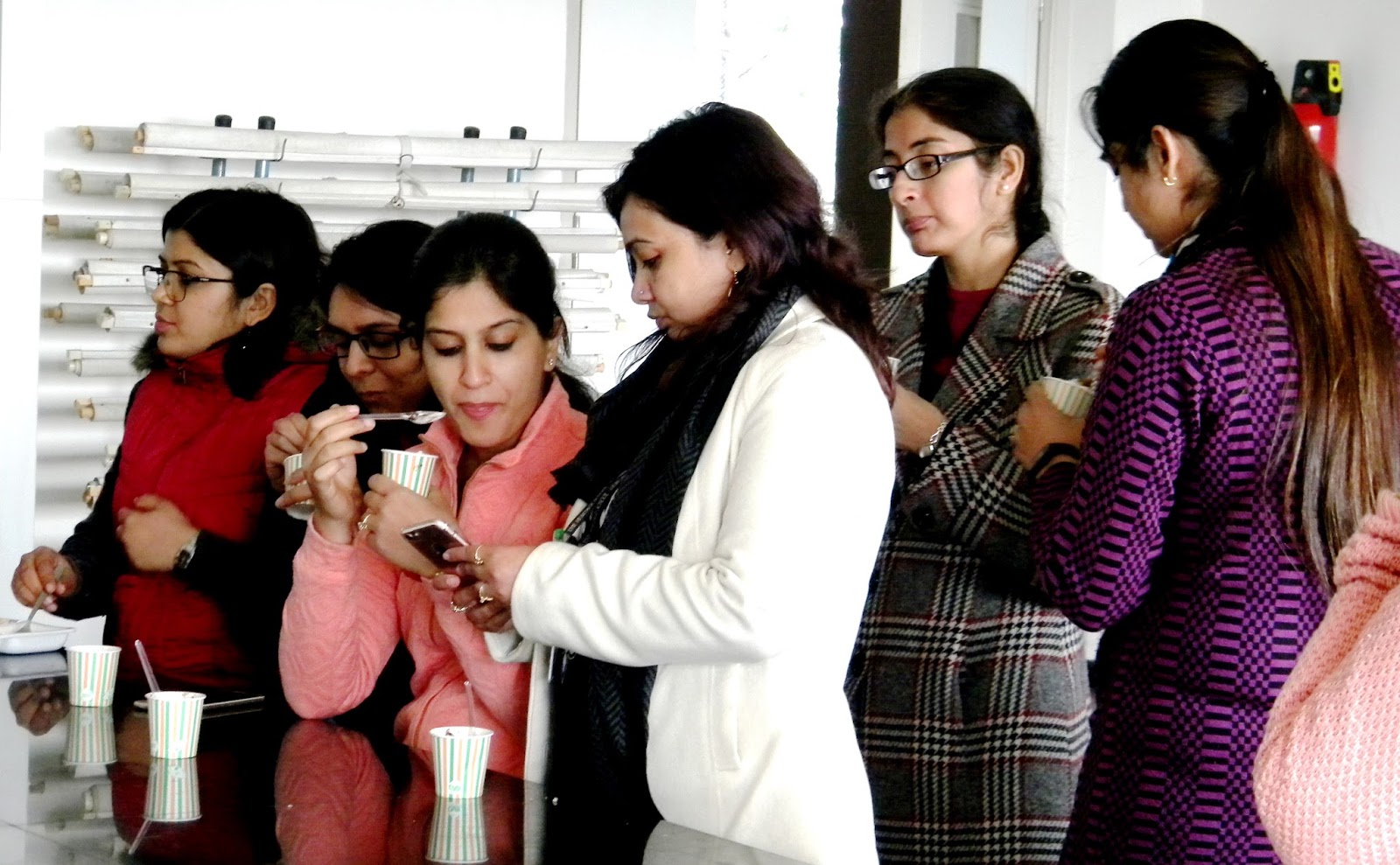
Potluck meals are a fine way for bonding together and also for bringing about a change in the working environment. When we decided to organize a potluck lunch and take a break from the mess, it was a wonderful opportunity to display exceptional culinary skills too! The photographs below will give the reader a glimpse of the actual event itself!