Saturday, 11 November 2017

At the Dhanpatmal Virmani Education Trust and Management Society Centenary Celebrations


It was an honour to be invited to the centenary celebrations of the Dhanpatmal Virmani Education Trust and Management Society today. The first school run by the Dhanpatmal Virmani Education Trust and Managment Society was established in Lyallpur, Pakistan a hundred years ago. Ever since the Trust has been offering quality education to the underprivileged. The chairman of the Trust, Mr Anil Virmani is a philanthropist and an educationist with a vision that far surpasses expected possibilities. I served the trust for seventeen years which happen to be the most important formative years for me.


The function started with a narration of the history of the school. The partition affected the family adversely. The members of the Dhanpatmal Virmani Family were forced to leave everything behind in Pakistan. Yet, the elders decided to open a new school in Roop Nagar, Delhi at first in a rented accommodation.


Staff members of the Virmani Public school were felicitated for their service by the trust as were the staff members of the Dhanpatmal Virmani Sr. Sec school.


It was a great joy to see the retired staff members with whom I had once worked. Among those present was Mr  G.L. Naswa, the first principal under whom I had worked, Mr  R.B.Aggarwal the first Vice Principal under whom I had worked, Mr  A.R. Ahuja, and Mr Tayal, who had retired before I joined the school in 1994.

It was an emotional moment also to see a group of students of the 1984 batch acknowledge the contribution of their teachers all those years ago because of which they have reached their present status as accomplished professionals.


It was indeed a high energy moment for Mr.Amitav Virmani and Mr Anil Virmani, the Nephew and Uncle combo of the Trust, as you can see from the above snap!


Mr Vinod Dua, eminent media person and alumni of the Dhanpatmal Virmani School was the chief guest on the occasion shared his anecdotes as a student of the school. He spoke at length about the need to go beyond the textbook and what is limited to the curriculum. He talked about developing skills that go beyond the textbook, skills that help equip the learner for life as a professional He talked about the need for crossing the class barrier and to acknowledge one's Indianness. He talked about his memories of life as a small child in Dera Ismail Khan, in Pakistan and his struggles as a child in India after the partition.


The students presented a scintillating cultural programme for all those who were present on the occasion.  

It was an honour to see Mrs Asha Kishore, Vice President of the trust whom I was closely associated with as the editor of the Dateline E-Newsletter. She read out the vote of thanks.


Last but not least, lest you should think I covered the whole function by proxy, I would like to thank Mr S.R.Sharma for acknowledging my presence at the function with this lovely snap!




Thursday, 9 November 2017

A Confirmation Service at the St. James' Church


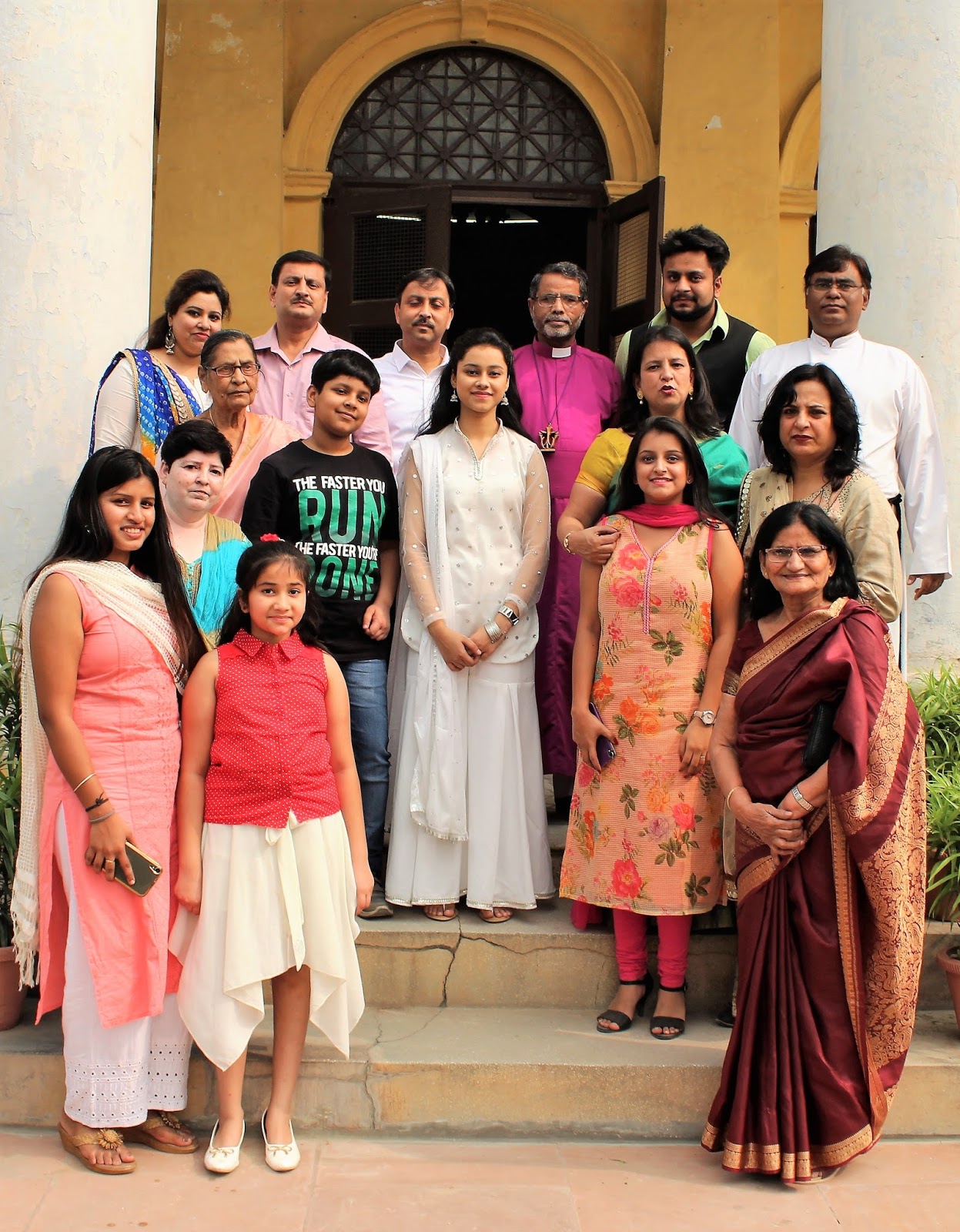
The fifth of November my family and I heading to the St. James' Church Kashmiri gate to attend our Niece's confirmation service. The Sunday Mass at the church at Kashmiri Gate Delhi was an amazing experience as there is something that is rather special about the church in itself. The church incidentally was built much before 1857 and it bore witness to the uprising also known as the first war of independence. It is also known as Skinner's church as it was built by Skinner a soldier in the British Imperial Army.


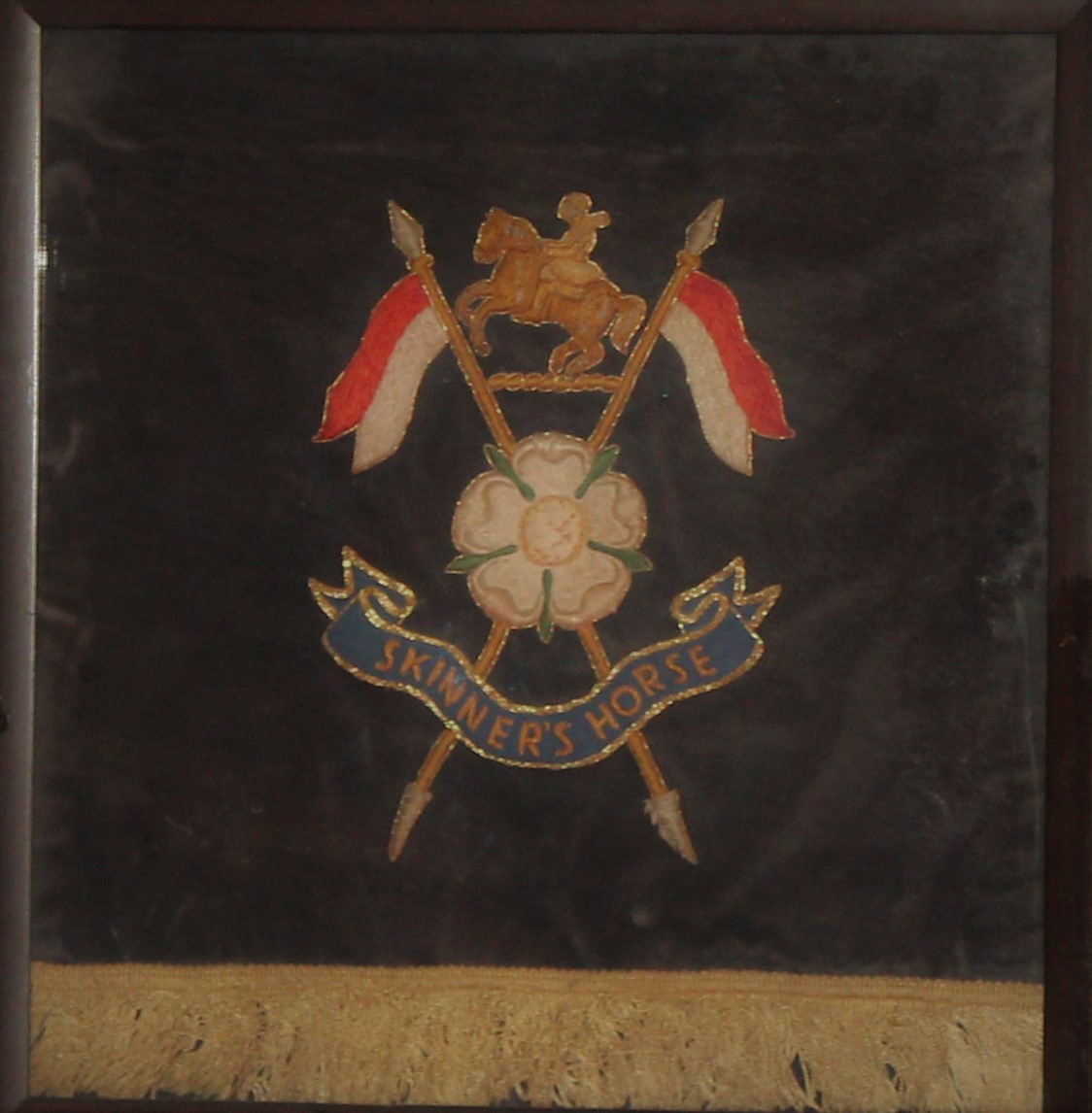
The above insignia belonged to Skinner's Horse Regiment. I was able to take a photograph of one of the members of the Horse Regiment, and impressive rendition, no doubt!


At the church, I was able to get a few more photographs that I wish to add to this blog post. They are posted below:


This is a photograph of the church as it was in 1857.

A much later photograph is of the Skinner's Horse Regiment.

But then, I guess enough of the History, I should move on to the children who were confirmed that day, the fifth of November, for it is an honour for them to share a slice of history by virtue of being confirmed in this church.


Saturday, 4 November 2017

We, The Change Makers, at the Basai Wetlands


When I floated a proposal to the photography club, Click, students of which I am a faculty advisor about visiting the Basai Wetlands, I was not sure if there would be a good response, a non-working Saturday, and the joy of getting up late, would I was sure, put a dampener on the whole proposal. My pitch to the students was that they had to make a difference to the society through their photography skills and with the possibility of the Basai Wetlands disappearing off the radar completely, thanks to the changes ushered by progress, it was likely that the photographs that they shot of migratory birds would remain virtual memories. 


The challenge to the members to of the club was to become changemakers and not mute spectators watching the degradation of the environment. I wanted them to pick their equipment and take photographs of the flora and fauna supported by the Basai Wetlands. To my pleasant surprise, about ten students turned up early in the morning along with their fathers, and then we proceeded to the wetlands. I would not be wrong to state that they were pleasantly surprised to see a large number of Purple Swamphens, Teals, Cormorants, Ibis, Ducks, Egrets and Kingfishers. Some of them got down to work right at the beginning of the waterline, although I told them there was more ahead.


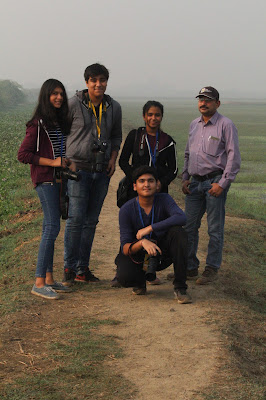
Ansh did not carry a zoom lens so I told him not to be disheartened as there was always a purple bird, (Me in the snap) that he could always photograph. I guess I will have to pay him a royalty for taking this snap, with my camera of course!


I had to get the Club card in focus and I did it! It was difficult getting them back because each step they took on the return, they saw something new to photograph, and I would not blame them for their reluctance to return home because there was so much to photograph. I am sure the reader would agree that the Basai Wetland is simply too precious as a Wetland because it is home to so many species of birds. This naturally occurring water body, one of the remaining water bodies in Gurgaon is under the threat of the axe of development! Unless the authorities do something to save this precious ecosystem, the birds that you see in this post will only be a memory of a trip we made one fine Saturday! I hope my students and members of the Photography Club, Click will do their best to spread awareness about the Basai Wetlands!


The scene of Ducks rising into the skies, amidst the background of greenery is only marred by the shells of buildings that I have seen in the same state for the past five or more years! It is a sorry thought that one day, instead of these green surroundings and the sight of ducks flying off into the horizon we will have only highrises shimmering in the heat haze with a cloud of dust hovering over them like an ominous portent that warns all mankind that when man advances, forests disappear, and when forests disappear, and grasslands disappear, then streams and wetlands disappear. When streams, wetlands, and forests disappear, then animals disappear. When animals disappear, then how far away can Man's time be before he too disappears!


And so I sing a song for these beautiful creatures,
That call out aloud of greater horizons,
Even as they swing into the sun,
Heed this song all ye who hear,
To save our wetlands and 
Forests, we must rise on
The wings of  greater good
And think of a better good
Than living inside concrete
Cages that breath in a fug of dust!
For better good, it would be,  to fly Like
Thes magnificent birds, God's own Angels
That guide us towards better sense and mature thought!


If words could suffice to express the great joy and deep sense of connect that one has while visiting places where nature still exists in its pristine untrammelled state, then what need for photographs that reflect that amazing feeling? These are some of the snaps that I took in order to bring to the readers, the treasure trove we have in the Basai Wetlands!


But then it is not just about the birds, it is about the turtles, fish and amphibians living in the depths of the lake that sustain the birds. A couple of Ornithologists from SriLanka told me that it was a virtual paradise for them!


How to reach: You need to reach Pataudi Crossing, or Pataudi crossing, from the crossing, take the road that takes you to the Sultanpur Bird Sanctuary, this is the Gurgaon-Jajhar road. About two or three kilometres from the Pataudi Crossing you will come to a right bend in the road leading to a flyover. On your left is the Huda Water Processing Works. The Basai Wetland is on your right. Immediately after descending from the flyover, look for a narrow lane on the right-hand side of the road. You will have to take a right turn to enter a lane that seems to lead to nowhere. Take this track and drive on till you reach a sort clearing with a shed built on the right-hand side. You have arrived!


Sunday, 29 October 2017

Jim Corbett Museum, Kaladhungi and Memories of Arba Minch


This month when we visited the Jim Corbett National Park I made sure that we visited his museum, located in a bungalow that he probably lived in. I first came to know about this legendary hunter and tiger conservationist from my father when we were living in Arba Minch, in Ethiopia, a town surrounded by dense forests and the favourite haunt of African Lions, hyenas, pythons, and all sorts of predators that were attracted to the town because of the domesticated cattle that were to be found. I could somehow relate to Jim Corbett because my dad often took us on post-dinner drives into the thick forest that surrounded the town. More often we drove down the ArbaMinch Addis Abeba highway close to the Cooperative farm popularly known as Lemat. Those were the years preceding the Socialist revolution that took place in 1975. Somehow my memories go back to the days when, on our evening drives we would come across Mr Delville, an American with Native Red-Indian ancestry who dared to roam the forests armed with a bow and quiver of arrows, and not much else!


My father would often be able to tell from the behaviour of the deer baboons and other denizens of the forest that a lion was in the vicinity! Apparently, this was not rocket science for him because it seemed as if the deer and the baboons appeared more nervous and scared, and then there were those warning cries that my father recognized for what they were. Jim Corbett too must have gone through the same experience although he would have confronted tigers and not lions. Tigers talk and attack with the least of warning while lions are more likely to give a warning, more likely to attack from the front. In terms of equipment too, Jim Corbett was limited to a form of a lantern that burnt kerosene oil while today we have mobile phones and powerful battery-operated flashlight.


Our visit to the Jim Corbett museum about forty kilometres from our resort in Dhikuli transported us to the times when we lived in Arba Minch in the Gamugoffa province of Ethiopia. The quaint Charpoy and the rickety cane furniture simply belonged to an age long gone by! The present generation will never experience the thrill of looking at wildlife and nature as closely as we once did, and people like Jim Corbett were an inspiration for us! Of course, I would often step out of my school in Arbaminch in those days and take a stroll in the jungle that started right after the boundary walls, no barbed-wire fence of the school (This is something I never told my parents or they would have given me a piece of their mind!). The bungalow housing the museum reminds me of the kind of houses we had in Arbaminch, adobe houses with tin roofs, and cornice ceilings and no cement except for the flooring!


The above warning rings true, not just for tigers but for nearly everything that nature has given to us! Disappearing wetlands, grasslands, forests, and even the damage being done to the Aravali mountains in Gurgaon is a cause for concern. Tigers, migratory birds, even the now rarely seen sparrows are markers that indicate damage being done to the environment! Jim Corbett was a great man, a writer, a carpenter, a gentleman, and greatest of all, one of the greatest conservationists that India has had the honour to have. This gentleman had a strong conviction that the extermination of the tiger would rob the nation of its finest animal. Unplanned development, greed for money, selfishness and apathy, both the seen in the common man and the administration has led to the loss of valuable forest cover. We need to educate the common man about how important it is to conserve nature, flora and fauna.It is the duty of all the elected members of the Parliament to protect not only the rights of the citizens living in this country but also to protect the interests of wildlife and thereby the habitats they live in.


Today we maintain museums and relics of great people, we enjoy visiting such places, places which have become 'A Must See,' but we turn a blind eye to our existing valuable natural resources. The Aravalis, the Mangar Bani forest, the Basai Wetland, in Gurgaon, all are under the axe of rampant and unplanned development in a region that is headed towards an ecological disaster!


I hope that the light of reason coupled with better technology will help all of us see sense in conserving our environment. Jim Corbett used a relatively primitive kind of light source seen in the snap above, but we today have better light sources, halogen torches, LED-powered torches, mobiles, and laptops, and wifi, and internet, but then I wonder if all this technology has made us better than people like Jim Corbett!