Tuesday, 3 March 2020

Celebrating the World Wildlife Day with Some of my Favorite Shots of Birds in Flight


Tuesday, the third of March is the World Wildlife Day and my way of celebrating it would be to post some of my favourite photographs of birds in flight taken by me. While nature is fascinating and precious to all of us, we have somehow neglected it. Part of the neglect is due to our own obsession with development, success, competition, machines and the internet. 


Our blindness towards the state of nature today has resulted from an attitude of complacency and our habit of taking things for granted. Our greed for profits, success, name and fame have resulted in most of our wetlands and forests disappearing from under our very noses. The green tracts that once surrounded Gurgaon have all but disappeared, the wetlands that once were home to a variety of native Indian species of fish, turtle and native waterbirds have disappeared, swallowed by concrete structures, roads and flyovers all in the name of development.


Soon, the photographs of these flying birds will be all that remains of them, even as we gaze with wonder at life-like models and photographs of the actual birds. While few of our future generations will have seen the actual birds, I can claim with pride to have seen them in their real habitats, not just in a state of rest, but also flying into the heavens! 


Of course one might claim that ducks sweep into the sky like a lumbering jet, but then the grace of such might be the source of inspiration for bards, painters and poets. The grace of flight might be seen in the smooth take-off, of the ducks a fluid movement that draws our attention. But to see two egrets fight each other, might in some ways frighten, to see the interloper get chased away, two birds, sparring with each other!


I know you've seen these before, but trust me, never the models of the real ones. That, I guess is what we will have for wildlife in the years to come, images, sounds recorded on machines, shapes built out of cement, and plaster of Paris, all for the amazement of gullible children who wouldn't know the real from the reel!


The real pair immortalised in stone and cement did grace the skies even as the real pair did sing with great gusto to the world that would leave aside their work if only to hear them!


And quietly did a solitary Ibis fly into the ether, leaving memories of times when the birds did flock in numbers so great.


Sunday, 1 March 2020

It Takes Two to Tango


They say it takes two to tango and never has this been more truly supported than while looking at Sarus Cranes court each other. While no doubt it is said that Sarus Cranes bond for life, this is something to be seen and appreciated. True bonding, they say, depends on compatibility, synchronicity and understanding of each other.
Dance, they say is fluid, sinuous, sensuous and art especially when both partners are in sync with each other. It is almost as if their minds are connected and they anticipate beforehand without speaking to the other what their partner has planned to do.
I have seen quite a few videos of ballet dancers dancing gracefully, their movements fluid like water flowing past, sinuous and synchronised, playfully flirtatious, teasing, advancing and retreating. But then, one might claim that when human beings dance, they do so with great skill, using their exceptional levels of cognition and intelligence to form intricate forms of movement that might in the minds of the viewer be termed artful and mesmerising!
I, on the other hand, believe that we human beings might as well have copied our dance forms from birds and animals! Birds and animals too can perform some of the most intricate steps in their courtship rituals. It was a fortunate moment for me to observe at leisure the complete sequence of the steps in the dance of a pair of Sarus Cranes at the Sultanpur National Park when I visited it yesterday.
While I have without doubt observed specific synchronicity the dance patterns of the Sarus Cranes, it was only yesterday that I was able to record each step in a long sequence of movements of their dancing. It all began with the pair foraging for food, which in turn lead to a grooming ritual. The grooming ritual then led to the male heading towards a mound of Earth, rather like a stage which was higher than the surface of the lake. The female followed suit. The pair preened once again and then launched into their dance steps. The male fluffed his feathers stretched his neck out and began calling out loudly. The female copied the male word for word, both in perfect timing, bobbed their heads in unison, a veritable duet that would give a pair of human singers a run for their money (talent)!

Let's get ready for the dance!


Follow me to the dance floor, check out for competition!


Let's do it, Dear, let them see what we can do!


Ok, now, let's get back to work, we need to prepare the nest!


Strangely enough, the cranes faced a trio of photographers on the left bank who had their lenses pointed towards the birds. It seemed at that moment as if the birds had deliberately mounted the mound of earth, and faced the photographers as if challenging them to a competition. 
I very strongly believe that while visiting the Sultanpur National Park, you will surely come across this pair, if not you might be able to listen to their swansong! The sculpture of a pair of Sarus Cranes serenading, that greets you at the very entrance to the National Park is very lifelike and an indication that the park will be remembered for hosting this rather most romantic of all couples, and the best dancers in the world!
Nature is a great teacher and Sarus Cranes further the good work that nature is trying to do.


Thursday, 20 February 2020

Looking back at Traditional Attire and Folk Dances at the Surajkund Crafts Fair-2020


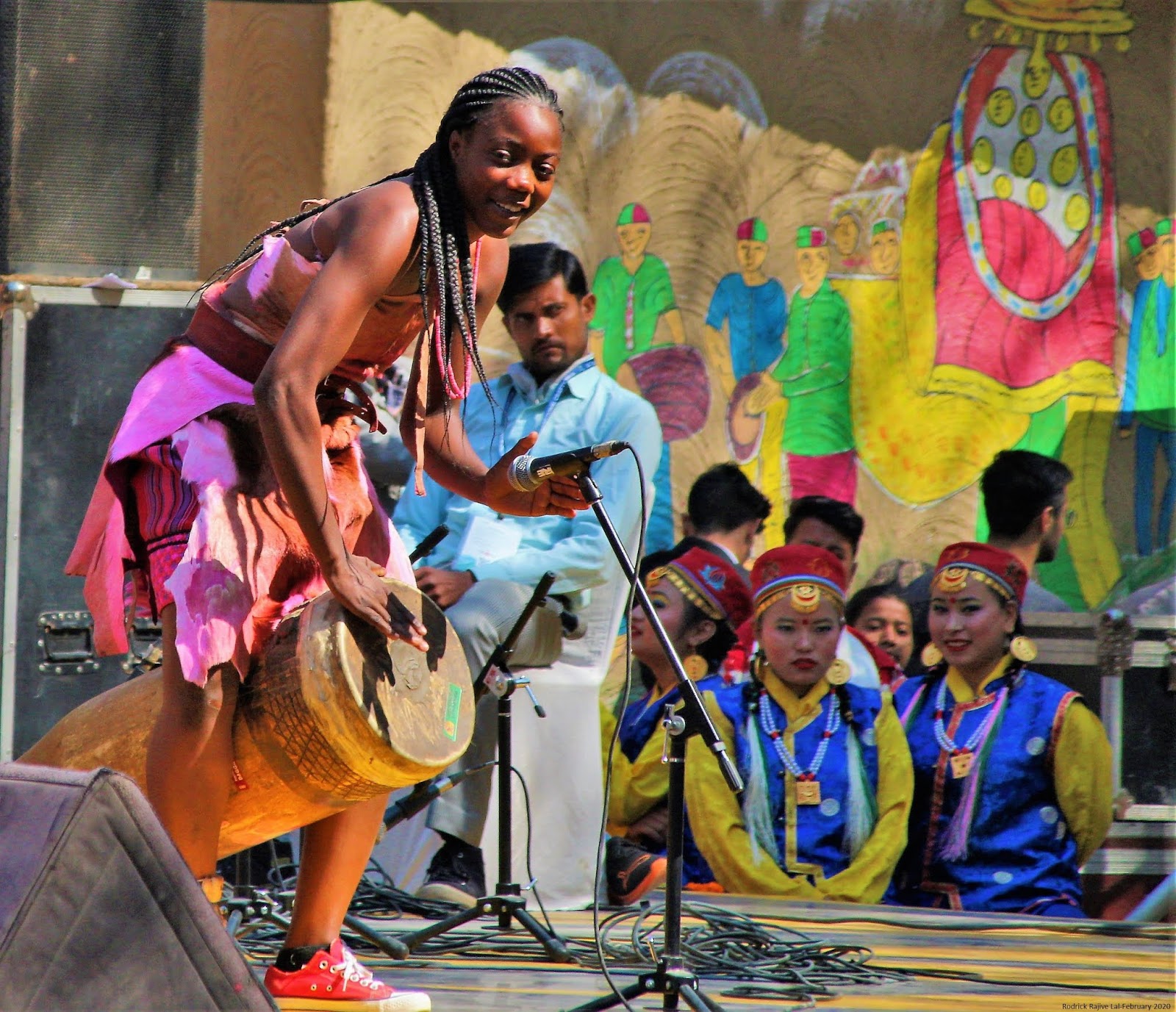
You might be wondering about the title of this blogpost, thinking perhaps why the looking back when the fair has just concluded. Well, the reason, for obvious reasons is that anything that is not recorded tends to fade away from the mind! This year, I visited the Crafts Fair not once, but twice. In my post about the crafts fair, I focused on the handicraft exhibits, but the second time I visited the crafts fair, I decided to take some photographs of the cultural performances. Gladly enough, I was able to photograph some amazing performances by troupes from Kangra, Garhwal, Tawang in Sikkim and Namibia.
While most of us tend to link the Surajkund Crafts fair in Faridabad to handicraft items, fabrics, decoration pieces, we don't realise that the crafts fair is a melting pot of cultures not only from India but also from all over the world. I was able to watch an astonishing performance by the troupe from Namibia. Their dance performance started with a light, rather rhythmic and swaying performance followed by a round of leaps over fellow dancers. It was like watching gazelles leaping over obstacles.

Traditional Costumes of  Dancers of Namibia


The folk dance from the Kangra region in Himachal Pradesh, India was, on the other hand, more subtle and somehow with a beauty of its own. What was striking about them was the choice of colours of their costumes. If the Namibian dance was minimalistic, the Kangra folk was more elaborate. I was able to take quite a few photographs of them too. I was also able to photograph a group of traditional wandering musicians, artists belonging to one of the tribes of Himachal Pradesh. These people are nomads, shepherds who tend their flock of sheep.

Traditional Costumes, Nati Dance - Kangra, Himachal Pradesh


  Traditional Attire of the Gadi Tribe of Himachal Pradesh


The folk dance from the Garhwal region in Uttarakhand, India has much in common with the performance from the Kangra regions. Very subtle and fluid-like aggression was evident in the Garhwali dance in the use of bows and arrows. The traditional costume worn by the artists was similar to that worn by the Kangra dance troupe. Notice, however, the headdress and the nose ornaments.

Traditional Dance, Costume and attire of Garhwal, Uttarakhand


The dark blue colour of the costumes of the troupe from Tawan, Sikkim reminded one of the light blue colour of clear skies, a luxury that all of those living in the Delhi National Capital region can only dream of today. 

Traditional Dance Costumes of Sikkim


Thursday, 13 February 2020

Poets and Pancakes - A Critical Analysis of Important Themes


Poets and Pancakes by Asokamitran is an important biographical description of the Gemini Studios in the early days of the film industry in India. While its historical significance cannot be denied, Poets and Pancakes, in spite of its rambling style, also dwells on various important themes.

Important Themes

1. Favouritism and Sycophancy at the place of work
Kottamangalam Subbu reaches the position of second in command at the Gemini Studios because of favouritism, 'by virtue of being born a Brahman. He had the ability to look cheerful at all times even after...a flop film.' Subbu seems to be highly versatile as he can up with four alternative ways to do a scene. If they were not good enough, he could come out with fourteen other ways to do the scene. He was a poet, a novelist, and yet, the office boy believes that all this success might have been 'because he seemed so close and intimate with The Boss'. Another reason for Subbu's success might be that 'his general demeanour...resembled a sycophant's'.
2.Hierarchy at the place of work
According to Asokamitran, 'A strict hierarchy was maintained in the make-up department.' The chief make-up man applied make-up on the chief actors and actresses, his senior assistant looked after the second hero and heroine, the junior assistant looked after the comedian. The office boy, the one who feels jealous of Subbu, is on the lowest rung of the hierarchical ladder.
3. Social Integration at the place of work
While favouritism sycophancy and hierarchy are divisive in nature, it is surprising to know that social integration was closely followed in Gemini Studios. As such, the make-up department was first headed by a Bengali who was succeeded by a Maharashtrian. The Maharashtrian was assisted by a Dharwar Kannadiga, an Andhra, a Madras Indian Christian, an Anglo-Burmese and then, of course, there were the local Tamils.
4. Propaganda at the place of work
Unfortunately, Gemini Studios does become a battlefield for propaganda in which the people who work in Studios become the confused, dazed and hapless victims in a war of philosophies and schools of thought that they don't really understand! The Moral Re-Armament army's hidden agenda was to counter 'International Communism'. It was with this express purpose that they visited Madras in 1952! Later when Stephen Spender visited Gemini Studios, it was to propagate the virtues of Communism. Although his speech was interspersed with words like 'freedom' and 'democracy', his accent left them 'baffled'.
5. Jealousy at the place of work
Asokamitran describes jealousy at great length. In this case, there was one person who was jealous of  Kottamangalam Subbu. This was the office-boy who had 'entered the studios years ago in the hope of becoming a star actor or a top screenwriter' but he had not managed to any of them. He was in his early forties and looked at Subbu with envy. 'In all instances of frustration, you will always find the anger directed towards a single person openly or covertly and this man of the make-up department was convinced that all his woes, ignominy and neglect were due to Kothamangalam Subbu.' Subbu had managed to write poetry, he had written a novel, and 'He was an amazing actor' all of which the Office boy had wanted but could never achieve.

Important extract-based questions

Such a charitable and improvident man, and yet he had enemies! Was it because he seemed so close and intimate with the Boss? Or was it his general demeanour that resembled a sycophant's? Or his readiness to say nice things about everything? In any case, there was this man in the make-up department who would wish the direst things for Subbu.

1. Who is the 'charitable and improvident man'?

2. What is the contradiction in the first line and what does it expose about Subbu's character?

3. How did he resemble a 'sycophant'?

4. Who is 'this man' who has such negative feelings toward Subbu? Why does he have such negative feelings towards the number two in Gemini Studios?


It was some years later that I learnt that the MRA was a kind of counter-movement to international  
Communism and the big bosses of Madras... simply played into their hands.

1. Who is 'I' in the first line, and what did he learn about MRA?
2. What is the full form of MRA?
3. Name two of their plays that were seen over and over.
4. Who was the Boss of Gemini Studios? How had he 'simply played into their hands'?

He wasn't the editor of any of the known names of British publications in Madras, that is, those known at the Gemini Studios. Since the top men of The Hindu were taking the initiative, the surmise was that the poet was the editor of a daily - but not from The Manchester Guardian or the London Times. That was all that even the most well-informed among us knew.

1. Who is 'He' in the first line of the extract?
2. Name one poem written by 'He' that you might have read recently.
3. Identify the name of the British Publication that 'He' was an editor of.
4. Identify the narrator of the above lines.

Stephen Spender, the poet who had visited Gemini Studios! In a moment I felt a dark chamber of my mind lit up by a hazy illumination. The reaction to Stephen Spender was no longer a mystery. The Boss of the Gemini Studios may not have much to do with Spender's poetry. But not with his god that failed.

1. Who was Stephen Spender?
a) A politician  
b) An English poet and novelist
c) A Communist
d) A theatre artist

2. Why did the narrator's mind light up with a hazy illumination?
a) He was able to recall the visit by the poet.
b) He was inspired to write poetry by the visitor.
c) He was able to feel an affinity with the visitor.
d) He was saddened by his struggles as a writer.

3. The statements: the 'Boss...may not have much to do with Spender's poetry. But not with his god that failed,' suggests that:
i) S.S.Wasan did not subscribe to Communism.
ii) S.S. Wasan had deliberately called Spender because of his disillusionment.
iii) S.S. Wasan wanted Spender to talk about his disillusionment.
iv) S.S. Wasan wanted to counter communism.
a) both i) and ii) are correct
b) both ii) and iii) are correct.
c) Both i) and iv) are correct.
d) All i), ii), iii) and iv) are correct.

4. The 'god that failed' refers to:
a) The book titled The God That Failed
b) Spender's disillusionment with Communism.
c) A play produced by the MRA
d) both a) and b) are correct.


Sunday, 9 February 2020

Glimpses from the Surajkund Crafts Fair, 2020


The Surajkund Crafts Fair that takes place in the month of February in the town of Faridabad is perhaps the largest cultural and arts fair in the country. An important event for the Delhi NCR area, it hosts artisans from the country and all over the world too! Like all the other years, one country is selected as the theme country and this year it was Kazakhstan. The fair lasts from the first to the sixteenth of February every year.


While the even might be seen as an occasion to go out as a family, many art-lovers make it a point to head out to the fair to buy some unique artefacts from all over the country and all over the world. I was able to buy my stock of first-day covers, exotic stamps, contact-sheets from the post-office counter, while the rest were able to buy sarees, suits, and designer jewellery items. The handicraft items for sale were especially amazing and I couldn't help taking a few photographs of them. The use of Oxen horns, wood, cloth was prevalent throughout. Other most striking exhibits included colourful Turkish lanterns that were mesmerising in appearance.


It was also great fun to see the long-forgotten bioscope operator twirling his moustache and the man dressed up as the ten-headed Ravan. Our own Indian culture was highlighted everywhere, whether it was in the folk-dances or even the traditional costumes.


Also fascinating were the facades lining the entrance from the Chattisgarh gate. Replicas of important historical structures were there for all to gaze and admire.


And of course who could forget the ice-lollies and the traditional food that one doesn't really come across in daily life.


The cost of the tickets on weekends is Rs.180 for the general public while for senior citizens it is Rs. 90. On weekdays, however, there are numerous discounts. Students can get discounts on the tickets on showing their identity cards. When I visited the crafts-fair yesterday, a Saturday, it was overcrowded.


The Surajkund Crafts Fair had some important messages to convey to the visitors. These included the need to recycle things and the need to observe traffic rules. It was also most heartening to see how the organisers of the Crafts Fair had tried to communicate awareness about the harms of climate change. There was a display that reminded the visitors about the harm caused by the forest fires in Australia-a truly International and global message indeed! How can one forget the iconic Traffic Tao. I was able to get one photograph with Traffic Tao holding a placard exhorting motorists to follow traffic signals and to stop on the red light.