Thursday, 16 September 2021

The Banjara Market-A Lost Treasure


A benevolent Buddha smiles at the visitors at the Banjara Market

The Banjara Market in Sector 56 Gurugram used to be a go to place for furniture, decoration items and even ceramic ware. The word 'Banjara' means, 'nomads' akin to, perhaps, the word 'gypsies' and so it was that this market was run by a nomadic trading tribe of people hailing from the Mewar region of Rajasthan. This rather quaint and rather unorganized market in terms of proper stalls deserved to be labelled as the Delhi Haat of Gurugram. Unfortunately, the settlement of migrants from Rajasthan faced closure as the land on which they had settled on belongeg to the Government. Most of the residents in the market area had been in situ for about twenty years. The furniture sold was mostly reconditioned from old and weathered wood which gave it an antique look. Some of the furniture was sourced from furniture manufacturing export houses. In fact you might have been lucky enough to have the original tags in place.


Artisans work on an artifact that will adorn the walls of the well-heeled.


The Banjara Market was home to a large number of artisans whose creative art could be seen in the magic they performed on recycled wood and other materials. The vase below, however. seems to have been brought to the venue fully manufactured.


A wooden vase greets the setting sun

While one might wonder if many of the art products might have been made by the artisans of the Banjara Market, what is clear, however, is that the market was a confluence of 'objets d'art' and so you were likely to spot art objects such those you might find in more upscale outlets.

In the company of the Budha-an assurance of good luck

The Covid-19 Pandemic had certainly left its mark on the flea market. Before the pandemic one saw a large number of people visiting the spot for window-shopping and purchasing of unique items bur after the pandemic there were fewer people, a trickle compared to the hoard of people in earlier times visiting the spot.

A collection of effigies of the Buddha assure of a happy future. 


Where else could one find such items if not a flea market like the Banjara Market? It is certainly unfortunate that this amazing market will soon be replaced by developmental projects, surely a big loss for Gurugram and a gain for any other locality that becomes home to the  nomads from Rajasthan.

The message on the canvass, ironical though it might be, says it all. 


Today, ( 5th of October-2021) when I visited the Banjara Market after I had been told by Rishi that the stalls had been disbanded by members of the Municipality, I was greeted by an air of desolation. The items for sale had been confiscated and impounded, the stalls disbanded. Unfortunately, the people running the market had seen it coming and had not done anything about it. When I talked to some of the stall holders about their plans for the future, some of them stated that they had no idea about what to do. A few stated that they would shift to a plot close to the Chattarpur Temple while others stated that they would shift to a plot adjacent to the Leisure Valley park. Others stated that they would go back to Rajasthan from where they had migrated looking for better prospects. Unfortunately, the people running the flea market didn't see it coming, they had been paying a rental of Rs. 2000/- to the land mafia. 

A family gathers around a hookah discussing the way forward.

The unfortunate  fact is that it is the poor people, children and women who are the most affected by displacement caused by civil wars, developmental processes and a general apathy of the people in power. The least that could have been done was to offer these displaced people an alternative site to set up their stalls. This, unfortunately doesn't seem to have been done and today, the people running the flea market have no other place to go to! It is indeed a tragedy of great proportions to see the people running the market left high and dry by the circumstances dictated by the need for development.

A bunch of stuffed animals await a better home


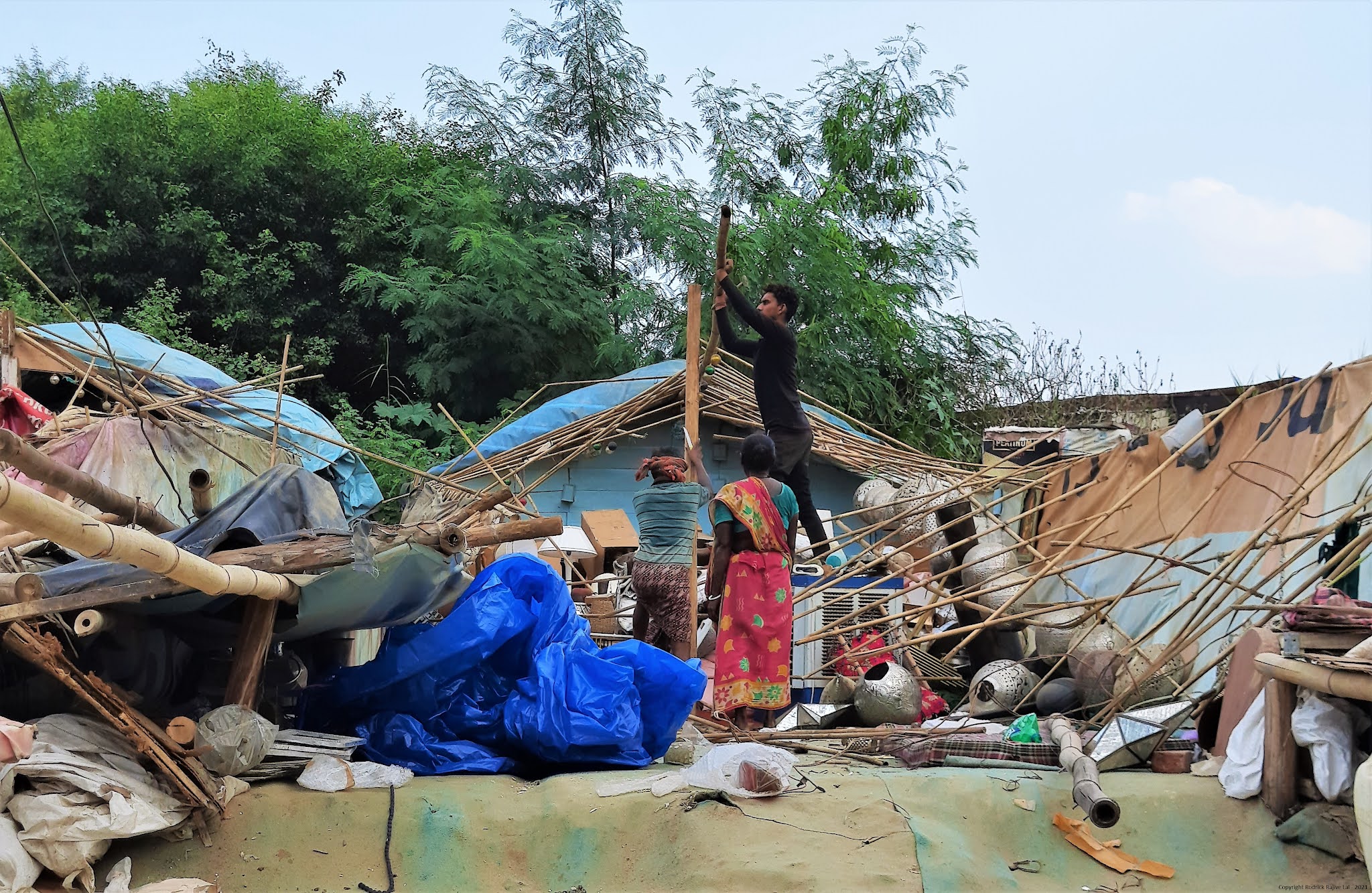
The sense of desolation was palpable and the energy of the stall holders calling out to prospective buyers was missing. It somehow looked as if a bomb had descended on the people. All around I could see people trying to salvage whatever had been left by the administration that had broken their stalls and confiscated the goods they were selling. A most forlorn sight was to see men and women dismantling their stalls, removing supporting structures that had held up the roofs of their stalls and their homes.

Dismantling a home that had sheltered its inhabitants for years

Looking at the desolate stalls and the dejected faces of the people who had once done brisk business one cannot but help feel an intense sadness for them. While one might not blame the administration for the eviction process, one might indeed have hoped for a more humane solution to the problem an acknowledgment of the role that the people running the Banajara had played in promoting traditional art, a yeoman job in recycling products and contributing to the beautification of  the living rooms of the well-heeled!

A curious onlooker looks at the camera even as the stall holders are lost in grief


Thursday, 9 September 2021

Are Men and Women in the Novel Train to Pakistan larger than life?

The Train  To Pakistan presents four male characters out of which three are typical stereotype that exist even today. Out of these, Iqbal, the young man wearing the Sam Browne Belt, Malli the leader of the gang and Jaggut Singh are typical characters. Iqbal and the young man wearing the Sam Browne belt are in fact two sides of the same coin. While Iqbal is the archetypal young man out to change the world through his ideas and Philosophy of social equity, the young man wearing the Sam Browne belt is the typical angry young man who wants to bring a change to the world through violence, bloodshed and revenge. Both, however fail in their tasks, perhaps because of the impractically extreme views they hold about the world. Juggut Singh however stands far apart from both Iqbal and the young man wearing the Sam Browne belt for the very fact that he is the least likely candidate for social fame and glory. A practical minded and down to earth person, he ends up sacrificing himself to save the people travelling on the train to Pakistan. He succeeds in his mission to save the world while the other two fail miserably.

A close look at Iqbal and the young man wearing the Sam Browne belt, reveals them to be most fashionably dressed, with a sound education and a rather distinctive personality. They end up looking rather proud, vain and artificial in nature and they are filled with feeling of contempt for the people they intend to lead to glory. Iqbal, the social worker is out to teach the locals about their rights and motivate them to fight against the injustices to the society meted out by the rich. Yet, he fails to mingle with the villagers of Mano Majra. He carries his own food, his tin of sardines and won't drink the offered milk which has been stirred by a grime stained finger because in spite of everything, he is disgusted by the  lack of hygiene and sophistication. It is rather as if he has set himself out on a mission to educate and emancipate the locals from their rather crude standards of life. This seems rather familiar when compared to what happened when the British attempted to civilize people of the countries they colonialized. A typical westernized nerd, he has set himself out to educate the natives. One of the candidates of Hukum Chand decides to free, he fails to prevent the crowd from gathering at the railway bridge for the massacre of those travelling on the train. Hukum Chand had great hopes from Iqbal, believing that his superior education would help him convince the crowd to spare the people travelling on the train. Iqbal turns out to be the least likely candidate for heroism because ultimately he goes with his mind and decides that self preservation weighed heavier than the glory of heroism. 

The young man wearing the Sam Browne belt instigates the village youth to take up arms so that they can massacre the people travelling on the train to Pakistan. Like Iqbal he too fails in his mission because of the intervention of Juggut Singh. His extreme aggression, vindictiveness, and dependence on violence end up in a loss of face and dignity for him too. People like him and Iqbal turn out to be less successful in their missions because of their extreme views. They are impractical in nature and often thwarted by uneducated people like Juggut Singh. People like Juggut Singh turn our to be the least likely candidates for heroism especially because they are not dressed like heroes, or even look like heroes. Through Juggut Singh, Khushwant Singh is trying to advocate authenticity over artificiality and superficiality. He is celebrating the authenticity of people who are led by the heart rather than the mind, or, perhaps even those who depend too much on their minds.

A third interesting character is Malli. He is  the leader of the gang that murders Lala Ram Lal. He used to be friends with Juggut Singh till they fall out with each other. After the break down in their relationship, they become sworn enemies. Ultimately it all ends up with Malli throwing bangles into Juggut Singh's house to make fun of him. Ultimately, Malli ends up behaving like a devious criminal, the caretaker of the property of the migrating Muslims whose real intention is to acquire it. Malli is later on inducted into the gang of attackers who plan to massacre the people on the train to Pakistan by the young man wearing the Sam Browne belt-a fitting duty for a petty criminal. In the end Malli devolves into a young man looking for some kind of validation of his importance in the society especially when juxtaposed before Juggat Singh who literally beats him to death every time  they come into contact with each other.

Iqbal and the Man wearing the Sam Browne belt can at best be viewed as stereotypes. While Iqbal might be viewed as the typical young man in love with his ideas and philosophy with which he would like to change the world, the young man wearing the Sam Browne belt is the typical angry young man who would like to change the world by force, violence and bloodshed. Both of these men are stereotypes of the young fashionably dressed, dandified youth who have a superior air about them. Iqbal has narcissistic feelings, he is in love with himself, and for him self-preservation is more important than saving the world. The same can be said of the young man who swaggers around mollifying the rather innocent villagers with his rhetoric even as he taps his pistol. He is intoxicated by the influence and power he holds on his men.

Juggat Singh, however is larger than life. He is the village bad character, the good criminal who is led by his heart, the garrulous and boastful man but with a heart of gold. His garrulousness and boastfulness about women is merely what he has imbibed from the society, deemed. probably as being an appropriate instance of masculinity and  prowess. He beats Malli whenever he has the chance to do so. He will never kill anyone who lives in his village. He is larger than life in terms of his physical build. Moreover Juggut Singh becomes the unlikely hero of the novel towards the end when he sacrifices his own life while cutting down the rope that had been strung across the path of the train. His brave action results in the prevention of a massacre that would have led to the deaths of thousands.

While the women in the novel, Train to Pakistan are portrayed as mere objects, passive and subservient in their roles, they are, nevertheless, important influencers of events. They play a rather subtle role in the novel in a society that is dominated by the male psyche. The women in the novel are described as sensual, desirable objects of desire, to be bragged about by the men who have been in contact with them. Sundari, about whom not much has been written is the unlucky victim of a mob frenzy, helpless and unlucky, she becomes an object  of revenge, desecrated of all that is human. She becomes little more than spoilt goods, broken bangles that have lost their symbolism of the auspiciousness in matrimony. Khushwant Singh probably did not want to dwell too much on her because he was probably already done with passing on his message.

The women in the novel, Train to Pakistan are unlike the young men, more subservient, objects of desire or even targets of frustration. Hasseena, the dancing girl and the underage prostitute who a regular guest at the Dak Bungalow is an object of desire for Hukum Chand, the  Magistrate and Deputy Commissioner of Mano Majra. Their relationship is a rather complex one especially as Hukum Chand probably sees her as a mother figure and a daughter he has never had. Going beyond the obviously carnal relationship, there seems to be another more platonic relationship. Although Hasseena has been objectified, she, however does play an important role in the novel. While she might not have an actual active role in the novel, she does however influence Hukum Chand's decision regarding the release of Iqbal and Juggut Singh from jail. His concern for the welfare of the passengers travelling on the train to Pakistan is because Hasseena is travelling on it. Some of the women in the novel though passive players in the plot do bring out the best in their men. 

Nooran, another rather passive character in the novel also influences Juggut Singh's actions towards the end of the novel. It is because  of her that Juggut Singh decides to prevent the massacre of the Muslims travelling on board the train. Like Hasseena, Nooran too brings out the best in Juggut Singh. It is because her that Juggut Singh has turned away from serious crime. He has broken up from Malli's Gang and leads a more 'domestic' life. 

Both Nooran and Hasseena are also larger than life especially because they are symbols of hope for humanity. Nooran is carrying Juggut Singh's child who will be born in safety. Their child will be a symbol of hope in a world of chaos and disruption a possibility of the two communities coming together in the future. Hasseena too is a symbol of hope a celebration of life and survival amidst the tumult of hatred and irrationality.

Sundari, unfortunately, also becomes larger than life, not as survivor but as a victim of mob violence, a grim reminder of what an irrational and hate-filled mob can do to innocent people.

Saturday, 21 August 2021

We Are Not Machines - A Poem


We are not machines, we love to 
Watch the sun set in the sky,
Blazing in all his glory,
Before the day ends.

We love to pause a while, to
Sip on a cuppa tea and just
Watch the world rush by in
All its madness!

We are not machines, we love to
Watch  pets doze, slack-mouthed,
Not caring about future plans,
Timelines and targets.

We love to pause a while to
Dream of flying in the sky,
Watching the world grow grow
Smaller and smaller!

We are not machines, we want to
Live our lives, to dream and aspire,
We like to  pause and wait even as
The mad world rushes by.

We love to gossip and chat, to
Joke with friends and foe in the
Corridors, even as others rush by
So what if we're a minute late?

We are not machines, we're vulnerable to
Stress and breakdown, we need our
Moments of rest to laze and doze,
While the world rushes by!

We love to watch flowers, to
See them sway in the morning breeze,
An epiphany of spirituality and joy,
So what if we get late to work.

We are not machines, we love to
Take breaks and pauses, we like shifting
Gears, we love change and thrills,
So let the world snare itself!


Saturday, 7 August 2021

Simulacrum-A Poem


First, we laughed at those in masks,
Only to wear them ourselves! A cough sent us running for cover,
Fearing droplets of plague. And then it struck - young and old, healthy
And weak alike!


We squabbled for Oxygen to breathe,
Figured out saturation levels and learned of what the virus could
Do, that a deadly blow had dealt. A great leveler it was, that brought down the rich
And poor.


Many left before time, still in their prime, hearty
Souls full of life, crashing to the ground without a whimper. Grim 
Tales of sadness and grief not seen in a world so advanced! A world alas, ruled by
Arrogance.


After a  year we thought we were done. Alas! With
Vengeance it returned, rearing an ugly head, Reaper with his scythe,
Gathering a rich harvest! First those we knew less, and then those we cherished and loved
Drawing tears.


Joyful reunions turn into grief, smiles into grimaces. We
Grapple with emotions of shock and despair, remember those we 
Celebrated happy moments with. Lives end up in a mad search for Oxygen and
Vaccinations.


Our homes are adorned with cylinders and gadgets, 
Prizes of a year gone by. Those who survive wake up to a world,
Bleak, bereft of loved ones, grim reminder of our frailty! Now only memories remain of
The world that was.


It has been more than a year of staring at flickering screens
Virtual worlds, simulations of places and faces trying to figure out 
Reality. We have lost our touch, and voices that pour of speakers sound tinny and disjointed-
Buffering!


We live in a fantasy world of pixels and bytes, knowing not
Differences between simulation and reality! The reel has become real
And the real has become a reel even as we try to grapple with the reality of our lives,
Simulacrums.


Arrogance and ignorance, greatest faults, we paid a
Price for. If only we had prepared for it better, these cries of pain and
moments of mourning would not have drowned the cheerful sounds of celebrations and
Reunions!


Wednesday, 21 July 2021

Protaetia Alboguttata Beetles Spotted in Gurugram

The rainy season brings with it many surprises, some exciting and some, well not so, especially when it comes to getting drenched. While last year the rains brought in hordes of bees of all kinds, this year it was a number of greenish-blue metallic beetles with white/cream coloured spots on their bodies. After doing some research I came to understand that these beetles might be the Protaetia Niveoguttata beetles but then later was informed by Dr. Saraswat a well known Scientist that these were more likely Protaetia Alboguttata Beetles While most of the information was rather scarce and focused on sightings made in Thailand, other information speculated on this beetle's relationship with the Scarab beetle.

While I would leave all the speculation to the experts, I will nevertheless gloat about how I used a 40mm prime lens to capture these exotic beetles, that too without a tripod. The Canon pancake 40 mm STM lens does not have image stabilization and so taking macro shots becomes a task indeed. Fortunately for me, the prime lens I used for these snaps is a fast enough f-2.8 lens allowing me to take hand-held snaps with a fast enough shutter speed!


I mostly shoot in the RAW format but this time I shot JPEGs as I was not very sure I needed high resolution shots. Incidentally I used an older camera, a Canon 1300D for these snaps. The results when they came out happened to be better than expected. These snaps were taking in morning in my front yard which has abundant greenery for insects to thrive on. It was indeed a change from having to photograph birds in flight, having stuff to photograph without having to travel to the nearest wetland.


Somehow, it makes me wonder why there is so little data about this particular beetle, especially as I have noticed an abundant number of these beetles in Gurugram, the city where I live. I have reason to believe that the Protaetia Alboguttata Beetles are commonly found all over India, especially the North.


A dorsal view of the beetle photographed by me suggests that the beetle in the above photographs is the Proataetia albogutata beetle. It was a challenge to take a dorsal photograph of the beetle as it was constantly on the move.