Showing posts with label Sultanpur Bird Sanctuary. Show all posts

Saturday, 29 December 2018

Ferruginous Duck, Spoonbill and Northern Shoveler Ducks spotted at the Sultanpur National Park

Ferruginous Duck

Ferruginous Duck


Saturdays seem to be a good day to visit the Sultanpur National Park a few kilometres from Gurgaon. The best time to gain entry into the park is, of course, is early in the morning, at about 7:00 a.m. The migratory birds have started arriving in large numbers and I could find a few new species in a span of a week! This time I was able to spot a Ferruginous Duck, a Spoonbill, a Red-Breasted Flycatcher besides the regular Spotbill Ducks and Common Teal!

Spoonbill

Large birds apart, it is the smaller, native species, however, that seems to draw your attention, like for example this Munnia that had grass seeds sticking to its bill, or perhaps the Robin that seemed to like posing for the camera!

Munnia

Red-Breasted Flycatcher

Ferruginous Duck, well that seems to be a rather strange name. The rather red head contrasts strongly with the rather bright eyes!

Ferruginous Duck

Northern Shovelers, Pintails, Spotbills are regular visitors of the Sultanpur Bird Sanctuary. One might also spot the Shikra or the Indian Falcon besides the Asian Antelopes that are residents of the National Park.

Shoveler Duck


Shikra (Falcon)

Spot-Bill Ducks


Friday, 30 March 2018

Sarus Cranes Spotted at the Sultanpur National Park


While going through my photographs that were taken at the Sultanpur National Park a few kilometres from my home in Gurgaon, I came across a few more snaps of a couple of Sarus Cranes that were good to share. I had not known that they existed because they had been in a lot that I had overlooked. I guess, this is what happens when you get to take too many photographs of the same bird. Nevertheless, the intimacy and the courtship ritual displayed in the photographs are worth a relook. The Sarus Crane, Antigone antigone is a large non-migratory bird found in the South Asian continent and Australia. These are incidentally huge birds reaching a height of five feet eleven inches! Their red head contrasting with their grey bodies makes for a study in natural aesthetics. These handsome birds have been the subjects of many medieval paintings. I saw recently a painting of a pair of Sarus Cranes with an inscription in what I believe was Urdu or perhaps Farsi at my uncle's home recently. These birds, unfortunately, are facing extinction, what with a lopsided contest with human beings for space. Sarus Cranes are revered in Indian Mythology and they are revered and respected by people in India.


Sarus Cranes mate for life and their fidelity is a lesson for everyone! I was able to somehow edge very close to them moving through the thick grass, and when we came face to face, I wonder who was more surprised the cranes or me! Immediately on spotting me, the cranes started to do an odd kind of dance. The male, I presume because of his height and size began to dance aggressively in what could be either an act of aggression or perhaps a show of his love for his lady, that too in front of me.


Sarus Cranes pairs imitate each other's movements and they make the same kind of sounds as if singing a duet! I wouldn't, of course, claim that they have a melodious voice; they create a ruckus when they sing and it is startling enough! I guess because of their size they have little to fear!


The male is the more dominant of the pair, and he is the one who leads, whether it is in dancing or making a move or even initiating the song!


As you might see, the female of the pair is smaller and more delicate than the male! She seems to be the more passive of the two and seems to be happy to follow her mate's orders! The Sarus Crane pair build up their nests on a pile of twigs and stubble close to the water level. The nest is protected at all times and though the eggs and the hatchlings are perhaps most vulnerable till they gain in size. As you can see from the snaps, Sarus Cranes are to be found in wetlands, and paddy fields and their diet consists of whatever they can forage from the shallow water bed and the undergrowth. Their diet consists of roots, tubers, insects and crustaceans. These birds can be found in wetlands and marshes all over the northern part of India.


I can only hope that conservationists and Government organisations take definite steps to protect this species from total extinction. The dwindling number of wetlands in the country is a matter of concern. Today wetlands and marshlands are being drained out to make space for building projects. Whatever wetlands exist as protected spaces, continue to be threatened by the very fact that water runoff from rains has been severely cut off by building projects that come up around protected wetlands. If we don't take up immediate steps to conserve our wetlands, then surely all that will remain of these majestic birds are these photographs!


Sunday, 4 March 2018

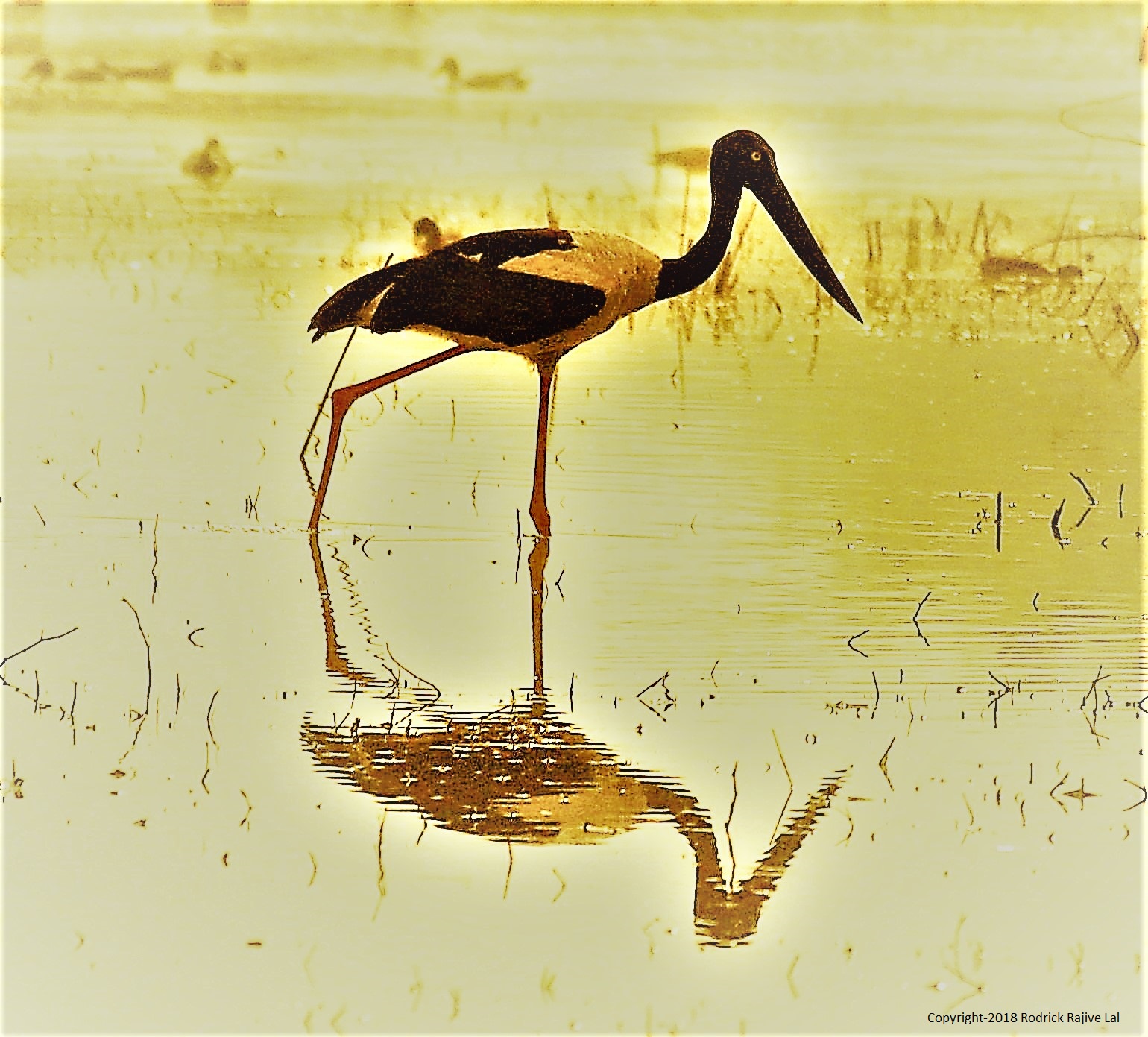
The Black Necked Stork


This time when I last visited the Sultanpur Bird Sanctuary close to Garhi Harsaru, Haryana, I was able to spot quite a large number of birds, especially red-billed geese, Sarus cranes, and ducks, different species of ducks. What struck me the most, however, was a Black Necked creating some of the most elaborate stances, all angles and corners even as he fed on the lake. The silhouettes this fellow created were some of the most striking ones. I knew from the very moment that I clapped my eyes on him, I would aim for silhouettes. I have pasted a few of them below:


The Black Necked Stork seems to be a solitary bird that is happy in its own company. Looking at the next snap, one would wonder if the Black Stork might not also be a bit of a Narcissist! I guess the golden cast of the snap adds to the effect!


But then, Narcissism apart, one would certainly not deny the fact that this is one of the most majestic birds one might see. The stance, head held high, one foot at right angles to the torso, the proud head, and the general demeanour suggests that the Black Necked Stork is indeed, not to be trifled with!


Sunday, 25 February 2018

Courtship Ritual of Sarus Cranes


The photograph below was taken in September 2019. It shows a couple of Sarus cranes serenading, or dancing and singing in perfect unison. This is an amazing sight for all. The two birds are so perfectly synchronised that one might be confused about what one is actually seeing. I have never seen such a photograph, that too from such an angle in the whole world of photography, at least not yet! To appreciate the photograph, click on it and try to zoom in!


Just yesterday, the 24th of February I was able to get really close to a pair of Sarus Cranes that were courting at the Sultanpur Bird Sanctuary. It was simply out of this world! Sarus Cranes, Scientific name: Antigone antigone, pair for life! These birds are endemic to India. They are huge birds and have a red band around their heads. Needless to say, these are very beautiful and majestic birds. I would suggest that there is a lot we can learn from them, especially that one should continue romancing one's beloved all one's life!


The photograph I have posted below was taken much later in September 2019 when I got to visit the Sultanpur National Park. Needless to say, it was a most spell-binding enthralling and mesmerizing display of love and togetherness! For some reason, my latest photographs are not being listed by Google, nor are my posts so I decided to post these latest photographs for the benefit of my readers.


For more: