 |
| These Symbols will make things easier! |
It is important for students of all grades and subjects to develop skills in note-making and note-taking. Developing sound Note Making skills can be the key to understanding comprehension passages, treatises and many other texts. Although the CBSE has removed note-taking in Grade twelve for the session 2020-2021, it is important to note that simply ignoring note-taking skills can be highly detrimental. Note-taking helps you identify the key points in the passage, and it helps you break up the passage into its key components. Developing note-making skills helps you summarise what you have read in roughly one-third of the number of words used in the passage. The Summary, which follows after you have written down the notes, is the final step in note-taking. Note-taking and summarising are two important skills that should be taught in earlier grades, like eighth and ninth. Note-making is an essential tool that helps students understand difficult treatises, passages and research passages in different subjects, not just English.
Learning Tasks:
1. The whole passage is read quickly and then the student tries to identify the Key Paragraph that contains the Nucleus Sentence. It is from the key paragraph that the student is also able to draw a title. In many cases, the key paragraph might be the first paragraph.
2. The passage is then divided into headings and subheadings ( I, II,III, IV, V, or 1,2,3,4,5). The numbers are listed on the outside of the margin.
3. Supporting sub-points are then listed in numerical order (1, 2, 3 under the first heading, then 1, 2, 3…etc. In some cases, there might be sub-subpoints where points might be listed as 1.1., 1.2., and sub-sub-sub 1.1.1., 1.1.2., 1.1.3., …etc. Depending on how these sub-subpoints develop. The numbers are listed inside the margins.
4. The students will use recognisable abbreviations and symbols in order to write down the notes in a contracted form.
5. The next task, following the note-making exercise, will include the drafting of the summary based strictly on the notes prepared by the student. The student should note that the word limit should not be exceeded, as marks will be deducted. Also, students should avoid repetition of ideas and make good use of sentence connectors to join sentences, thus avoiding too many repetitions of words.
Important Note: Generally, each paragraph is devoted to one topic. However, the same topic might be shared by one or more paragraphs. In such a case, students can merge two or more paragraphs under one topic sentence.
Important Note: Generally, each paragraph is devoted to one topic. However, the same topic might be shared by one or more paragraphs. In such a case, students can merge two or more paragraphs under one topic sentence.
The marks distribution for the twelfth board CBSE paper is as follows:
1. Title: 1 mark
2. Notes ( at least three headings and the notes under them):2 marks (Content 1 Marks + 1 Mark Coherence) Coherence refers to the listing, alignment, overall neatness.
3. List of abbreviations (minimum 4) in a box: 1 mark
4. Summary: 4 marks
Important: the final notes will be in the form of a linear listing of points, or in a branched format. A typical note-taking exercise in the linear format will look as follows:
Title:
1. Nucleus Sentence
1.1 sub- point
1.2 sub- point
1.3 sub- point
2. Topic Sentence
2.1 sub- point
2.2 sub- point
2.3 sub- point
3. Topic Sentence
3.1 sub-point
3.2 sub-point…and so on.
Important: Remember that notes that come under the headings (sub-points) cannot be written as sentences. Notes should be written only as phrases. As such, one needs to remember that full stops will not be used. Also, ensure that each sub-point is short and doesn't run into more than one line at the most!
Important: Remember that notes that come under the headings (sub-points) cannot be written as sentences. Notes should be written only as phrases. As such, one needs to remember that full stops will not be used. Also, ensure that each sub-point is short and doesn't run into more than one line at the most!
Important Tips
The length of the notes will depend upon the length of the passage. The student will avoid noting down points which are being repeated for the sake of brevity. Also, use recognisable abbreviations, and avoid the use of articles, prepositions and conjunctions. This, however, does not mean that your notes are vague to the reader. Your notes should make sense to the examiner when he or she goes through them. Also, remember that you are not allowed to use sentences in note-taking. You need to identify the main points and not entire sentences. You need to have a minimum of three main headings. You need to have a minimum of four abbreviations. Remember to indent the notes properly.
Standard recognizable abbreviations for countries include U.P. U.K.
Standard abbreviations for titles include: Mr, Mrs, Ms, Dr, Messrs...etc
Common symbols include: &, +ve, -ve, >,<, ...etc
Common measurements: kg, lb, sq.ft. mm, ml, ...etc.
Standard recognizable abbreviations for countries include U.P. U.K.
Standard abbreviations for titles include: Mr, Mrs, Ms, Dr, Messrs...etc
Common symbols include: &, +ve, -ve, >,<, ...etc
Common measurements: kg, lb, sq.ft. mm, ml, ...etc.
The Passage given below is in the form of an example. Go through it carefully and see how the Headings have been listed, followed by their supporting value points:
Strategic planning is typically thought of in terms of how large businesses and nations design a plan of action to accomplish their specific goals -- but it is a fabulous tool for individuals as well. If you find yourself disappointed by your life, consider taking a look at how strategically you are living it.
Some people worry that being strategic is about being manipulative. Certainly, there is a fine balance between passivity and trying to live life according to the "my way or the highway" approach to influencing the course of events. I think of being strategic as actively engaging in shaping and directing your life. It is about being thoughtful, careful, and purposeful -- the antithesis of simply drifting along being caught up in whatever situations and circumstances you happen to bump into in the course of your life. Strategic living means being smart enough to embrace the opportunity of playing an active role in determining what you are creating, promoting and allowing in your life.
If you were investing in a business, wouldn't you want to know that it was being run by individuals who were well-versed regarding the opportunities and challenges they faced? Wouldn't you want them to use their resources (people, money and time) in such a way that they maximised the company's short- and long-term return on investment? Most likely, it would be important to you that these returns be measured not just in terms of money, but relative to such other factors as alignment with the company's mission, and their commitment to such values as integrity, social consciousness and the quality of their relationships with employees and other stakeholders.
Now, let's apply this thinking to how you assess your own life choices. Being strategic is about getting off autopilot behaviour and being thoughtful about the choices you make in your life. It means living within the context of having a good understanding of who you are, what matters to you, and what resources and options you have available.
As a life coach, I work with this perspective as a means of increasing my clients' self-awareness, well-being, enjoyment and creative self-empowerment. Making thoughtful and strategic choices about how you live your life can have an enormous impact on your level of satisfaction and enjoyment.
There are three fundamental, ongoing, and interrelated activities involved in strategically living your life. They are: creating a plan, keeping track of results and altering your course based on those results and the unanticipated surprises life brings your way. A good strategist needs a great sense of humour and an appreciation for the power of the unknown because no matter how thoughtful and thorough your planning techniques, life will throw you curveballs. It's humbling, but the alternative of having no plan means being at the mercy of your life rather than being an active participant and driving force.
There are three fundamental, ongoing, and interrelated activities involved in strategically living your life. They are: creating a plan, keeping track of results and altering your course based on those results and the unanticipated surprises life brings your way. A good strategist needs a great sense of humour and an appreciation for the power of the unknown because no matter how thoughtful and thorough your planning techniques, life will throw you curveballs. It's humbling, but the alternative of having no plan means being at the mercy of your life rather than being an active participant and driving force.
Our lives tend to be very complex and to include conflicting priorities and demands on our time. A seasoned life strategist is like a juggler trying to simultaneously stay on course with specific plans for each major aspect of his or her life. For example, you might have plans for your spiritual life, family, career, finances, etc. For a novice planner, I suggest picking one area of your life where you are experiencing the greatest challenges and starting there. As you stabilize one area of your life, develop a plan for another aspect and learn to develop skills in making the trade-offs that are necessary between the various aspects of your life.
(This article, written by Judith Johnson was posted on “The Blog, Huff post-Healthy Living” on 09/26/2013 12:17 pm)
Task 1: Identifying a suitable title from the passage
The importance of Strategic Planning
How we benefit from Strategic Planning
Benefits of Strategic Planning
Benefits of Strategic Planning
Important Note: Avoid single-word titles. There should be a minimum of at least two words. Remember, your titles are important. Vague titles indicate confusion.
Task 2: Write notes under each heading from the passage
1. What is Strategic planning?
1.1 plan of action
1.2 tool for large org. & nations
1.3 tool for ind.
2. Why is Strategic Planning important for people?
2.1 helps bal. b/w passivity & trying to live acc.
2.2 Antithesis to simply drifting
2.3 smartness to embrace opportunities
3. Importance of Strategic Planning in Business
3. Importance of Strategic Planning in Business
3.1 provides knowledge about employees
3.2 maximise short/long-term investments
4. Three fundamental steps in Strategic Planning
4.1 Creating a plan
4.2 Keeping track of results
4.3 Altering course based on results
5. How can we plan for complexities in life?
5.1 Pick one area of life which is most challenged
5.2 Start planning for it
5.3 When you stabilise that area, dev. plan for another aspect
5.4 Learn to dev. Skills in making trade-offs b/w various aspects of life
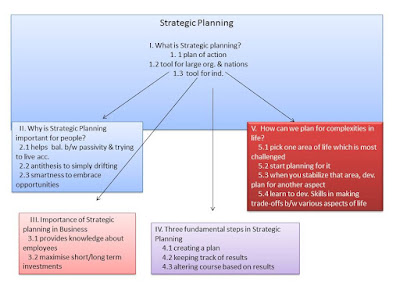
One example of the branched format for note-making is given as follows:
Title: Strategic Planning

There are interesting ways of making notes, but then, if it is about appearing for a specific exam, then the student will have to enquire about the formats that will be accepted by the examiner. Generally, the CBSE accepts the linear form of making notes.
Task 3: Draw a list or key for the abbreviations used by you in your notes
List of abbreviations:
1.b/w : between
2.ind. : individual
3. acc: according
4. dev. : develop
5. inv. : investment
Task 4: Draft a summary of the notes you made
Write the summary in a specific number of words. In this case, the total number of words is a hundred and twenty. Note: remember to write the summary from the notes you have made, and try to stick to the word limit. The grid is for representational purposes and it can be drawn with a pencil and then rubbed off! Drawing a grid will help the student to stick to the word limit and a quick calculation will determine the number of rows and columns required. In this case, the student is required to write a summary in 120 words, so eight columns and fifteen rows will give you 120 boxes in which you can write 120 words. The advantage of using a grid is that it guides you about the number of words you have written without making you pause and count each word! You get a visual feel about how much space is left. To keep the summary short, avoid repeating ideas, use connectors like and, which, because, since, however, to join sentences.
Strategic
|
planning
|
refers
|
to
|
a
|
plan
|
of
|
Action.
|
It
|
Is
|
an
|
important
|
tool
|
used
|
by
|
large
|
organisations
|
industries
|
nations
|
and
|
Individual.
|
It
|
Is
|
important
|
because
|
it
|
provides
|
a
|
balance
|
between
|
passivity
|
and
|
living
|
according
|
to
|
Plan.
|
Strategic
|
planning
|
leads
| |
to
|
smartness
|
in
|
embracing
|
Opportunities.
|
Planning
|
Is
|
important
|
in
|
business
|
because
|
you
|
need
|
to
|
know
|
the
|
individual
|
and
|
you
|
need
|
to
|
maximise
|
Short-term
|
and
|
Long-term
|
Investments.
|
The
|
three
|
fundamental
|
activities
|
in
|
planning
|
include
|
creating
|
a
|
plan,
|
keeping
|
track
|
of
|
results
|
and
|
altering
|
course
|
based
|
on
|
results.
|
One
|
can
|
plan
|
for
|
a
|
complicated
|
life
|
by
|
picking
|
up
|
an
|
area
|
of
|
life
|
that
|
is
|
most
|
challenged
|
and
|
starting
|
to
|
plan
|
for
|
specific
|
areas.
|
When
|
one
|
area
|
is
|
Stabilized,
|
start
|
on
|
the
|
other!
|
Total: 120 words
Important tips for the summary:
The summary is made up entirely of the notes.
Paraphrase rather than copy the exact words of the author of the passage.
Use liberal use of linkers or connectors to reduce repetitions.
Don't compromise on fluency.
Write complete sentences, avoid using abbreviations and symbols.
Use third-person narration, indirect speech and past tense where required.
Supply a suitable title, not in one word, but at least a couple of words or a phrase.
Do not exceed the word limit of 80 words.
Exercise 1
Read the following passage carefully:
Important tips for the summary:
The summary is made up entirely of the notes.
Paraphrase rather than copy the exact words of the author of the passage.
Use liberal use of linkers or connectors to reduce repetitions.
Don't compromise on fluency.
Write complete sentences, avoid using abbreviations and symbols.
Use third-person narration, indirect speech and past tense where required.
Supply a suitable title, not in one word, but at least a couple of words or a phrase.
Do not exceed the word limit of 80 words.
Exercise 1
Read the following passage carefully:
By Jen Laskey/Medically reviewed by Sanjai Sinha, MD
1. Did you know that your body weight is approximately 60 per cent water? Your body uses water in all its cells, organs, and tissues to help regulate its temperature and maintain other bodily functions. Because your body loses water through breathing, sweating, and digestion, it's important to rehydrate by drinking fluids and eating foods that contain water. The amount of water you need depends on a variety of factors, including the climate you live in, how active you are, and whether you are experiencing an illness or have any other health problems.
2. Water does more than just quench your thirst and regulate your body's temperature; it also keeps the tissues in your body moist. You know how it feels when your eyes, nose, or mouth get dry! Keeping your body hydrated helps it retain optimum levels of moisture in these sensitive areas, as well as in the blood, bones, and the brain. In addition, water helps protect the spinal cord, and it acts as a lubricant and cushion for your joints.
3. Adequate water intake enables your body to excrete waste through perspiration, urination, and defecation. The kidneys and liver use it to help flush out waste, as do your intestines. Water can also keep you from getting constipated by softening your stools and helping move the food you've eaten through your intestinal tract. However, it should be noted that there is no evidence to prove that increasing your fluid intake will cure constipation.
4. Digestion starts with saliva, the basis of which is water. Digestion relies on enzymes that are found in saliva to help break down food and liquid and to dissolve minerals and other nutrients. Proper digestion makes minerals and nutrients more accessible to the body. Water is also necessary to help you digest soluble fibre. With the help of water, this fibre dissolves easily and benefits your bowel health by making well-formed, soft stools that are easy to pass.
5. Your body loses fluids when you engage in vigorous exercise, sweat in high heat, or come down with a fever or contract an illness that causes vomiting or diarrhoea. If you're losing fluids or for any of these reasons, it is important to increase your fluid intake so that you can restore your body's natural hydration levels. Your doctor may also recommend that you drink more fluids to help treat other health conditions, like bladder infections and urinary tract stones. If you're pregnant or nursing, you may want to consult your physician about your fluid intake because your body will be using more fluids than usual, especially if you're breastfeeding.
6. There's no hard and fast rule, and many individuals meet their daily hydration needs by simply drinking water when they're thirsty, according to a report on nutrient recommendations from the Institute of Medicine of the National Academies. In fact, most people who are in good physical health get enough fluids by drinking water and other beverages when they are thirsty, and also by drinking a beverage with each of their meals, according to the Center for Disease Control and Prevention. If you are not sure about your hydration level, look at urine. If it is clear, you are in good shape. If It is dark, you are probably dehydrated.
1. Prepare notes on the above passage. Remember to supply a suitable title for the passage. (4 Marks)
2. Draft a summary in not more than 100 words for the above passage. (4 Marks)
There are some more passages for practice below.
Read the following passage
carefully and answer the questions that follow.
1. How does television affect our lives? It
can be very helpful for people who carefully choose the shows that they watch.
Television can increase our knowledge of the outside world; there are high-quality programmes that help us understand many fields of study, science,
medicine, the different arts and so on. Moreover, television benefits very old
people, who can’t leave the house, as well as patients in hospitals. It also
offers non-native speakers the advantage of daily informal language practice.
They can increase their vocabulary and practise listening.
2. On the other hand, there are
several serious disadvantages of television. Of course, it provides us with a
pleasant way to relax and spend our free time, but in some countries, people
watch television for an average of six hours or more a day. Many children stare
at the TV screen for more hours a day than they spend on anything else,
including studying and sleeping. It’s clear that TV has a powerful influence on
their lives and that its influence is often negative.
3. Recent studies show that after
only thirty seconds of television viewing, a person’s brain ‘relaxes’ in the same
way that it does just before the person falls asleep. Another effect of
television on the human brain is that it seems to cause poor concentration.
Children who view a lot of television can often concentrate on a subject for
only fifteen to twenty minutes. They can pay attention only for the amount of
time between commercials.
4. Another disadvantage is that
television often causes people to become dissatisfied with their own lives.
Real-life does not seem exciting to these people. To many people, television
becomes more real than reality and their own lives seem boring. Also, many
people get upset or depressed when they can’t solve problems in real life as
quickly as television actors seem to.
5. Before a child is fourteen
years old, he or she views eleven thousand murders on TV. He or she begins
to believe that there is nothing strange about fights, killings and other kinds
of violence. Many studies show that people become more violent after viewing
certain programmes. They may even do the things that they see in a violent
show.
1. Prepare notes on the above passage. Remember to supply a suitable title for the passage. (4 Marks)
2. Draft a summary in not more than 100 words for the above passage. (4 Marks)
Read the passage carefully and answer the questions that follow.
1. Some people say that the best defence
is a good offence; an octopus, however, would disagree. In addition to being
one of the strangest and most beautiful creatures in nature, the octopus has
some of the most inventive and effective defence mechanisms imaginable. While
other animals have teeth, horns, or claws to help defend themselves from predators,
the octopus concentrates its energy on hiding from and confusing its attackers.
When it wants to get away, the octopus has an impressive arsenal of tricks at
its disposal.
2. The most well-known of the
octopus’s defence mechanisms is its ability to squirt clouds of ink into the
water. Some octopi use this cloud of ink as camouflage; after squirting the
ink, the octopus retreats into the ink cloud, where the predator cannot see it.
Other octopuses use the ink cloud as a decoy. If a large, intelligent predator
such as a shark knows that octopi use ink clouds for camouflage, it might
simply attack the ink cloud blindly, hoping to make contact with the octopus
inside. However, some sneaky octopi will release the ink cloud in one
direction and scurry away in another direction, leaving the predator with
nothing but a mouthful of ink. In addition to confusing predators’ sense of
sight, these ink clouds also confuse their sense of smell. The ink is composed
primarily of melanin (the same chemical that gives human skin its colour),
which can shut down a predator’s sense of smell. If an octopus cannot be seen
or smelled, it has a much higher chance of escaping an attack.
3. Camouflage, another defence mechanism
possessed by many octopi, refers to their ability to change colour, much like a
chameleon. Most animals get their skin colour from chemicals in the skin called
chromatophores (melanin is one of these chromatophores). Chromatophores might
contain yellow, orange, red, brown, or black pigments, and the amount of each
pigment present in the skin determines an animal’s colour. While most animals
are always the same colour, some species of octopi can control the amount of
each colour pigment in their skin cells, allowing them to change colour. Some
poisonous octopi, when provoked, will change their skin to a bright,
eye-catching colour to warn predators that they are dangerous and ready to
strike. Other octopi use this ability to change their skin to the colour and
texture of seaweed or coral, allowing them to blend in with their environment.
Finally, some octopi—such as the mimic octopus—use this colour-changing ability
to masquerade as another type of animal. The body of an octopus is highly
flexible, and some species can combine this flexibility with their
colour-changing skills to make themselves resemble more dangerous animals such
as sea snakes or eels.
4. Yet another defence mechanism
possessed by some octopus is the ability to perform autotomy, or self-amputation,
of one of their limbs and regrow it later. Many species of skink and lizard
also possess this ability, which allows them to shed their tails when caught by
a predator and therefore get away. When a predator catches a tentacle, the
octopus can amputate this tentacle, thereby unfettering itself, and regrow the
tentacle later. Some octopus, however, are even cleverer. When threatened by a
predator, these octopi will shed a tentacle before being attacked in the hope
that the predator will go after the detached tentacle rather than the octopus
itself.
5. While the octopus may not be
the most vicious creature in the ocean, its numerous and clever defence
mechanisms help it to survive in the dangerous undersea world.
1. Prepare notes on the above passage. Remember to supply a suitable title for the passage. (4 Marks)
2. Draft a summary in not more than 100 words for the above passage. (4 Marks)
III. Read the following passage
carefully and answer the questions that follow.
1. Given the general awareness of the woeful condition of our State
schools, it would be surprising to find someone not engaging a private tutor or
two, if he could afford it. We, the urban, articulate and decision-making top
5% of Indians, perfectly understand why only the rarest of rare among our
politicians and bureaucrats send their children to a state school. They’re not
for people like us; they’re for people like them. And so, in 21st-century India, we are immune to the fact that the vast majority of Indians will
be educationally deficient, uncompetitive in most contemporary skills and quite
unable to raise their standards of living through the straight route.
2. Our complacency does not get shaken by the alarming rate of growth
of the private tuition industry. This industry is exploiting the mediocrity
that has spread even to our private schools. Attempts by the state governments
to ban private tuition have failed because the schools’ managements don’t
cooperate. Indeed, they often sabotage these moves. The common practice is to
first deny the teachers their just wages and then look the other way when they
try to make it up by giving private tuitions. In some states, teachers are
forced to sign bonds that bar them from giving private coaching, but this
promise remains on paper.
3. Parents are both perpetrators and victims of this pernicious system.
The hedonism bred by free-market principles has led to the commodification of
education. Those who can afford it, recruit private tutors because it gives
their children an edge in competitive examinations. The vast majority of people cannot afford
tuition and, therefore, fall behind. The national objective of the society,
where every child gets equal opportunity, is lost.
4. When the NCERT began working on developing a new National Curriculum
Framework in 1999, one of the objectives was that the course content should be
set keeping in mind contemporary realities and global trends. To have both
parents working is more the norm than the exception in modern India. The
pressures of the workplace don’t allow mothers the time to assist their
children anymore. To prevent young parents from falling into the tuition trap,
several steps, including the introduction of grades in place of marks, were
recommended. Long-forgotten recommendations made on education, like the Yash
Pal Committee’s report of 1990, which recommended lighter school bags, were
brought out of the backburners.
a) Based on your reading
of the above passage, make notes on it using headings and subheadings. Use
recognisable abbreviations (minimum four) and a format you consider suitable.
Supply a suitable title for it. 5 Marks
b) Make a summary for your passage based on your notes 3 Marks


