Tuesday, 28 February 2017
The Mask Photo by Rodrick Lal -- National Geographic Your Shot
The Mask Photo by Rodrick Lal -- National Geographic Your Shot: This is a snap taking of a procession which was taken out on the road in front of my house on the occasion of Maha Shivratri. I thought that the sleeping man in the background made a good contrast to the person in the mask.

Sunday, 26 February 2017
Flower Decoration Photo by Rodrick Lal — National Geographic Your Shot
Flower Decoration Photo by Rodrick Lal — National Geographic Your Shot: This time when I visited the HUDA flower show at the Leisure Valley park in Gurgaon, I came across this exhibit in which the flowers were arranged to look like a dog. I found it interesting and wanted to share it with a wider audience.
Fun with Close-up and Macro Photography

It goes without saying that Macro photography can be real fun, especially because you look at things from a completely different angle and perspective. You see things that are not commonly seen and realise how beautiful life can be in its tiniest form! I used a Canon 1100D DSLR camera and a 40 mm f-2.8 STM lens, just to see how well it was into macro photography. The major disadvantage I had with this lens was that I had to step really back in order to get the object into view. This is not a problem I face with my 18-55 mm kit lens.

A close-up photograph of a couple of flowers at the 2017 HUDA Flower show revealed the ubiquitous fly sitting on top of one of them. I decided to keep it rather than trash it.

The stamens and pistil of this flower have come out nicely. If you double click on the same, you will be able to enlarge the photograph further.

A close up of these flowers shows all the intricate details, remarkable, I guess because these were all hand-held snaps.

The Pistil and the stamens of this flower have come out very nicely, though the soft and muted tone has been caused by the diffused lighting caused by the white cloth tent covering. If you double-click on the snap, you will be able to expand it further.

The shallow depth of field makes this snap interesting and I have added it because of the effect it has created with a blurred background and a sharp focal point upwards.

Talking of a shallow depth of field, this is yet another example of I deliberately tried to create a shallow depth of field by taking the smallest f-stop number, and an increased shutter speed to compensate for over-exposure.

A clash of colours, rather like a painting, a surfeit of yellows and pinks, suitably brings out the colours of the Autumn season. It seems to be poetry written in images. They say, a picture can say a thousand words, I would say that a picture can convey the message of a thousand books!

A rose in all its glory beginning, however, to whither away. There is something compelling about the stand this flower is making.

.
A botanist would probably call this love in C-Minor, the Pistil and Stamens have come out beautifully. The lighting was tricky in this case as the white cloth covering the tent frame seemed to be diffusing the light in all directions. Backlighting would have solved the problem, but then I guess I got what I wanted!
Saturday, 18 February 2017
The Dhanpatmal Virmani Education Trust & Mangement Society Celebrates the Twelfth Anniversary of Its Women's Literacy & Empowerment Programme

It was indeed an honour to be present at the twelfth anniversary celebration of the Women's Literacy Programme. It all began twelve years ago when Mr. Anil Virmani, who was then the Manager of the Dhanpatmal Virmani Sr. Sec. School, Roop Nager told me about a computer module that could be run to teach an adult functional literacy in Hindi in 45 hours. I was cynical about the same and decided to run a pilot programme during the summer break of the year 2014. We could not achieve a lot of progress at that time because firstly, we had to get the women to the school. The second drawback was that we were not able to decide whether we were to run a programme on computer basics or run a module for the teaching of Hindi. Today, when I visited the school, it was to see how well this programme that almost never took off is doing today. About one Lakh and fifteen women have been attended the functional literacy programme, and quite a few have even learned a vocational skill like stitching. It felt really great to have been part of this rather successful project, and I am thankful to the Dhanpatmal Virmani Education Trust and Management Society for remembering me and inviting me to attend the programme like they have done every year.
 |
| In this snap you can see, Mr.Anil Virmani, Chairman of the Dhanpatmal Virmani education Trust lighting the lamp |
The event was attended by a lot of women who have undergone training in the Adult Literacy centres from all over Delhi. It was an honour also, to have Mr. Naveen Chawla, retired Civil Servant, and Ex-Election Commissioner with us. He is a philanthropist who running an NGO for Leprosy patients which also provides assistance to people with special needs. Also with us were representatives of Tata Power DDL, Mr. Praveen Sinha, C.E.O. Tata Power DDL. Tata Power has been associated with the Adult Literacy programme for the past five years. It was also after many years that I was able to meet Mr. Amitav Virmani, who was once the Manager of the Dhanpatmal Virmani Sr.Sec. School.
 |
| Aakashi is a special child, she performed, an amazing dance, that too with one leg. |
 |
| These Kids did a wonderful performance. Their energy level was simply amazing! |
 |
| Mr. Amitav Virmani is working for the furtherment of Education. |
 |
| Mr.Praveen Sinha, CEO, Tata Power has been a great support to the programme. |
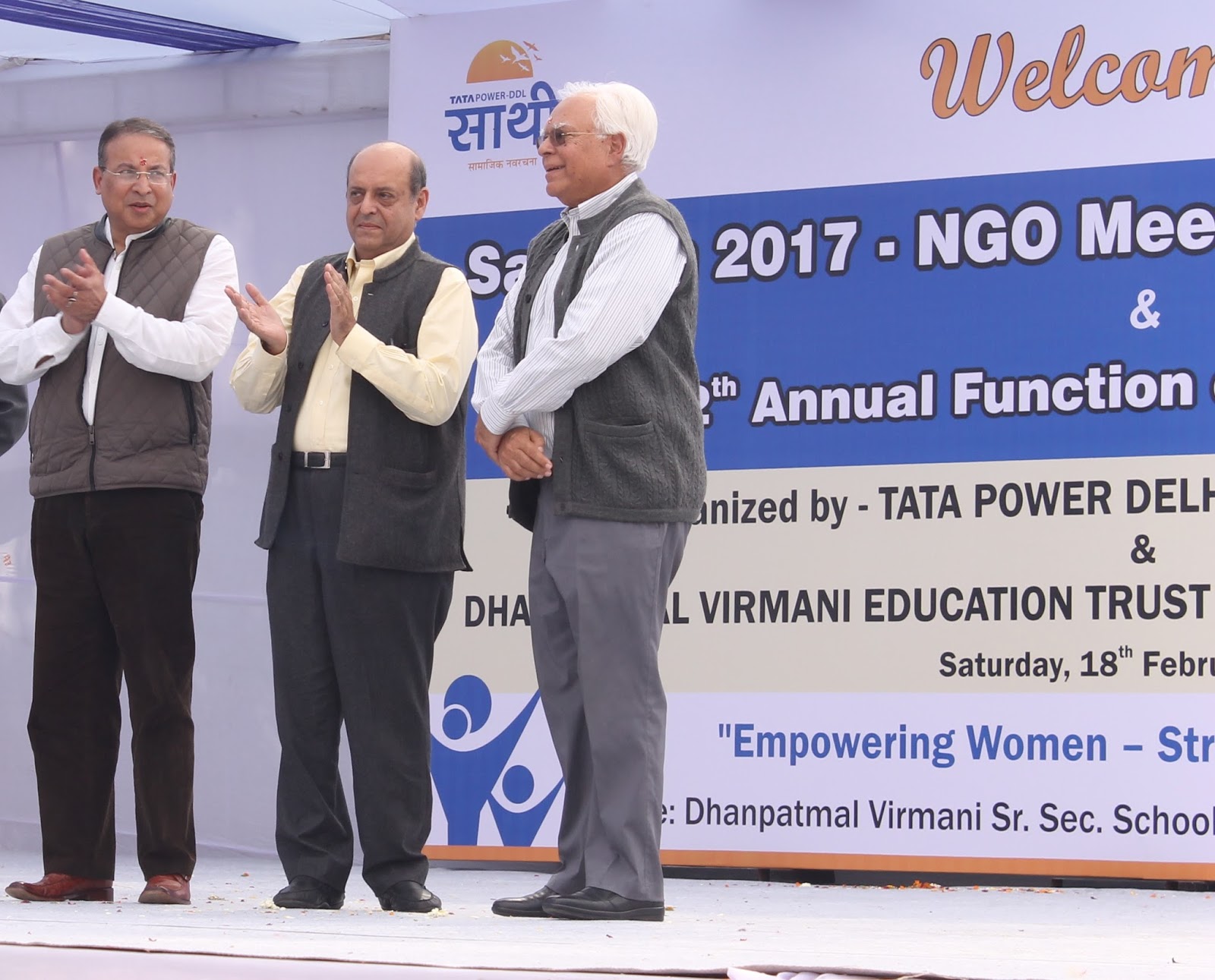 |
| In the snap are, from the left, Mr. Praveen Sinha, CEO, Tata Power, Mr.Naveen Chawla, Ex.Civil Servant, and Mr. Anil Virman, Chairman of the Dhanpatmal Education Trust and Management Society. |
 |
| Members of the Adult Literacy Programme and recipients of awards. |
Friday, 17 February 2017
IOT in Education

The Internet of Things (IOT) is a topic of discussion these days related to the impact of Internet on life. Perhaps the greatest impact of IOT is on Education today. Education includes the Pedagogy, the learners, the educators, the syllabus and the building itself, (though I guess, the building will soon become unnecessary).
For an initiate, the increased integration of IOT into the educational system might seem daunting, but for those who are into apps, coding, this might appear to be a piece of cake. Connectivity lies at the base of IOT, and this provides opportunities for collaborative learning, sharing of ideas, and research work.
One will argue that with increased connectivity come added responsibilities and a greater amount of distraction in class. The connectivity offered by the internet needs to be regulated or focussed on the learning outcomes of the lesson or topic for the day. Students who bring their own devices to class and are given internet access tend to wander away to gaming and social networking sites rather than do research on the topic of the day. One might claim, also that IOT in education might also foster cyberbullying.
With loads of information being available at a mouse-click, students and teachers alike might feel overwhelmed by the amount of unnecessary information. To be able to sift through all that information might require Information processing skills. Information glut or information explosion is often associated with stress and confusion caused by having to sift through loads of irrelevant information. Another major problem faced by educators as a result of IOT and Education in the growing amount of plagiarism taking place in research work. It might be claimed that the Internet has given rise to a copy-paste generation of learners who far from displaying out of box thinking and problem-solving skills, are in fact rote memorisers lacking in original thinking skills. Research material, such as data and information supplied by IOT cannot and should not be the end of education. IOT should be the means towards a greater understanding of the world we live in.
Some institutions and other organisations might introduce IOT in a big way simply because of the novelty factor of technology. The belief that IOT makes things very easy and the belief that the work of Educators will be lighter than ever before is a fallacy. The introduction of IOT into classroom pedagogy in schools presents challenges before educators even as they come across students who might be as informed as they are, if not better informed! Teachers who use IOT in class need to be constantly upgrading their skills, they need to be continuously doing research and have a decent knowledge about using apps.
Greater integration of IOT in classrooms in schools should ideally, enhance Social intelligence, promote creativity, help foster conflict resolution and encourage deep thinking all because of better interconnectivity, and freeing us up from having to menial tasks like driving cars, cleaning the green board, writing the learning outcomes, and most important of all, having to check homework notebooks and test papers. The benefits for students would be that they would probably not have to carry textbooks or notebooks to class instead one I-Pad or a tablet could take up the burden of all those textbooks. Most schools in the country have already integrated IOT in daily transactions. The ERP Module takes care of attendance, leave applications, student data, and contact numbers. The Report Bee module used by my school handles all matters pertaining to assessments, remarks, updates, and analyses whether comparative or static analyses. Augmented reality allows face to face interaction between students across the globe, they can work on virtual models face to face, and each improvement on the model can be seen taking place online. The use of holograms 3-D imaging and augmented reality can help save space and requirements for laboratories for conducting experiments. For a country like India, IOT has much potential, it can help remove the infrastructural gap between schools in rural areas and schools in urban areas. Uniformity of pedagogy can be enhanced and better standardization ensured. While initial glitches, so-called teething problems exist with the introduction of new systems, the benefits will outlast them. What matters is that policy makers and curriculum framers need to put in safety measures to ensure that we stay abreast of technology. A quote attributed to both Einstein and Victor Salva states, “It has become appallingly obvious that our technology has exceeded our humanity”.

Subscribe to:
Posts (Atom)