Sunday, 16 January 2022

Is the pressure to perform making our students feel stressed?

Most of us will have come across students who have become victims of mental stress caused the pressure to perform. Parents, relatives, peers and the society at large been largely to blame for this. I have come across parents who pressurize their children to score well in summative exams. Children studying in grades eleven and twelve are forced to go for tuitions, coaching classes, and prepare for entrance exams. They would rather prepare for their entrance exams, college applications than complete their projects, the marks of which are added to the final scores at the twelfth grade board results.

We are as parents, peers, and the society is driving our students towards burn out! We have forced our children to give more importance to coaching classes, entrance exams, college applications than to completing their school projects on time. Parents have put on too much pressure on their children to excel in studies so that they can join well known universities both in the country and abroad. Parents want their children to become doctors, engineers, chartered accountants, not realizing that by putting undue pressure on their children, they are robbing their children of the joy of being themselves.  

Forcing children into a veritable rat-race has led to mental health problems. When an otherwise brilliant student is forced to take up a course that is not according to his or her interest then we causing him or her undue stress. Our obsession with excellence, irrational expectations, and the pressure to perform well in exams is robbing our children of their right to celebrate childhood. What is happening is that children are being forced into adulthood much before they are mentally prepared. You can't have everyone getting admission in Harvard and that doesn't mean that those who don't will have successful careers!

There have been instances students of grade eleven taking a whole week off from school just because they were preparing for an entrance exam. Another grade 12 student told me that she wouldn't be able to submit her project because she was working on her college applications. Another student of mine is into so many things at same time that she remains confused all the time. Though a brilliant student she seems to lose track of what is being done in class. This obsession for grades, admission in good colleges, leadership positions within the school and a general desire to be popularity is creating mental health problems in students.

Why don't teach our children to prioritize tasks? Why are we forcing our children into a rat race? Why don't we train our children to take one thing at a time? Taking too many responsibilities at the grade 11 and grade twelves might impact their performances in summative exams. Anything that detracts from studies can only add to negative stress levels in students. Unfortunately students are hard pressed for time and the quality of submissions of projects, home work suffers. Undue pressure on students to excel in multiple fields by parents and peers has created more harm than good.

The pressure to perform in multiple fields is leading to a lack of focus on studies. Confusion, deteriorating concentration and overall distraction results in mental blocks often requiring the need to visit councilors. Doing too many things at the same time or multi-tasking erodes the quality of work submitted. The saying, 'Jack of all trades, master of none', an age old proverb, is as relevant today as it was in the past.

We are living in the IT age which has contributed to what is known as information surfeit. The use of technology has promoted the culture of multitasking. Only few students are able to cope with the stress of multitasking and that is because they have mastered the art of prioritizing, microplanning and macroplanning. Few students are able to tackle the stress of multitasking and the pressure to perform exceptionally well in studies.

The unfortunate fact is that we are driving our students too hard! Most of us put undue demands on our children. We want them to be involved in cultural activities, take up student leadership roles and yet perform exceptionally well in exams. We expect our children to study in best institutions, we expect them to land up jobs that pay very good salaries. Parents often expect their children to cover up for their own deficiencies and failings. This obsession for success in entrance exams, cent per cent marks in the final board needs to be curbed. We are asking for too much in our children and it augurs ill in the long term!

Is Teaching Finally Losing Its Sheen?

They say charity starts from home and I would like to start by mentioning that I belong to a family of teachers. My parents were teachers who taught abroad, my grandmother was a teacher and my grandfather was the Principal of one of the oldest schools in Gurgaon. It goes without saying that when my daughters passed out of school and college one of the career options before them was, obviously teaching. However, while my eldest did her B.Ed. the younger one was adamant about doing her L.L.B., a breakaway from the family tradition! You must be wondering about the elder one? Well, she decided not to get into teaching at all, that too in spite of her professional qualification, and now she is working with a startup dealing with online education and she is a business development professional!

When I ask some of my students if they would like to become teachers one day, their reply is instant 'No!' One wonders  why fewer and fewer youth want to take up teaching as a profession. Today, thanks to the Covid-19 Pandemic and the concurrent online teaching platforms, teachers are taking more of their work home than they used to. Children of parents who are teachers see their parents work till late hours sending invites for the next day's online classes, or even prepping lesson plans activities, entry tickets and exit tickets for the next day's class. They see how hard their parents are working and thus they don't really want to be like their parents. Students who attend school for hybrid classes see their teachers carrying a laptop, an assortment of cables, textbooks, diaries running from one class to another, from one floor to another just so that they can reach their classes on time, in order to connect their devices to the internet or LAN cable, login to the Zoom Meeting, start the projector  and then cater to the needs of the students who are attending classes physically and those who are online. It is indeed an act that only the most talented and skilled jugglers can manage.

Students can see how hard their teachers are working and when they think about their future careers, they are daunted by the effort put in by their teachers. The same happens to the be case with parents whose children might be attending classes offline and online. Even they have begun to respect the effort made by the teacher's of their children. Unfortunately, teaching has become more of an act of walking a tight rope or juggling a few balls in the air than a so called act of 'enlightening' or even facilitating learning. Teachers have become data entry operators, audit clerks, counsellors, anything apart from what they have been trained for. The requirement for the profession of teaching has been split between being an I.T. expert on the one hand and being a subject expert. It is not surprising, therefore to see how many teachers fall victim to burnout or stress-related complications.

In the days to come we are going to see fewer and fewer young people opting to become teachers. Discerning people would like avoid the stress, fatigue and hard work that marks one of the oldest professions in the world. One sees fewer and fewer men taking up the profession as other more lucrative options have opened up that offer less stress. In a country like India, for talented people who appear for Civil Services Exams with the hope of become an IAS officer, the teaching profession becomes the last option if they don't succeed. A good many years go into the preparation for entrance exams for Civil Services and if they don't get through then most of them have already grown quite old. 

The Covid-19 pandemic has had its toll on teachers, what with the uncertainty of what the future holds accompanied by the psychological impact of virtual learning platforms that in a way seem to have turned the whole profession into a rather mechanical and unemotional one. The lack of emotional connect with students, having to listen to the tinny voices coming from laptops, the stress of having to cope with new LMS/ERP platforms every now and then, power failures, poor internet bandwidth problems, servers that keep flashing "internal server error", all of them have made teaching a task rather than a joy. The unfortunate advent of the Pandemic has given us a picture of the future of teaching, and it is not very pleasant. The whole educational process was meant to promote joyful learning, experiential learning, learning through expeditions and learning by doing. 

The teachers of tomorrow will have to be multitaskers, people who have to balance subject expertise with a very sound knowledge of how to use Internet Technology. This in itself will add to the burden that a teacher will have to shoulder. Many private schools during the Pandemic have been forced to layoff teachers due to lack of funds. Parents have found it hard to pay there children's school fees because they themselves have been without jobs. Lack of funds, layoffs, extended workhours, increasing work-life balance problems, lack of  'me time' and distractions caused by the need to focus on IT skills, pressure on delivering products on virtual platforms have all robbed teaching of its sheen. 


Friday, 31 December 2021

Restoring an old Church in Gurgaon

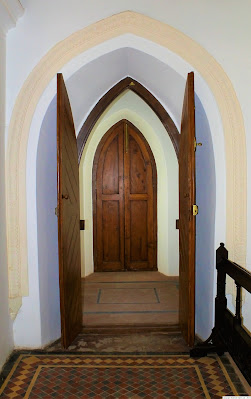
It was before the pandemic that we noticed how the slates of the roof of the Epiphany Church of Gurgaon had begun to give way to the elements. Our immediate priority at that time lay in getting the slates replaced. However, what had begun as a project for mending the 150 plus-year-old roof ended up spiralling into a massive project of renovation of the entire church building. The challenges were enormous as cement could not be used for mending the walls. The Presbyter in charge, Pastor Daman Rodgers mentioned that the cement that was used was a mixture of ash and lime. Moreover, once the slates were removed, it was evident that the ravages of time had affected the entire structure and so it was not only the roof but also the walls, flooring and the wooden fitments that would have to be redone. Utmost care had to be taken in order to retain the historical identity and integrity of the structure. The church was built more than a hundred and fifty years ago for the British Garrison based in Gurgaon. 

I visited the Church of the Epiphany Compound recently and I was amazed by the quality of the restoration work done. Everything had been done to restore the old church building to its original form, as it had existed more than one and a half centuries ago. The wooden doors that had been painted in thick layers of paint were stripped of the paint and their wooden finish was restored. The original brass fittings, locks and latches were stripped of coatings of paint and they were revealed in their original form. The switches were replaced with the age-old bakelite and ceramic switches.


It was indeed an onerous task for the Pastorate Committee and the Contractor to come to a consensus about how to go about the task of restoring the old church building. The Presbyter in charge, Revd. Daman Rodgers spoke about the numerous arguments that took place between the Building Committee, the Pastorate Committee and the Contractor who worked on the project. The final result, however, proves that it all ended up well. It is said that the walls and the structure do not make up a Church, but then, it has to be admitted that the old church building evokes a sense of awe and a vibe that results from being in an ancient structure - a testament of a fellowship that has lasted more than a hundred and fifty years.

The Church of the Epiphany, Civil Lines, continues to be an important landmark for the town of Gurgaon. It is venerated by all people alike, worshippers and those lighting a candle for blessings. Gurgaon has quite a long history. From being the home to Acharya Dronacharya to being a garrison town during the British occupation. Unfortunately, only a few monuments remain in their original form. The Kaman Sarai is all but gone. The Cricket Club with its library in Civil lines barely exists. Of another ancient structure, another Sarai or inn that existed in the past, located in the heart of the Sadar Bazaar Sabzi Mandi, only the outer walls remain. Of the prayer hall allotted to Indians during the late 1800s and early 1900s, also in the Sadar Bazaar, nothing much can be seen. It is in the context of its historical significance that I felt the need to do a write up of the restored Church building. It is evocative of the times that were, the techniques used to build structures, the brass-alloy casting techniques that gave the church its bell and of course the Anglo-Indian architecture.


I am indeed amazed by the work done by the conservationist and architect, Surbhi Anand Roy who strived to ensure that the original structure of the church was retained. The switches were sourced from Ambala, the brass locks were sourced from elsewhere. I was told by the Presbyter In Charge, Revd. Daman that she had fought throughout the restoration process arguing against shortcuts. A big hats off to her for understanding and ensuring that the original beauty of the church could be brought out only through conscious effort, painstaking research and a careful study of the structure itself!


I was able to meet the Presbyter In Charge, Revd. Daman Rodgers while he was working in his office. It was later as he stepped out to supervise the laying of tiles in the ground that he was able to spare time to describe the interesting things that were uncovered during the restoration process. He described how upon removing a layer of cement on the floor of the church they discovered the original tilework. Scraping of multiple layers of paint from the locks and latches revealed the brass below and of course the year of manufacture.


Of course, I had to ask my brother, Sanjay to accompany me on the day I took photographs of the newly restored church. I had to carry three DSLR cameras and a tripod and I told him that it would be difficult to handle all of that equipment single-handed. The reaction on his face, when he set foot inside the church is worth sharing here.


And of course, many thanks to him for taking a photograph of me too! I have taken these photographs as I feel we need to save some of these things for posterity.


Sunday, 19 December 2021

The Psychological Impact of the Covid-19 Pandemic


Credit: Molly Ferguson


The Covid - 19 Pandemic has had a far-reaching impact on all the stakeholders in the educational system (teachers, students and parents alike). The impact has been on the mental health of everyone involved in education! I have seen fathers weep tears of grief before me and mothers sharing their anxious thoughts with me regarding their inability to help their children with their homework and projects because of their inability to navigate through online LMS modules. The grief and anxiety of parents, expressed in words and tears is a dire call for help. Mental experts, councillors and life coaches need to address the mental issues faced by the shareholders of the educational systems all over the world. Unfortunately, all subject teachers can do is to listen to them with sympathy, though the solutions they can offer are very limited in nature as subject teachers are not trained to handle such issues.

Some of the issues faced by students and their parents alike are linked to the former being confined within the four walls of their homes due to extended lockdowns and concerns associated with the fear of contracting the disease. This enforced quarantine has affected young students' ability to connect with others, express their feelings with the result that they have retreated into a shell. This in itself has led to anxiety and stress. Another very issue is related to the trauma of losing family members to the disease. For young students who are at a vulnerable mental stage in life, it has been very difficult to cope with the tragedy of loss. The trauma of seeing dear ones fade away before their very eyes has become a painful experience that most students are struggling to emerge from.

It has been a painful experience for the parents too, who, because of the Covid-19 Pandemic have been working from home. They too had to undergo a difficult time balancing the stress of working from home, the uncertainty of holding on to their jobs, an uncertain future, the added responsibility of looking after their children who in better times would have been looked after by their teachers in school. The added stress of learning to work with online platforms on which homework, projects and learning materials are posted has confused well-meaning parents who previously took an active interest in their children's studies. A mother literally wept in front of me expressing confusion and helplessness in helping her younger daughter keep up with her studies. She had received an intimation from her daughter's teacher regarding her pending work!

Another parent told me how she and her husband had not earned a single cent since the Covid-19 Pandemic as they had been working in the travel industry that has suffered great losses with the drop in travel and tourism. It set me wondering about how their daughter was coping as she must surely be aware of the economic uncertainty her parents were going through. Job loss and lack of economic stability caused by the Covid-19 Pandemic have added to the mental stress faced by both parents and children alike. 

The shift to an online platform in school education has been a lifesaver but it has come with its own set of problems affecting the mental health of students parents and, even, teachers. The need to adapt to an entirely new (for many) system/platform has had its own issues. It has led to undue confusion and stress caused by the need to unlearn and relearn and modify neural networks in the brain. The virtual learning platform forced on us by the Covid-19 Pandemic has added to the psychological impact of living in unprecedented times. Noam Chomsky would be hard-pressed to explain how neural networks, hardwired for the learning of languages for ages would have to be modified in an instant!

Neural networks in human brains that have been wired taking into consideration centuries, if not, ages of learning, race memories, social, cultural and instincts to make us what we are, have been rudely jolted by this Pandemic. This emergent rewiring of neural networks in the brain has created more confusion and chaos than ever before. You just don't switch off, switch on, erase at will and then write at will unlearn and relearn things that have been etched in your brain from ancient times. The Covid-19 Pandemic will be seen as a significant blip in the story of Mankind. History has probably never seen an upheaval such as that caused by the Covid-19 Pandemic. Social conflict, war and even pandemics seen in the past have not had the kind of impact that the Covid-19 Pandemic has had on us. The greatest irony is that all our technological prowess and our knowledge of Science has not helped save us from the attack of a virus. We have won our battle against Polio, Small Pox, Plague, and Cholera,  but not against what is claimed to be a biological weapon against all mankind.

I understand and appreciate the efforts made by health experts to address concerns associated with the impact of a pandemic of epic proportions but, unfortunately, not much has really been done in this regard. The fact of the matter is that we are not mentally prepared to address the problems associated with the impact of a pandemic of such proportions. The Covid-19 Pandemic has exposed the need to work on our mental health preparedness both at the school level, family level and individual level. The Covid-19 Pandemic will go down in history as an event that has exposed the ineffectuality of science and technology in combating the impact of a virus attack on humanity at large.

We are, unfortunately, today befuddled and confused by the impact of a global pandemic. Our technological prowess in space sciences, medical sciences, psychology, warfare, and any other field has exposed our lack of preparedness in tackling a global pandemic caused by something as small as a virus. This knowledge in the inefficacy of science in tackling and defeating a virus has had a mental and psychological impact on all of us. The knowledge that we are, after all, not in control of our viruses and pandemics has led to a feeling of deja vu, a feeling of disenchantment and helplessness in a world that is supposedly moving towards advancement never before seen in the history of mankind.


Sunday, 5 December 2021

Tips for Shooting Exclusive Wildlife Photographs

Some of the best photographs of birds in flight are taken early in the morning and my preferable ISO setting is between 100 and 400. In most cases, a shutter speed of 640/1 should work preferable well. Although I carry a monopod or a tripod most of the time, I, however, rarely use them as they restrict free movement.

Greylag Geese and Painted Storks are some of the larger birds that can be shot easily in flight, taking off or alighting. If you are subtle enough and careful about hiding yourself from the birds, you might get close enough to them to use a 70-300 mm zoom lens. I find the USM lens handy enough for wildlife photography.


Some of the larger animals like Antelopes can be photographed using a slower shutter speed, again if you are still enough and properly camouflaged. Wearing clothes in muted colours helps a lot. This is why the clothes you wear is as important as the camera equipment you carry. Although I wear spectacles generally, I avoid wearing them on wildlife shoots. Any glint from the lenses of your glasses can frighten away wildlife. I like shooting in the raw and aim for slightly underexposed photographs so that the colours come out really nicely!


One very important tip for all wildlife photography enthusiasts is to reach the venue early in the morning, preferably before all the others appear. My go-to place happens to be the Sultanpur National Park in Gurgaon, or the nearby wetlands, especially the Basai Wetland. I prefer reaching the spot by seven in the morning even when it is foggy. Fog, ironically, makes the animals and birds lethargic and thus easier to photograph. The fog also helps conceal the photographer from the animals and birds. This brings me to the question of photographing birds in flight. A reasonably fast shutter speed coupled with the right angle can help greatly. The photographs below are those of Painted Storks landing on the ground to collect sticks and twigs to build up their nests. They have come up reasonable nicely because of the angle of the camera and the direction of the sun.


A final word about taking exclusive photographs of wild animals and birds is that it requires a lot of patience and an instinct for being at the right place at the right time. In the case of the Asian Antelope, it was all about standing still and calmly taking well-aimed shots without making excessive movements. While the Doe was feeding her calves, the male stood guard. All three of them probably did not find my presence threatening so they went on with what they were doing. All these photographs were taken in foggy conditions early in the morning at the Sultanpur National Park in Gurgaon.