Showing posts with label #wildlife_photography. Show all posts

Sunday, 5 December 2021

Tips for Shooting Exclusive Wildlife Photographs

Some of the best photographs of birds in flight are taken early in the morning and my preferable ISO setting is between 100 and 400. In most cases, a shutter speed of 640/1 should work preferable well. Although I carry a monopod or a tripod most of the time, I, however, rarely use them as they restrict free movement.

Greylag Geese and Painted Storks are some of the larger birds that can be shot easily in flight, taking off or alighting. If you are subtle enough and careful about hiding yourself from the birds, you might get close enough to them to use a 70-300 mm zoom lens. I find the USM lens handy enough for wildlife photography.


Some of the larger animals like Antelopes can be photographed using a slower shutter speed, again if you are still enough and properly camouflaged. Wearing clothes in muted colours helps a lot. This is why the clothes you wear is as important as the camera equipment you carry. Although I wear spectacles generally, I avoid wearing them on wildlife shoots. Any glint from the lenses of your glasses can frighten away wildlife. I like shooting in the raw and aim for slightly underexposed photographs so that the colours come out really nicely!


One very important tip for all wildlife photography enthusiasts is to reach the venue early in the morning, preferably before all the others appear. My go-to place happens to be the Sultanpur National Park in Gurgaon, or the nearby wetlands, especially the Basai Wetland. I prefer reaching the spot by seven in the morning even when it is foggy. Fog, ironically, makes the animals and birds lethargic and thus easier to photograph. The fog also helps conceal the photographer from the animals and birds. This brings me to the question of photographing birds in flight. A reasonably fast shutter speed coupled with the right angle can help greatly. The photographs below are those of Painted Storks landing on the ground to collect sticks and twigs to build up their nests. They have come up reasonable nicely because of the angle of the camera and the direction of the sun.


A final word about taking exclusive photographs of wild animals and birds is that it requires a lot of patience and an instinct for being at the right place at the right time. In the case of the Asian Antelope, it was all about standing still and calmly taking well-aimed shots without making excessive movements. While the Doe was feeding her calves, the male stood guard. All three of them probably did not find my presence threatening so they went on with what they were doing. All these photographs were taken in foggy conditions early in the morning at the Sultanpur National Park in Gurgaon.


Monday, 28 December 2020

Large Flock of Bar-headed Geese Spotted at the Basai Wetland

Finally, a large flock of Bar-headed Geese was spotted at the Basai Wetland today. Unfortunately, the flock spotted was less than half the size of the one spotted in the year 2017. There is an apparent change in the migratory patterns of Bar-headed Geese headed towards the plains of India which is prompted by a reduction in the availability of food and the steady disappearance of Wetlands and other Biodiversity hotspots. 


This flock of Geese was preceded by a pair early in the week of December. Looking at the lone pair of Bar-headed Geese earlier I was under the impression that no more would be coming to the Basai Wetland in Gurugram. Apparently, I was wrong! It was a great relief to see a large flock of about fifty birds on the ground. I have always looked forward to spotting the annual visitors to the wetland every year. 


Bar-headed Geese are known to be among the only birds that can fly at an altitude of 20,000 feet, a feat that is remarkable especially because few birds can survive without Oxygen at such heights. Moreover, Bar-headed Geese have remarkable navigational skills since they land up in the same spot year in and year out. The Basai Wetland incidentally is a stopover for these birds that migrate to the warmer climate in the Northern plains of India for the purpose of breeding from the months of December to March.


Bar-headed Geese are also spotted at the Sultanpur National Park at some distance from the Basai Wetland, however, I haven't been to the National Park since the onset of the Covid-19 Pandemic. Bar-headed Geese are a noisy flock that advertise their arrival long before they are seen. I have seen them alight on the drier grassy parts of the Basai wetlands. In all probability, they'd rather feed on insects and small crustaceans left behind in receding waters. At the Sultanpur National Park, however, I have seen them settle on the water itself.


The Bar-headed Geese that visit the Basai Wetland in Gurugram are very shy in nature and it is often very difficult to get close to them without startling them. Additionally, they can be found only in the early mornings from seven to eight. The early morning mist rising from the wet ground can often make it a challenge to get clear photographs of them.


I hope to see these birds return to the same spot next year though I don't see that happening with all the draining of the water of the wetland and the filling up of low-lying areas for development-related purposes. The construction of a flyover close by and the Dwarka Expressway will change the very shape of the Wetland.


Sunday, 30 August 2020

Amazing Wire-Tailed Swallows Spotted at The Basai Wetland Gurugram


Wire-tailed Swallows are amazing little birds! Swift-flying and playful in nature, they have been a part of our culture and literature. When I spot Swallows, I remember the story of the "Happy Prince", a story by Oscar Wilde. The Swallow was a constant companion of the Happy Prince statue till the end. In the end, when winter comes, it is the Swallow that remains with the Happy Prince since it doesn't migrate with the others to warmer regions. The story speaks volumes about the companionship with a human statue and a bird, symbolising the relationship between nature and man. Even Shakespeare had something to say about the Swallow when he wrote, "true hope is swift, and flies with swallow's wings."
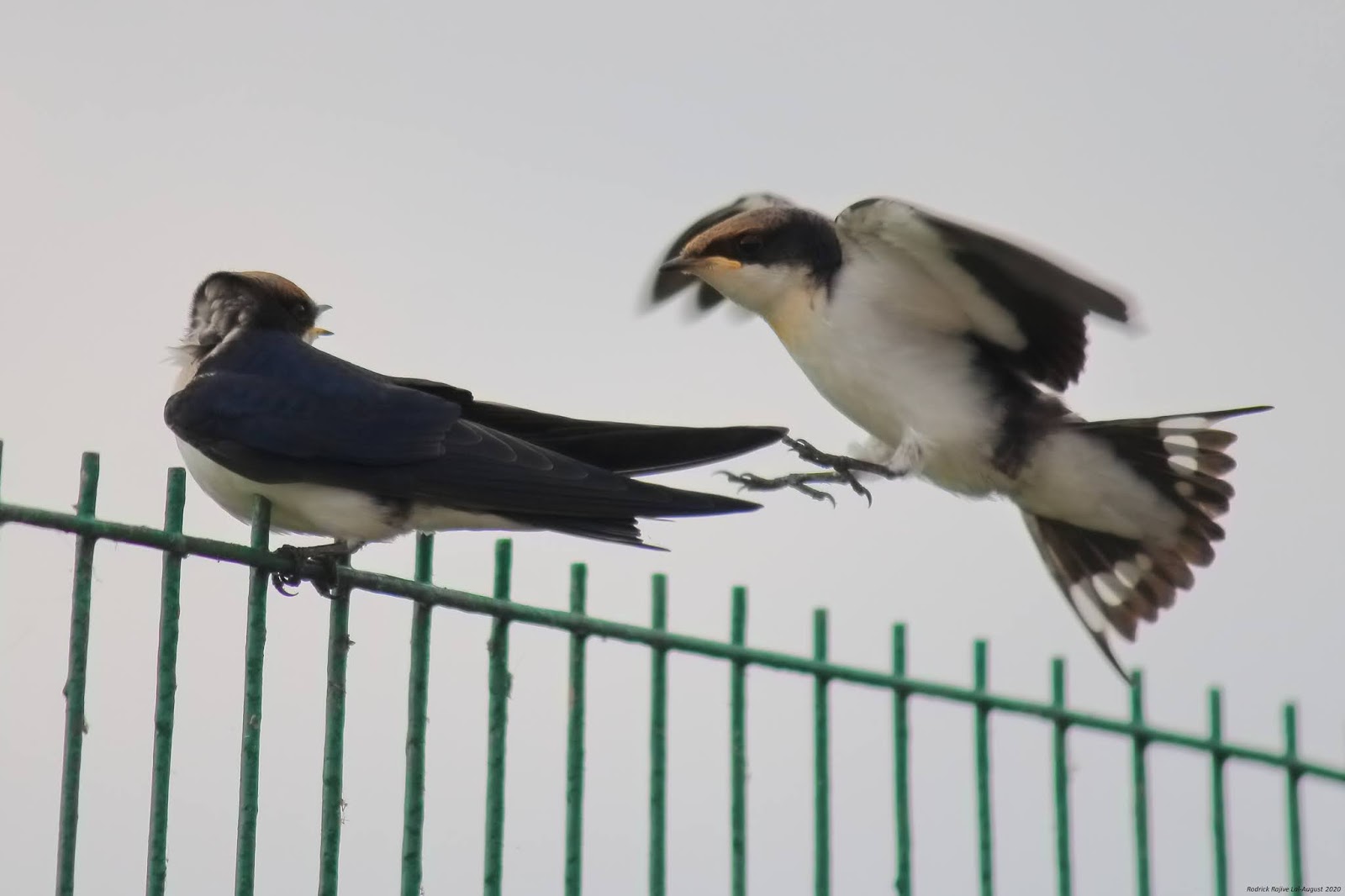
The swallow symbolises love, care and affection towards family and friends, and fidelity. The birds interestingly choose a mate for life and will nest with only there partners. In various cultures, swallows symbolise hope and freedom. Whenever I spot swallows I am filled with joy. Their friskiness and swift swoops all over the area are often difficult to capture on camera, but their memory will always remain in the mind! I was fortunate enough to spot a few juveniles accompanied by adults at the Basai Wetland when I visited it today. The wind was strong and the birds were clinging on to a wire-mesh fence lest they should be blown away. I got as close to them as possible, and they did not mind, probably as they were juveniles.
This is the first time that I have gotten so close to Wire-tailed Swallows, and although the lighting was not so good, managed to take a few decent shots of them. What struck me the most was to see three of them sitting close to each other like the three stooges. I could sense their wonder and curiosity about what I was doing with the camera. Without further explanation, I would like to present a series of photographs that I would like to label as "The Three Stooges."

The Three Stooges


The birds might as well be in a silent conversation, or perhaps, I might have missed their whispers. The wind must have snatched away their silent whispers (even as I was eager to get them into the frame) or I would tell you what they were conversing about- me of course! Whatever might be the case, their body-language is so familiar to that of human beings.
A clear distinction exists between adult and juvenile swallows. While adult Wire-tailed swallows have longe wire-like projections coming out from each of their wings, the juveniles have yet to develop them. Additionally, juveniles Wire-tailed swallows have a dash of yellow on the base of their beaks.
The Juvenile

Swallows are playful birds and they can be seen swooping around chasing each other, trying to settle on a perch that is already occupied. I was able to capture a few instances of Wire-tailed swallows trying to dislodge their siblings from their perch. These games reminded me of the games that our own children play with each other.

Juveniles Playing for a Perch


If the juvenile Wire-tailed swallows are playful, the adults are more reserved and watchful. They perch on posts with long 'wires' trailing from each of their wings. This is a graceful sight for those who have a sharp eye.

The watchful Adult


I guess there is more to Wire-tailed swallows that meets the eyes. The way they have adapted to life in the cities is somehow a success story that we need to learn from. These photographs were taken at the Basai Wetland in Gurgaon today. While I was not able to spot too many big water-birds, I had to make do with these tiny ones.