Showing posts with label #canon_1500_D. Show all posts

Thursday, 17 November 2022

Why Photographing Wildlife is Like Fishing for Landlocked Salmon

A pack of Golden Jackals and a pair of Asian Antelopes at the Sultanpur National Park

Some of the best photographs I have taken have turned out to be those shot in unexpected conditions, an experience most wildlife photographers will have experienced. You plan to visit a wildlife sanctuary because the weather is clear. You set out early in the morning and reach the location only to have the weather worsen. The mist rolls in and you are in a state of uncertainty about whether to return home or hope that the wind will drive away the mist. On another occasion you see a large bird flying towards you, you point your camera towards the bird, and see it filling the viewfinder even as you press the shutter button, hoping to have taken your best shot to date, alas, lo and behold, it comes out blurred because the shutter speed was way too low. In other cases, it might be about having the wrong aperture or even the wrong ISO setting. Often the settings you have for still shots will not work for shots that have movement in them, especially those of birds flying in the air. It is clear that photographing wildlife is like fishing for landlocked Salmon. Sometimes you get a good catch, but most often you end up with nothing!

A pack of Golden Jackals and a pair of Asian Antelopes at the Sultanpur National Park

Just yesterday when I visited the Sultanpur National Park early in the morning I least expected to spot a pack of Golden Jackals and a pair of Asian Antelopes, also known as Neel Gai staring down at me down the trail that I was walking on. Thankfully I had been alerted by a fleeting glance of a Golden Jackal fleeting into the underbrush by the side of the trail. You might not however be as lucky when a brace of Partridges shoots across your path just in front of you! At other times you hide in the bushes hoping to take a potshot at some of the ducks paddling around seemingly unaware of your presence, but then, the moment you poke your head out, a Lapwing calls out the alarm and the entire flock vanishes into thin air! It goes without saying that some of your best photographs might not be the ones in which the birds' eyes are in focus, in fact, some of the best photographs might be ones you might discard or delete because you think they are not very clear! Just one day while on a visit to the Najafgarh lake near the Chandu Budhera village I spotted a troika of Flamingos out in the distance. The weather was really bad, thanks to the poor AQI levels and the photographs that I took of these birds turned out to be not so sharp at all. However, on looking at them closely, I realised that while the birds were not so clear, I had however managed to capture the atmosphere and the ambience of the scene. There was a sense of mystery, a sense of suspense in the moment.

Flamingos spotted one misty morning at the Najafgarh Lake

Flamingos can stand on one leg for hours!

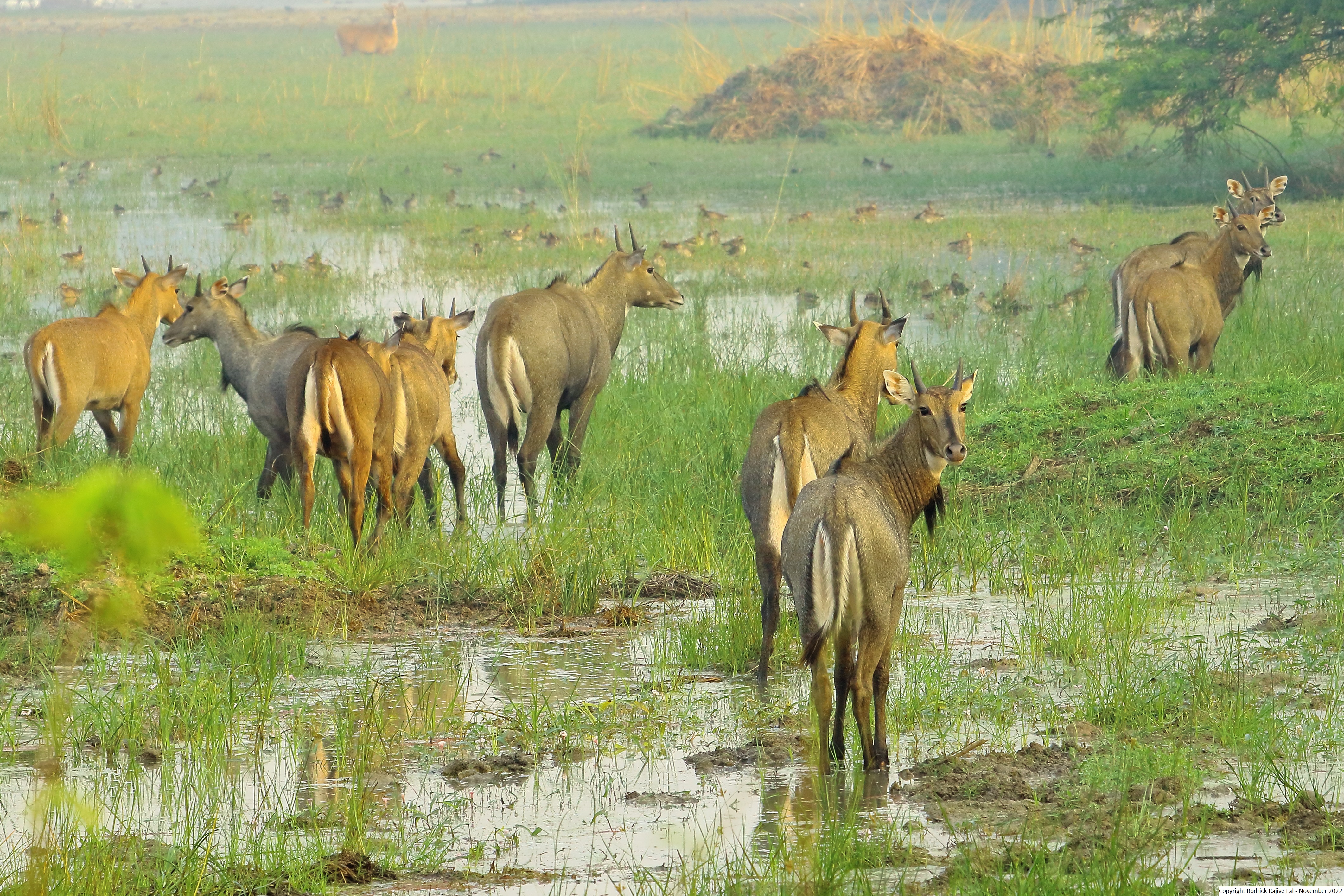
As if the weather was not a spoilsport, having a large number of Batchelor Asian Antelopes wander across the scene scaring away that exotic bird you had been trailing so patiently might be a put-off, so you might as well decide to take a snap of the intruders, with good effect . If you can capture their startlement, then I guess it would be a better tradeoff from photographing that exotic bird.

A flock of Asian Antelopes at the Sultanpur National Park

Who was more startled, these Antelopes or me?

How strange it is you visit a national park thinking you will get a few photographs of migratory birds but end up taking photographs of animals! This blog post should have had more pictures of birds than it has, but then, I guess you need to make do with anything that offers a decent enough reason for stepping outdoors on a holiday, early in the morning. I guess you need to have something to justify your inability to stay at home even on a holiday! 

A Kingfisher at the Sultanpur National Park

A Blue-throat at the Sultanpur National Park

A Greater Coucal at the Sultanpur National Park

The best possible photograph that one can take is that of an expression of startlement or amazement etched on the faces of bovine creatures. It is amazing how many of them you will find in a National Park like the Sultanpur National Park. Having a multitude of domesticated animals including stray dogs can defeat the very purpose of having a National Park for migratory birds.

We need to have a National Park for domestic animals too!


Saturday, 2 April 2022

At the Surajkund Craft's Fair, 2022


This year when the Surajkund Craft's Fair finally opened after a gap of two years, I was eager to visit it and try my skills at a different kind of photography not limited to wildlife. Besides, however, the vast opportunities for the enthusiastic photographer, the Surajkund Craft's Fair continues to be a place where you can purchase a large number of handicraft items, both from the country and other participating countries from all over the world.


The Surajkund Crat's fair also offers one an opportunity to witness the cultural diversity of different countries through cultural performances, handicraft items, and even eatables! One gets to meet people from different countries and even, perhaps talk about conditions in their countries. I got to talk about the civil strife in South Sudan with a gentleman from that country, and then the current situation in Ukraine with another gentleman from Uzbekistan. The gentleman from Sudan spoke about the problems faced by people in the Darfur region and he stated that things were yet to get back to normal. On the other hand, the gentleman from Uzbekistan talked about how Uzbekistan had broken away from Russia in1990 and that the people of his country were very disturbed by the events taking place in Ukraine.


While it is indeed a joy to enjoy meeting so many people from all over the world at the Crafts Fair, it is also a great opportunity to experiment with styles of photography. Objects on display at the Fair offer opportunities to practice object photography skills. The dance performances that take place at the central stage in the crafts fair are a great attraction. The daredevil dance performances by the African dance troupes are simply amazing and they remind me of my days in Ethiopia where we got to see some of the most energetic dance performances. I have tried to share a few photographs of the same.


Sunday, 5 December 2021

Tips for Shooting Exclusive Wildlife Photographs

Some of the best photographs of birds in flight are taken early in the morning and my preferable ISO setting is between 100 and 400. In most cases, a shutter speed of 640/1 should work preferable well. Although I carry a monopod or a tripod most of the time, I, however, rarely use them as they restrict free movement.

Greylag Geese and Painted Storks are some of the larger birds that can be shot easily in flight, taking off or alighting. If you are subtle enough and careful about hiding yourself from the birds, you might get close enough to them to use a 70-300 mm zoom lens. I find the USM lens handy enough for wildlife photography.


Some of the larger animals like Antelopes can be photographed using a slower shutter speed, again if you are still enough and properly camouflaged. Wearing clothes in muted colours helps a lot. This is why the clothes you wear is as important as the camera equipment you carry. Although I wear spectacles generally, I avoid wearing them on wildlife shoots. Any glint from the lenses of your glasses can frighten away wildlife. I like shooting in the raw and aim for slightly underexposed photographs so that the colours come out really nicely!


One very important tip for all wildlife photography enthusiasts is to reach the venue early in the morning, preferably before all the others appear. My go-to place happens to be the Sultanpur National Park in Gurgaon, or the nearby wetlands, especially the Basai Wetland. I prefer reaching the spot by seven in the morning even when it is foggy. Fog, ironically, makes the animals and birds lethargic and thus easier to photograph. The fog also helps conceal the photographer from the animals and birds. This brings me to the question of photographing birds in flight. A reasonably fast shutter speed coupled with the right angle can help greatly. The photographs below are those of Painted Storks landing on the ground to collect sticks and twigs to build up their nests. They have come up reasonable nicely because of the angle of the camera and the direction of the sun.


A final word about taking exclusive photographs of wild animals and birds is that it requires a lot of patience and an instinct for being at the right place at the right time. In the case of the Asian Antelope, it was all about standing still and calmly taking well-aimed shots without making excessive movements. While the Doe was feeding her calves, the male stood guard. All three of them probably did not find my presence threatening so they went on with what they were doing. All these photographs were taken in foggy conditions early in the morning at the Sultanpur National Park in Gurgaon.


Monday, 16 November 2020

Amazing Images of Courting Grey Herons at the Basai Wetland

Yesterday, when I visited the Basai Wetland for my weekly tryst with nature, I was absolutely stunned by the display of excellent aerobatic skills by a pair of courting Grey Herons. 'STUNNED', is how I would like to describe their display of courtship flight! 

This pair of Grey Heron went chasing each other, often wingtip to wingtip, literally skimming the surface of the water so much so that you could see the furrow created by their wingtips! Well, I did not expect this as I had planned to go further to a spot where I would be photographing ducks.

Of course, another pleasant surprise was to spot some Pied Avocet birds, but then, I was divided between the Pied Avocet and the flying Grey Heron. This would be the first time that I was seeing a pair of these rather graceful birds sailing on so gracefully. I could have stayed rooted to the spot if they had finally not decided to fly away into the horizon.

This blogpost is dedicated only to the wonderful Grey Heron I spotted at the Basai Wetland, and I hope that in the days to come, we will be seeing more of them and their offspring!

The best shots of the Grey Heron were those that I took of each one of them individually, and I am sure you will agree that they are simply out of this world!


So even as the female was trying to play hard to get, the male kept pursuing her even as she led him on 'Grey Heron's chase' all over the place. The sudden landings with wings flared, the deployed 'slats, lowered flaps, and the nose up attitude' seemed reminiscent of aerobatic aircraft (But then, of course, we learned the art of flying from them!).


Although the Grey Heron birds happen to be a mostly solitary bird hunting for fish, often motionless and still, they are happy to have the company of a mate during the mating season. These graceful birds are quite big standing one metre tall with wings extending even more! They have long legs black in colour that appear as if they are black twigs to fool fish into a sense of complacency waiting to be gobbled by the bird waiting above. Grey Heron are waders that feed on the surface of the water striking into the depths as soon as they spot a fish.


Well, I guess that's it for today, hope to come up with some more photographs of the amazing wildlife that can be spotted at the Basai Wetland in Gurugram.