Showing posts with label #basai_wetland_gurgaon. Show all posts

Sunday, 12 June 2022

Wildlife Photography Makes You A Better Person

The King Stands Tall-Asian Antelope at The Sultanpur National Park

Perhaps one of the greatest realities of Wildlife Photography is that things rarely turn out as planned! Setting out on a photo shoot in the wilds will make you question all the rules that you have been taught or learnt through experience! There have been times when I have made the arduous trek to my favourite spot only to realise that I had the wrong lens, or that I had in my hast forgotten to set the correct ISO setting or even that it was too foggy, cloudy or even that all the wild birds and animals had disappeared from sight. One of the greatest disappointments was to spot a family of Sarus Cranes which began to disappear into the underbrush the moments I pointed my lens at them! These obstacles, however, should not force one to back out of Wildlife Photography and instead opt for any other form of photography, that is, of course, if you have an inclination for the adventure offered by this form of photography.

The Inquisitive One

The story behind the photograph on top was a rather interesting one. I stepped down from the trail at the Sultanpur National Park towards the edge of the lake in search of a family of Sarus Cranes. While walking towards the edge, I suddenly turned back to see my Brother in Law Atul gesturing urgently indicating something right in my path. On peering into the trees I spotted a male Asian Antelope standing still looking at me. It was so sudden, there I was with my camera in my hand and standing a couple of meters away was a young male Antelope, face to face. This Antelope gave me the chance of taking quite a few photographs before moving away. My brother, who was also with me joked stating that the Antelope probably had very poor vision. I, however, have my doubts. It was not very dark and the sun was in front of me, so I was in a dark zone and the Antelope could not see me.

A pair of Nursing Sarus Cranes spotted at the Sultanpur National Park

The first photograph titled The King Stands Tall was an interesting one since this Asian Antelope Bull first confronted me on the trail in the Sultanpur National Park. He stood unmoving, blocking my path for quite some time and I also did not know what to do. After some time, the bull bolted off the trail and blundered into the open field, but by that time I was prepared for him and took a few shots of him. If you look closely at the photograph you will notice a Doe looking at me from the distance!

The Curious Three

It is always a good idea to take photographs of three animals together. It is somehow much more interesting than having a single animal before you. I was able to photograph three of these female Asian Antelopes while on a visit to the Sultanpur National Park recently. The rather curious expression on their 'faces' particularly drew my attention. I guess, therefore, a threesome provides a better story to photograph!

A Flash of Yellow-An Indian Golden Oriole

Things happen in a flash for those who set out to photograph wildlife. An incident, in this case, was a flash of yellow that crossed my vision. If it hadn't been for the bright yellow colour, I would have missed spotting a pair of Indian Golden Orioles. One of them paused long enough for me to focus on it, after, of course leading me on a run to catch it as it flitted from one tree to another. The strong wind helped me as the birds clung on to the branches battling the wind!

A Regal Crest Dominates the View

Hoopoes are generally amicable birds and they will offer the photographer a good opportunity to photograph them. I was able to follow one of them recently while on a visit to the Sultanpur National Park and the gusting wind seemed to ruffle quite a few feathers, literally as well as metaphorically. Like the Golden Oriole, I had to catch up with the Hoopoe as it hopped from branch to branch. Catching a Hoopoe in the middle of two dead branches brought out the colours really nicely. The dark-grey colour of the bark of the tree highlighted the brown tone of the feathers.

Babbling Cuckoos

Sometimes a lucky photographer will be able to capture the story of the shot. Spotting one 'Koel' or an Asian Cuckoo will be a lucky sighting, but photographing a couple of them fighting and squabbling with each other is simply amazing. I was able to spot not one but two Cuckoos squabbling with each other recently on a visit to the Sultanpur National Park in Gurgaon. Their chattering and loud voices drew me to the Acasia tree where they were having a heated debate. Somehow, they were so wound up in their arguments that they did not pay any attention to me.


Drongos are very difficult to photograph, and that is probably because their dark feathers make it difficult to photograph outdoors. However, if you have sufficient distance between the bird and the background, and if the background is of a different colour from that of the Drongo, then hopefully you might be able to get the eyes in focus. It is easier to get the eyes of the Cuckoo in focus because of their red colour, this doesn't happen in the case of the Drongo,

A Drongo Sits Still 


Sometimes, however, it is quite possible that you might come across a beast of prey, well, not exactly Tigers and Lions, but then you might be surrounded by Jackals such as what happened with me. There was one particular Jackal that I named 'Scarface' because of the scars on his face. It looked as if he had entered into a fight with other jackals, or perhaps something much bigger had attacked him?

Scarface, the Veteran

The Cunning one
Wildlife photography often leaves you improvising and changing well-laid and time-tested rules. I often ditch my tripod so that my movement is not hampered. I keep changing the settings for each photograph, switching from an ISO setting of 100 to a maximum of 1600. Depending on the situation I switch from an f-stop number of 5.6 to anything up to f-22. Similarly. the shutter speed can vary from 1/100 to 1/2000 or even higher.

A pair of Nursing Sarus Cranes have their chick cleverly hidden in the grass

In spite of all the disappointments one might face during a particular visit to a Biodiversity hotspot, one should believe that the very act of attempting to photograph wildlife can help make the world a better place! A record of animals and migratory birds spotted at a particular time of the year and the locality can help trace migratory patterns, ecological degradation, food patterns, the impact of human activity on ecosystems and even the impact of global warming. 

A Flock of Greater Flamingos spotted at the Basai Wetland


Sometimes, the most graceful birds of prey can give you a sense of beauty in all their forms. The Black-Winged Kite, a small-sized, rather beautiful raptor can be most enthralling to look at. The black and grey colour scheme of its plumage accompanied by its sharp beak and bright red eyes makes it rather imposing. The red eyes are suggestive of its nature, it is a hunter and it has the sharp eyes of a hunter. The Shikra too is an impressive bird. It is a hunter and in the past, it was used to hunt for small rodents like rats to feed larger falcons that were maintained by the kings of the Mughal era.

A Shikra in search of Breakfast at the Sultanpur National Park


A Black-Winged Kite spotted at the Sultanpur National Park


In the end, I would like to conclude this blog post with a poem that summarises my experiences as a wildlife photographer. It is called The Connect.

The Connect

I spot a flash of yellow from the corner of my eye.
A tingling in the back, warns me of something in the
Copse, watching me. I know it is there and scan the
Bushes for something to spot.

A rustle in the branches above as a bird watches me.
From above, a pair of doves take flight as I pass by.
Two Cranes walk past majestically, a baby, hidden
In the grass follows them.

In the distance, the Antelopes watch me wary and tense
Ready to take flight at the earliest alarm. The sun shines
Bright, the wind gathers strength, the Golden Oriole and
The Drongo hold on tightly to the branch.

A Peacock in the distance calls out to its mates, a single
Call multiplied by ten more, a loud cacophony of calls a
Message passed on to others. Up ahead a pair of Geese
Glide gracefully down to land.

I wonder where they have come from, the Bar-headed 
Geese, the Greylag Geese and the Northern Pintails. Is
It cold from where they come? Will they stay long in this
Place so I might visit them again?

And I thought all the Flamingos lived in the coastal areas.
But here they are, far inland. Perhaps they are searching
For ancient wetlands that once had vast swathes of water,
But now are no more to be seen.

Out of the undergrowth a brace of Partridge streak across
My path, too fast to note, and after them amble a pair of
Golden Jackals. They stare at me and then move away with
A dismissive gesture as if I don't count.

They chuckle at me, even as I carry my Camera and Tripod,
Denying me a decent pose! And I, the exhausted one think 
Breakfast to eat! I guess it was all a waste of time to come all
This way to get a good photograph!

As I walk past the trail and head back home, I wonder if I was
Able to get anything in my camera. A voice tells me what was
Important was the connection I had with them, the wild birds
And animals, even if they laughed at me!


A Heron waits for Breakfast at the Basai Wetlant

A Purple Heron Flies across the water at the Basai Wetland

The Remains of a Monitor Lizard at the Basai Wetland


Sunday, 15 November 2020

The Pied Avocet-A Winter Visitor at the Basai Wetland

The Pied Avocet is a migratory bird that visits the Basai Wetland during the winter months. It is a white wader with bluish-black long legs. What marks it apart from other birds like the Black-winged Stilt is its slender but long upturned beak. While feeding it pokes its beak into the water swinging its beak to and fro in order to catch its meal which includes fish and crustaceans. 

But then that was just about its appearance! What is fascinating about this bird is that it travels so far. Mostly a resident of the Rann of Kutch and Balochistan, it migrates to northeastern India during the winter season. According to an entry in Wikipedia, 'The pied avocet (Recurvirostra avosetta) is a large black and white wader in the avocet and stilt family, Recurvirostridae. They breed in temperate Europe and across the Palearctic to Central Asia then on to the Russian Far East. It is a migratory species and most winter in Africa or southern Asia.'-https://en.wikipedia.org/wiki/Pied_avocet


The Basai Wetland in Gurugram (Gurgaon), Haryana, India is an important biodiversity hotspot that supports a large number of migratory birds including the Common Starling and Bar-headed Geese flying in from all over the world! Today, when I visited the Basai Wetland, I was able to spot quite a few of the Pied Avocet birds feeding in the shallows. Unfortunately, I was not able to get close enough to get very clear photographs of them. 


Research data suggests that the Pied Avocet population might be in a state of moderate decline in India. No wonder this is because of the constant fight for space between man and birds, and also because of the disappearance of important Biodiversity hotspots, thanks to the need for more space to build residential complexes. Incidentally, The Agreement on the Conservation of African-Eurasian Migratory Waterbirds (AEWA) is applicable to the Pied Avocet birds in India.


According to an article appearing in the Guardian in April in the year 2012, "They came back from the brink of extinction in Britain in the mid-19th century and colonised the beaches of East Anglia that were closed during the war."-https://www.theguardian.com/science/grrlscientist/2012/apr/15/4
Another article appearing in the New Indian Express states, "Places like Kelambakkam backwaters or Pallikaranai marshlands have stopped attracting a number of varieties they used to. According to seasoned bird-watchers, ducks like garganey and common teal, another type of wader called the pied avocet are among the ones that have gone missing."-
https://www.newindianexpress.com/cities/chennai/2020/jan/28/number-of-bird-species-on-decline-say-watchers-2095431.html


Saturday, 3 October 2020

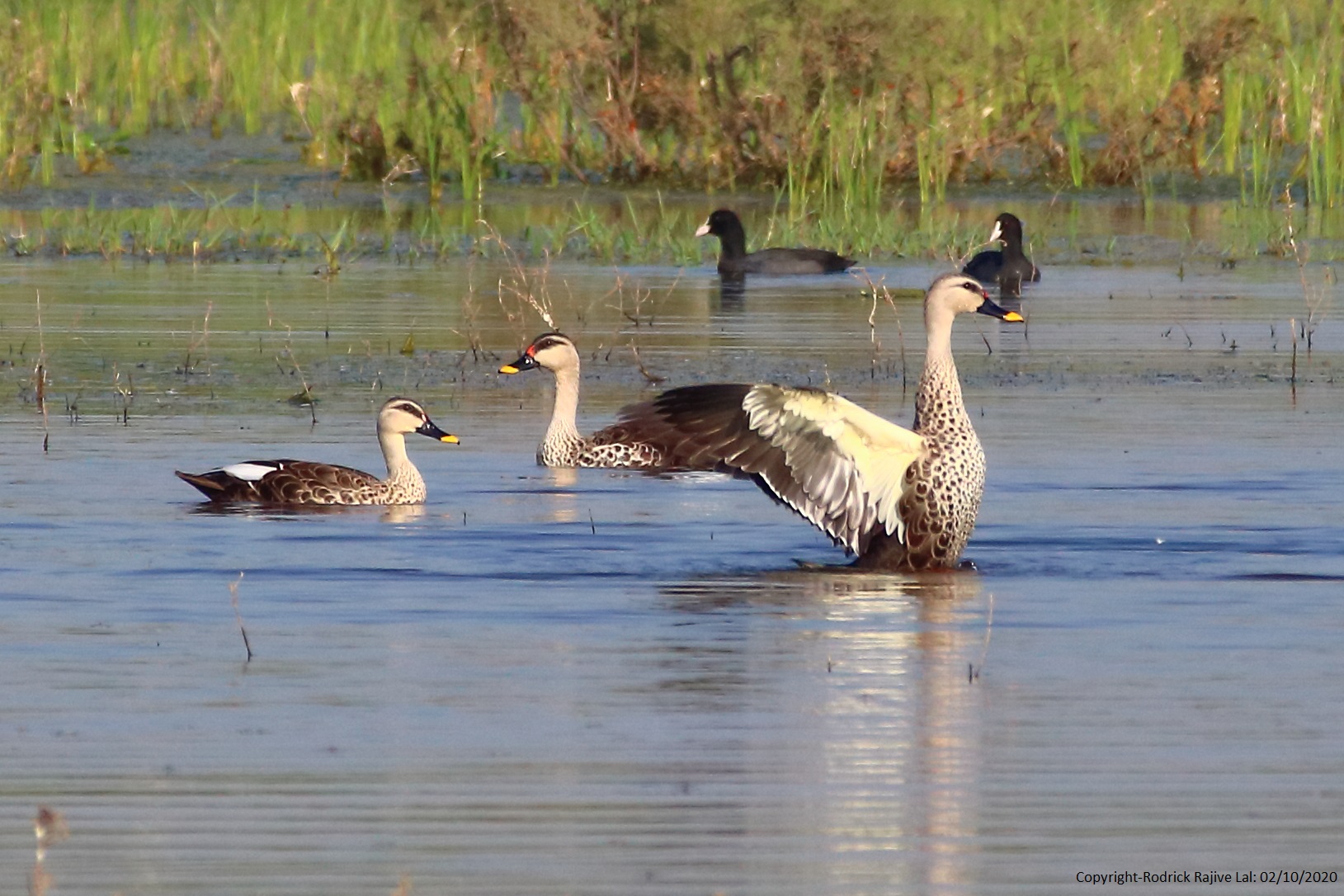
Spot-Billed Ducks at Play (At the Basai Wetland)


Yesterday while I was on the way back from the Basai Wetland in Gurgaon disappointed that I had not spotted any large birds, I was arrested by the sight of a flock of Spot-Billed ducks alighting on the water to join the rest of the flock. Since I had already packed my kit, I was in a tizzy and struggled to get my camera out. Of course I had been testing the Canon 70-300 mm USM lens so I needed to get something to show!

It was a joy to see such a large flock of ducks playing together. Some of them began chasing each other while others simply stretched their wings, I guess to take out the fatigue from a long flight. Though the ducks were at a great distance, the 70-300 mm USM lens did a great job and I was pleased with the results.


The true size of Spot-Billed Ducks becomes apparent when they stretch their wings out like the one did in the above photographs. If that was not enough, the ducks went around in groups diving in the water, looking for fish I guess.


Sunday, 30 August 2020

Amazing Wire-Tailed Swallows Spotted at The Basai Wetland Gurugram


Wire-tailed Swallows are amazing little birds! Swift-flying and playful in nature, they have been a part of our culture and literature. When I spot Swallows, I remember the story of the "Happy Prince", a story by Oscar Wilde. The Swallow was a constant companion of the Happy Prince statue till the end. In the end, when winter comes, it is the Swallow that remains with the Happy Prince since it doesn't migrate with the others to warmer regions. The story speaks volumes about the companionship with a human statue and a bird, symbolising the relationship between nature and man. Even Shakespeare had something to say about the Swallow when he wrote, "true hope is swift, and flies with swallow's wings."
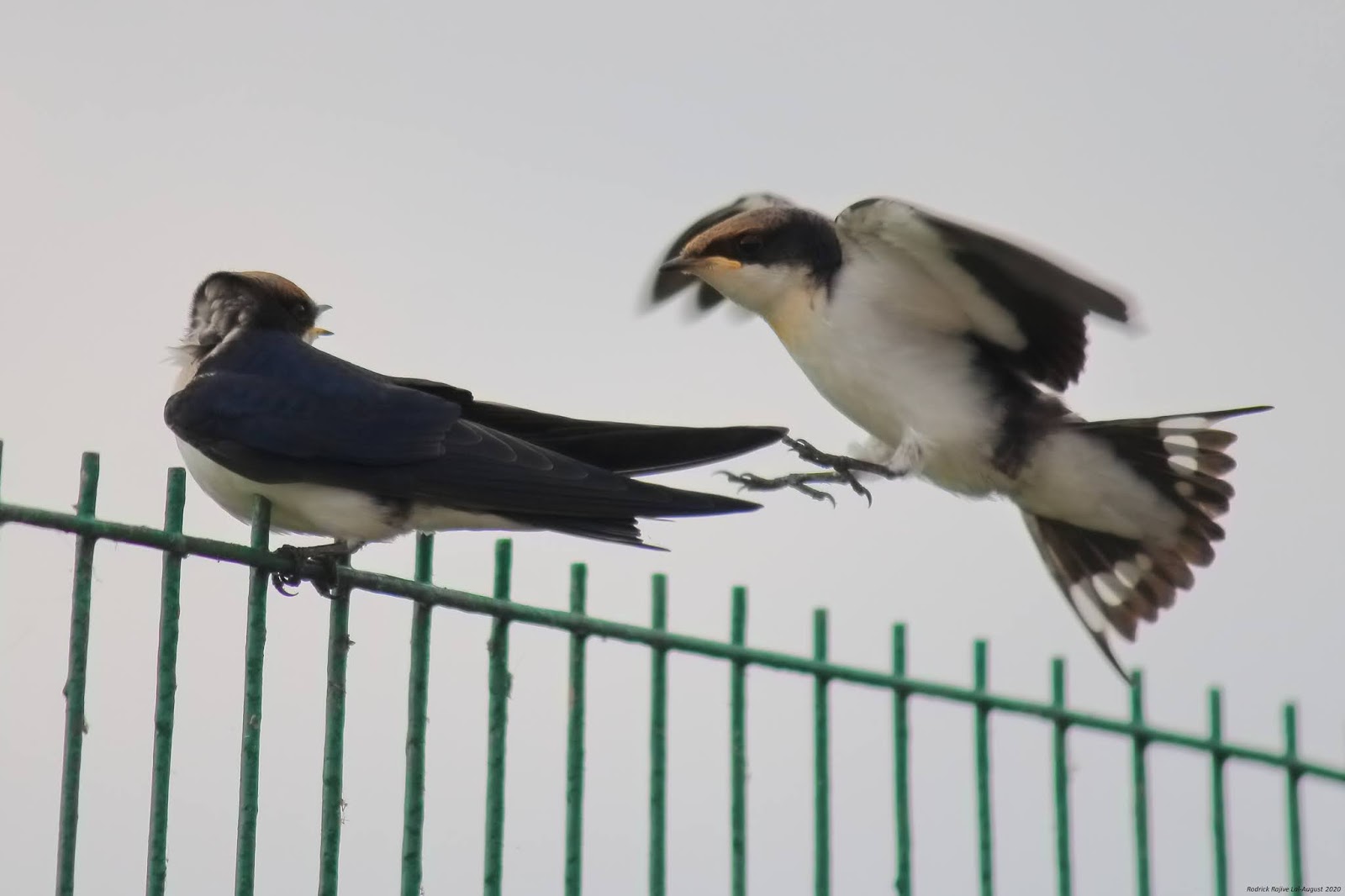
The swallow symbolises love, care and affection towards family and friends, and fidelity. The birds interestingly choose a mate for life and will nest with only there partners. In various cultures, swallows symbolise hope and freedom. Whenever I spot swallows I am filled with joy. Their friskiness and swift swoops all over the area are often difficult to capture on camera, but their memory will always remain in the mind! I was fortunate enough to spot a few juveniles accompanied by adults at the Basai Wetland when I visited it today. The wind was strong and the birds were clinging on to a wire-mesh fence lest they should be blown away. I got as close to them as possible, and they did not mind, probably as they were juveniles.
This is the first time that I have gotten so close to Wire-tailed Swallows, and although the lighting was not so good, managed to take a few decent shots of them. What struck me the most was to see three of them sitting close to each other like the three stooges. I could sense their wonder and curiosity about what I was doing with the camera. Without further explanation, I would like to present a series of photographs that I would like to label as "The Three Stooges."

The Three Stooges


The birds might as well be in a silent conversation, or perhaps, I might have missed their whispers. The wind must have snatched away their silent whispers (even as I was eager to get them into the frame) or I would tell you what they were conversing about- me of course! Whatever might be the case, their body-language is so familiar to that of human beings.
A clear distinction exists between adult and juvenile swallows. While adult Wire-tailed swallows have longe wire-like projections coming out from each of their wings, the juveniles have yet to develop them. Additionally, juveniles Wire-tailed swallows have a dash of yellow on the base of their beaks.
The Juvenile

Swallows are playful birds and they can be seen swooping around chasing each other, trying to settle on a perch that is already occupied. I was able to capture a few instances of Wire-tailed swallows trying to dislodge their siblings from their perch. These games reminded me of the games that our own children play with each other.

Juveniles Playing for a Perch


If the juvenile Wire-tailed swallows are playful, the adults are more reserved and watchful. They perch on posts with long 'wires' trailing from each of their wings. This is a graceful sight for those who have a sharp eye.

The watchful Adult


I guess there is more to Wire-tailed swallows that meets the eyes. The way they have adapted to life in the cities is somehow a success story that we need to learn from. These photographs were taken at the Basai Wetland in Gurgaon today. While I was not able to spot too many big water-birds, I had to make do with these tiny ones.


Wednesday, 24 June 2020

This Wetland is a Birder's Paradise


Situated on the Gurgaon-Jajjhar road, right adjacent to the Basai Water-treatment plant is a narrow lane seemingly leading to nowhere. On the right-hand side of the lane is a tall wall rather like the Great Wall of China and on the right-hand side is a pile of Debris meant to be processed by the so-called construction wast-treatment plant. One can reach the wetland from the Dwarka-Express way, or one can take the Basai Jajjhar road and then turn right after descending the flyover.


One of the most interesting bird species one can find at the wetland in the Purple Swamphen. These rather garishly coloured birds are rather funny. They chase each other around the wetland and make some of the funniest sounds. They often fly at a low height, but then I have also seen a few flying really high up in the sky! These colourful birds that very long toes and fingers. They are waders, therefore, they need big feet so that they can probe the water-bottom for succulent roots and weeds to eath.


Painted Storks can also be found in large numbers at the Basai Wetland. These really huge birds are a joy to photograph while flying. Painted Storks too are waders and they use their feet while foraging in the shallow water for insects, small fish and other food items.


But then there are quite a few more birds to be in the Basai Wetland and these include, Purple Heron, the common Pond Heron, Bitterns, Pheasant-tailed Jacanas


.

Unfortunately, this wetland is threatened by developmental activities taking place in the area. What was once a thriving fresh-water body teaming with indigenous species of fish has now been taken over by the banned African Catfish. The Wetland that stretched over an area of more than eight square acres now measure much less, barely four or five acres. The Basai Wetland is an important rainwater catchment area and filling it up will result in extreme flooding of the area. What people don't realise is that such wetlands act as important buffers against droughts and dry seasons. Gurgaon now has lost most of its catchment areas, many of which were once protected by bunds constructed by the British Administration during the late 1800s and early 1900s. Most of the old land records that clearly demarcate wetlands, bunds and forest areas have somehow been lost.