
A catchy title will draw the reader's attention. It goes without saying that the title is a window into the article itself, so be sure to make your title not just catchy, but also crisp!
3. Supply the name of the writer, the "By" line, in many cases, the name is in the question itself.
Attribution is an important element of article writing, so don't forget to write the by-line, otherwise, someone else might claim that he is the original writer of your article!
- A Suitable Title (This should be a minimum of two words but not exceeding five)
- Name of the writer or the 'By' line ( The name provided in the question is to be used, if it is not there in the question, then the student will supply a name.)
- The first paragraph of your article introduces the topic. It includes a brief description of the impact of the problem, a definition, (immediate impact on the society, the environment and flora and fauna). This paragraph sets the tone of the article, it can also include the thesis statement.
- The second paragraph will analyze the problem from a broader perspective. It deals with a greater emphasis on the following points (some of which were touched upon in the first paragraph): a) Impact on the environment, society, flora and fauna b) future implications. This paragraph brings out the conflict, the argument and could provide the antithesis to the first paragraph.Steps that were taken by the Government to solve the problem. Facts, data, and statistics are provided in this paragraph.
- The third paragraph deals with The writer's suggestions on how to solve the problem. conclusion about the whole issue, and the writer’s perceptions about the topic.All the loose ends, queries, and doubts are tied up in the concluding paragraph. This paragraph provides the synthesis of the first paragraph and the second paragraph.
Learning Targets
1. I can describe my ideas
clearly and logically with supporting evidence.
2. I can write an article within
the prescribed number of words and cover all the value points.
3. I am aware of the
importance of having transitions in my article.
4. I use appropriate words in my
article to convey my observations effectively.
3. I am aware of the five
parts of an article which include: The title, the by line, the first paragraph
or the introduction, the second paragraph or the body of
arguments/data/evidence and the third paragraph which is the conclusion.
Check List
1. My article has a catchy title
that has a minimum of two words not exceeding five words.
2. My article has the name of the
writer in the by-line.
3. My first
paragraph/introductory paragraph contains the thesis statement/statement of the
topic
4. My second paragraph
contains/states the antithesis - argument, conflict and includes the body of
evidence/data/examples/information.
5. My third paragraph or the
concluding paragraph contains the synthesis/the conclusion in which you have
addressed the issue/conflicts/ideas expressed in the first and the second
paragraph (where you take the first paragraph and the second paragraph and
create a conclusion).
Now attempt the below-mentioned
question. The question appeared many years back in one of the CBSE question
papers for grade 12, English Core. At that time the word limit was 150-200
words and the question was for 10 marks. Today the same question would be for 5
marks, hence the student would be required to write the answer in fewer words.
Morning assembly in schools gives
a cool and calm start to the otherwise hectic schedule of the day. It can be a
means of passing on important information to the students. What are your views
on this significant event of the day? Write an article in 100-125 words on the
‘Importance of Morning Assembly. You are Navtej/Navita. 5 Marks
The suggested number of words for
each paragraph:
1st paragraphs 30 – 35
words
2nd paragraph 40-45
words
3rd paragraph 30-35
words
What is communication? It refers to the effective transmission of information
1. Means of communication in the past: horseback, smoke signals, semaphores, the electric telegraph, radio …etc.
2. Means of communication in the IT age: microwave, blue tooth, Classroom Wi-Fi, internet…etc.
The second Paragraph or the analysis, argument or justification could be based on the
following headings:
Analysis of communication in I.T. age: The advantages
1. Communication has become fast - Vast quantities of information can be exchanged-Broadband,
Wi-Fi Technology has boosted the Speed of signals, microwave radio waves
2. Students are able to explore the whole world and do research
3. It has a classroom which is better connected to reality
4. Education without Boundaries
5. Transfer of Money
6. Browsing of books, study material,
7. Exchange of notes in medical research
8. Conferencing
9. Instant communication with pictures
10. Effective means of communication
11. The World as a global village
The Third and concluding paragraph could include the following points:
The benefit of Communication in the I.T. age
1. brings the rural communities into the mainstream
2. educate rural communities
3. provide solutions
4. Meteorological forecast
5. Communication
6. Pricing of Farm Produce
7. Illiteracy
8. Global Classroom
9. Basic tailor-made solution to cultural problems
10. To provide rural students with sufficient study material
11. Commerce-online transaction
12. Concluding statement:
I.T. has changed the entire society.We have come a long way from the time when we sent smoke signals. The Internet has transformed communication, it has become more effective and faster and more reliable.
Suggested Value points for an article on Global Terrorism could include the following value points:
The First Paragraph: The Introduction:
1. What is terrorism- the definition
2. Brief history
3.Few examples from recent times
The Second Paragraph: The Analysis
1. The impact of terrorism on human life
2. History of terrorism (I.R.A., P.L.O…etc.)
3. Present-day examples (detailed-with specific instances)
4. Steps that were already taken by the Government to solve the problem.
The Third Paragraph, the conclusion could include the following value points:
Suggested Steps to solve the problem
1.Democratic methods
2.Sanctions
3.Educate the masses
4.Dialogue
5.Military option
Work Smarter, not
Harder!
By Kunwar
1st Paragraph-
Introduction
Thesis Statement: Smart Work
Helps you Achieve Success Easily
a. What is Smart Work?
smart strategies
smart Habits
sound time management Skills
2nd. Paragraph
Antithesis Statement : Is
Smart work better thank Hard work?
a. Why Smart Work?
It helps you achieve success w/o too much
effort
It improves efficiency
Examples/instances/anecdotes
Robert the Bruce was inspired by the
spider
The Trojan Horse: an example of smart
strategies by the Greeks
b. How to work smart?
Identify problem areas
Adopt a smart strategy
Prepare yourself for a change in work
ethics
c. Tips/Suggestions for smart
Strategies
Smart planning includes micro planning and
macro planning
Prioritizing Work includes tackling
problem areas first
Taking guidance from a mentor or a
subject expert
Assessing performance regularly
Revising strategies
3rd Paragraph
Synthesis Statement: Smart
Strategies and Smart Work are Far Better than Hard Work!
a. Advantages of working smart- Statements
about how smart can be the best solution/in times of stress, deadlines, uncertainty/pandemic/the
only solution is Smart Work. When you are against the wall, when there is too
much work/when you are running against multiple deadlines, the only way out
depend on adopting smart strategies!
b. Concluding Statement
“Sometimes in life it is better
to be lazy than to plod like Tom because life is too precious to waste on hard work!”- Rodrick
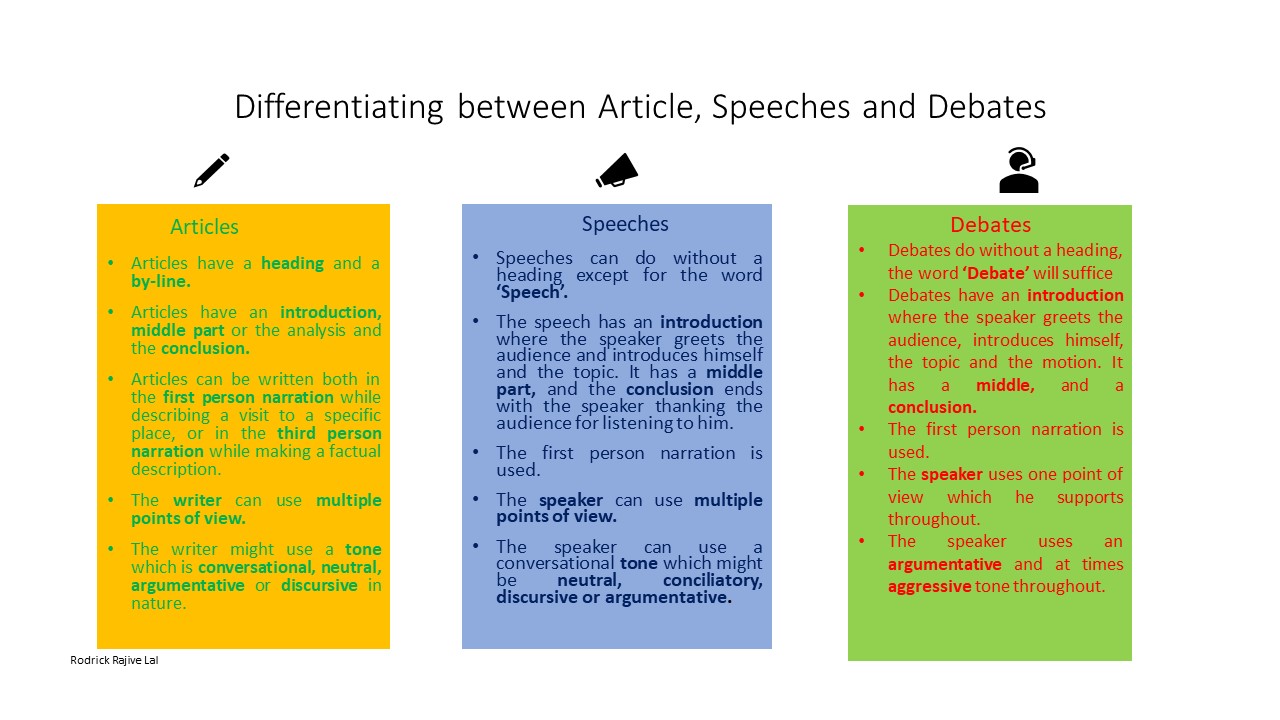
- The opening sentence and the closing sentence are different from that of the article. In a speech, you would use a more conversational style or voice because you are addressing a visible audience. Ideally, you would start by greeting the audience and then introducing yourself and the topic. Look at the example as under: "Respected Principal, respected teachers, and my dear friends, a very good morning to all of you! Today, I, Keshav Kumar of class 12-A am going to deliver a speech for morning assembly on the topic, 'How much information should we share on social networking sites.' I hope I will be able to do justice to the topic."
- The closing sentence of a speech would be: " I would like to thank all of you for listening to me so patiently, have a wonderful day!"
- Students should note that in a speech, the student is at liberty not taking a specific stance towards a particular topic. He or she might give equal importance to the positives and negatives.
- The opening sentence of a debate is different from that of an article because like in the speech, the student is addressing a visible audience. Unlike the article, the voice would be more conversational and unlike the speech, where the voice is more conciliatory, the voice in the debate is more firm and aggressive. An example of how an opening sentence would look like in a debate is: "Respected Judges, respected teachers, and my fellow students, I am Keshav Kumar a participant in this debate. The topic before me is, "We should allow students to bring their mobile phones to school" and I am going to speak for the motion. I am sure I will be able to convince my opponents and all of you that what I argue holds true for everyone."
- A good debate like a good speech should have a closing sentence, and one of the most common closing sentences could be: " I would like to thank all of you for listening to me so patiently, and I am confident that I have been able to convince you adequately, though there will be exceptions! Have a good day!"
- While the voice in the debate is the most aggressive voice of all, one has to ensure that etiquette is maintained and one's tone is not derisive or too sarcastic! One can use subtle sarcasm, tongue in cheek, or even irony without appearing to be insulting or cheeky!


- Voice: The personal tone, message of the writer, does he or she have a conversational tone?
- Idea: The main message, is the message clear? Is the writer clear about his ideas, and arguments?
- Presentation: The appearance of the writing, flow, handwriting, neatness...etc
- Conventions: The mechanical correctness (Grammatical structure, Syntax). Grammatical fluency cannot be ignored. Some students mix tenses.
- Organization: Internal Structure, flow, transitions, paragraphs (introduction, body, conclusion)
- Word Choice: Word usage, use of appropriate words which communicate the idea best.
- Sentence Fluency: The rhythm and flow of language (Semantics)
Rubric for a Written Speech
Speech Assessment Rubric (Max 10 Marks)
|
Criteria |
4 Marks (Excellent) |
3 Marks (Good) |
2 Marks (Developing) |
1 Mark (Needs Improvement) |
Weight |
|
Content & Structure |
Engaging hook; clear, logical main points; strong concluding thought.
Highly relevant to the topic. |
Clear introduction, body, and conclusion. Mostly logical transitions
and well-researched points. |
Structure is disorganized or hard to follow. Points lack sufficient
supporting details or clarity. |
Lacks a clear structure. Content is off-topic, minimal, or confusing. |
x 0.75 (Max 3) |
|
Delivery & Voice |
Excellent volume, pacing, and pitch variety. Clear articulation;
natural and confident tone. |
Good volume and pace. Mostly clear articulation with occasional minor
slips or monotone moments. |
Speaks too fast, slow, or quietly. Mumbles frequently or lacks vocal
variety. |
Inaudible, extremely rushed, or read entirely from notes without vocal
expression. |
x 0.75 (Max 3) |
|
Body Language & Engagement |
Exceptional eye contact, natural gestures, and strong posture.
Strongly connects with the audience. |
Consistent eye contact with most of the room. Good posture and
appropriate gesturing. |
Limited eye contact (mostly reading notes or looking away). Stiff
posture or nervous fidgeting. |
No eye contact. Back turned to audience or completely frozen/fidgeting
throughout. |
x 0.50 (Max 2) |
|
Time & Impact |
Fits perfectly within the time limit. Highly persuasive, informative,
or memorable. |
Closely aligns with the time limit (+/- 30 seconds). Leaves a clear
impression. |
Slightly too short or too long. The message is clear but lacks a
strong lasting impact. |
Significantly under or over time. Fails to leave an impact or finish
the message. |
x 0.50 (Max 2) |
How to Calculate the Score
Instead of doing complex math during the speech, you can simply score
each category out of 4 using the descriptions above, and then convert it to the
10-mark scale using this quick reference:
- Content
& Structure: Score
out of 4 $\times 0.75$ = Max 3 Marks
- Delivery
& Voice: Score out of
4 $\times 0.75$ = Max 3 Marks
- Body
Language & Engagement:
Score out of 4 $\times 0.50$ = Max 2 Marks
- Time &
Impact: Score out of 4
$\times 0.50$ = Max 2 Marks
Total Score: Sum the
adjusted marks from all four categories to get the final score out of 10.
You can also read the following articles as examples of frequently given questions in the paper:
1. http://rodrickwrites.blogspot.in/2010/06/are-we-headed-towards-apocalypse.html
2. http://rodrickwrites.blogspot.in/2011/07/impact-of-terrorism.html
3.https://rodrickwrites.blogspot.in/2013/07/climate-change-myth-or-reality.html

In your blog of science and art of communication have read and you have written very well in this blog post as i am able to see here, keep up doing well and keep posting here....thank you...dissertation paper online | thesis paper online | academic writing services
ReplyDeleteThis comment has been removed by a blog administrator.
ReplyDeleteGood website! I truly love how it is easy on my eyes it is. I am wondering how I might be notified whenever a new post has been made. I have subscribed to your RSS which may do the trick? Have a great day! trauma counseling near me
ReplyDeleteThis is a very helpful and informative post for Grade Twelve students. Writing articles, reports, speeches, and debates requires clarity, structure, and strong argument development, which can be challenging at this level. I especially appreciate how you highlighted the importance of proper formatting and critical thinking. Many students can benefit from academic writing services to better understand structure, improve language skills, and refine their ideas. Overall, this guide provides valuable direction for academic success.
ReplyDelete